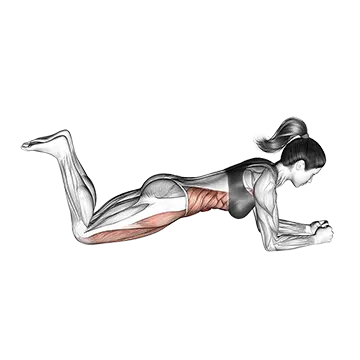
Suspended Reverse Crunch
- Target muscle
- Rectus Abdominis
- Synergist muscles
- Iliopsoas, Obliques, Tensor Fasciae Latae
- Equipment
- Body weight
- Body part
- Waist
- Type
- Strength
The suspended reverse crunch is a bodyweight core exercise performed with your feet secured in suspension trainer straps. It primarily targets the rectus abdominis while engaging the iliopsoas, obliques, and tensor fasciae latae as synergists. The unstable strap environment demands constant stabilization, making it an effective progression for building deep core strength and hip flexor control.
How to do the Suspended Reverse Crunch
- 1Set the suspension trainer straps to a low position, roughly 6–12 inches off the floor, and place both feet through the foot cradles so the straps sit across the tops of your ankles.
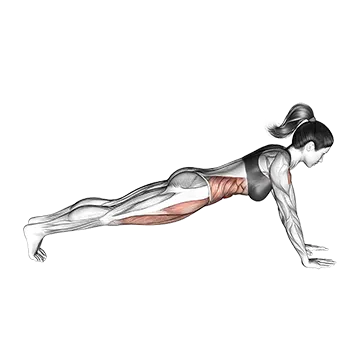
- 2Walk your hands forward and lower yourself into a high plank position with your arms fully extended, wrists directly under your shoulders, and body forming a straight line from head to heels.
- 3Brace your core tightly and ensure your hips are level — neither sagging toward the floor nor piked upward.
- 4Initiate the movement by pressing your lower back into a posterior pelvic tilt and drawing your knees toward your chest, allowing the hips to curl upward naturally as the knees travel in.
- 5Continue curling until your knees reach your chest and your pelvis has rotated fully under, squeezing the abdominals at the top of the movement.
- 6Slowly reverse the motion, extending your hips and legs back to the starting plank position under full muscular control — do not let your hips drop or swing.
- 7Maintain tension in your core throughout the return to prevent lower back hyperextension.
- 8Complete all reps, then carefully step out of the foot cradles to dismount.
Form tips
- Initiate every rep from a posterior pelvic tilt rather than pulling with your hip flexors — think of curling your tailbone toward your belly button to maximize rectus abdominis engagement.
- Keep your shoulder blades actively pushed away from each other (protracted) so the straps don't pull your upper body into instability.
- Control the eccentric phase for 2–3 seconds on the way back out; the slow return is where much of the core benefit is gained.
- Keep the movement symmetrical — any lateral drift of the hips signals that one side is compensating, so reduce range of motion and restore control before continuing.
- If the straps swing side-to-side, pause at the top and reset rather than muscling through — instability compounds quickly and compromises form.
Common mistakes
- Letting the hips sag in the plank position before the movement begins, which pre-loads the lower back instead of the core and turns the exercise into a hip-flexor pull.
- Swinging the knees inward with momentum rather than curling the pelvis, which reduces abdominal activation and transfers stress to the hip flexors and lower back.
- Allowing the hips to pike upward during the rep without spinal flexion — this resembles a pike rather than a crunch and shifts the work away from the rectus abdominis.
- Dropping the hips on the return phase instead of extending slowly under control, which can hyperextend the lumbar spine and strain the lower back.
- Holding the breath throughout the set — exhale as you draw the knees in and inhale on the return to maintain intra-abdominal pressure and core stability.
Frequently asked questions
What muscles does the suspended reverse crunch work?
The primary muscle is the rectus abdominis (the 'six-pack' muscle). The iliopsoas, obliques, and tensor fasciae latae act as synergists to control hip flexion and stabilize the pelvis throughout the movement.
How is this different from a regular reverse crunch on the floor?
The suspension trainer introduces instability that forces your entire core — including the deep stabilizers — to work harder to keep your body aligned. The range of motion is also greater since your hips can travel freely, compared to the floor limiting the movement.
What strap height should I use?
Start with the foot cradles set 6–12 inches off the floor, which keeps your torso roughly parallel to the ground in the plank. Raising the cradles higher tips you into a decline and shifts more weight onto your arms and core, so keep them low while you build strength.
Can beginners do this exercise?
It is best suited to intermediate or advanced trainees who already have solid plank stability and can perform floor-based reverse crunches with control. Beginners should master bodyweight reverse crunches on the floor before adding suspension instability.
How many reps and sets should I do?
Two to four sets of 8–15 controlled reps works well for most goals. Prioritize full range of motion and a slow eccentric over hitting a specific rep count — stop a set early if form breaks down.