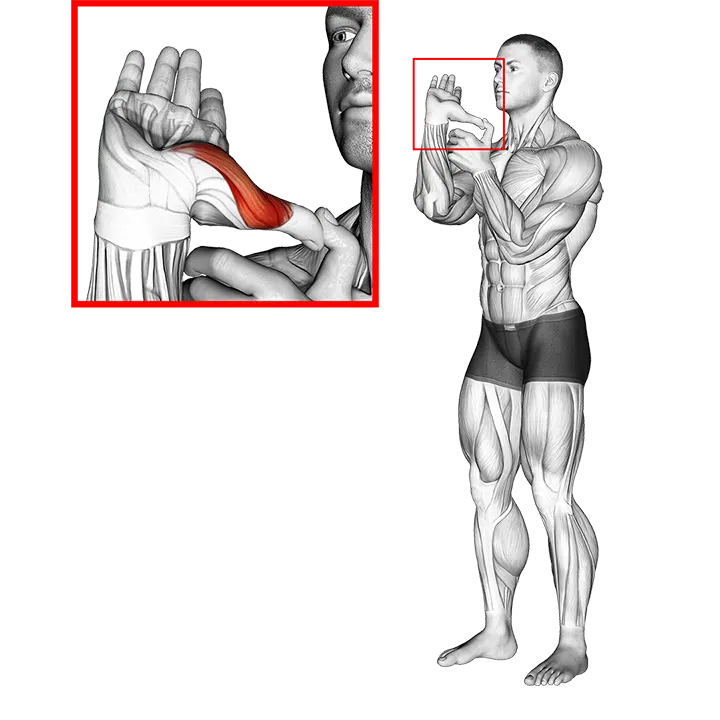
Thumb Stretch
- Target muscle
- —
- Equipment
- Body weight
- Body part
- Forearms
- Type
- Stretching
The Thumb Stretch is a bodyweight mobility exercise that lengthens the muscles, tendons, and connective tissue of the thumb and forearm. It is particularly useful for relieving tightness from repetitive gripping, typing, or phone use, and for maintaining hand flexibility and joint health.
How to do the Thumb Stretch
- 1Stand or sit tall with your spine neutral and one arm extended in front of you at shoulder height, palm facing down.
- 2Curl your thumb across your palm toward the base of your little finger.
- 3Wrap your remaining four fingers over your thumb to hold it gently in place.
- 4Slowly bend your wrist downward, toward the floor, until you feel a moderate stretch along the top of your thumb and the outer forearm.
- 5Hold the stretch for 20–30 seconds, breathing steadily and keeping your shoulder relaxed.
- 6Slowly release your wrist and uncurl your thumb.
- 7Repeat on the same hand for the prescribed number of holds, then switch to the opposite hand.
Form tips
- Keep your elbow fully extended throughout the stretch so the tension travels through the entire forearm rather than just the thumb joint.
- Apply gentle, consistent pressure — the sensation should be a mild pull, not pain. Ease off immediately if you feel sharp or pinching discomfort.
- Breathe slowly and let your muscles relax deeper into the stretch on each exhale.
- Keep your shoulder down and away from your ear to avoid compensating with the upper trap.
Common mistakes
- Bending the elbow during the stretch, which shortens the kinetic chain and reduces how much of the forearm tissue gets loaded.
- Pulling the thumb too aggressively, which can strain the carpometacarpal (CMC) joint rather than produce a beneficial stretch.
- Holding your breath, which increases overall muscle tension and limits how deeply the tissue can release.
- Skipping the opposite hand, which leads to asymmetrical flexibility and can contribute to imbalanced grip strength over time.
Frequently asked questions
What does the Thumb Stretch target?
It stretches the muscles, tendons, and fascia around the thumb and outer forearm, including the structures involved in thumb extension and abduction. It also decompresses the carpometacarpal joint.
How long should I hold a Thumb Stretch?
Aim for 20–30 seconds per hold. Perform 2–3 holds per hand for a thorough session, or a single hold per hand as a quick desk break.
Can the Thumb Stretch help with De Quervain's tenosynovitis?
Gentle stretching of the thumb tendons is often recommended as part of conservative management for De Quervain's, but you should consult a physical therapist or physician before adding it to your routine if you have been diagnosed with that condition.
How often should I do this stretch?
Daily stretching is safe and beneficial, especially if you spend long hours typing or gripping. Two to three sessions per day is a common recommendation for improving mobility or managing tightness.
Is the Thumb Stretch good for gamers and office workers?
Yes — repetitive mouse clicks, controller inputs, and keyboard use all load the thumb tendons and forearm extensors. Regular thumb stretching helps counteract that cumulative tightness and may reduce the risk of overuse injuries.







