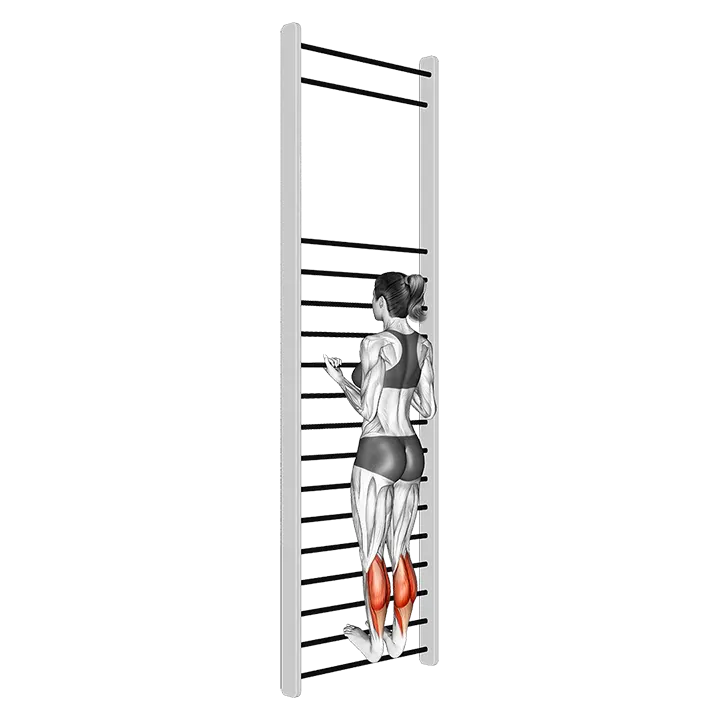
Tibial Flexion Stretch On Wall Bar
- Target muscle
- —
- Equipment
- Body weight
- Body part
- Calves
- Type
- Stretching
The Tibial Flexion Stretch On Wall Bar is a standing calf and Achilles stretch that uses a wall-mounted bar for support while you drive the knee forward over the foot, producing controlled dorsiflexion of the ankle. This sustained position relieves tightness throughout the lower leg and improves ankle mobility, making it a useful cooldown or warm-up stretch for the calves.
How to do the Tibial Flexion Stretch On Wall Bar
- 1Stand facing the wall bar and grip it at roughly hip to waist height with both hands, feet hip-width apart.
- 2Step one foot forward and place it flat on the floor, approximately 15–20 cm from the base of the wall.
- 3Keep your back foot on the floor with toes pointing straight ahead, maintaining a slight bend in the back knee for balance.
- 4Keeping the front heel firmly pressed into the floor, slowly shift your weight forward and drive the front knee toward the wall, allowing the ankle to dorsiflex.
- 5Use the bar for support — do not pull yourself forward with your arms; let your body weight create the stretch organically.
- 6Continue pushing the knee forward until you feel a distinct stretch along the back of the lower leg, Achilles tendon, and calf.
- 7For a deeper stretch targeting the soleus and Achilles, allow a slight bend in the front knee; for more gastrocnemius emphasis, keep the front leg straighter.
- 8Hold the stretched position for 20–30 seconds, breathing steadily and relaxing further into the stretch with each exhale.
- 9Slowly return to the starting position and repeat on the opposite leg. Perform 2–3 holds per side.
Form tips
- Keep the heel of the front foot flat on the floor throughout the hold — lifting it immediately reduces tension on the calf and Achilles and defeats the purpose of the stretch.
- Point the toes of both feet straight ahead rather than outward; a rotated foot changes the line of pull and reduces the stretch on the target area.
- Progress the stretch gradually by moving the front foot a little closer to the wall, which increases the dorsiflexion demand without needing any extra load.
- Relax your grip on the bar — hold it only for balance, not for support of your body weight, so your lower leg muscles receive the full stretch stimulus.
- Combine a straight-knee hold with a bent-knee hold in the same session to address both the gastrocnemius (two-joint muscle that crosses the knee) and the soleus (single-joint muscle) independently.
Common mistakes
- Letting the heel rise off the floor: this immediately releases the dorsiflexion load and shifts the movement into a plantar-flexed position, eliminating the calf and Achilles stretch entirely.
- Rushing through the hold: bouncing in and out of the position rather than sustaining a still hold prevents the muscle and tendon from fully relaxing and limits flexibility gains.
- Allowing the foot to toe outward: externally rotating the foot bypasses the gastrocnemius and Achilles and instead loads the inner calf unevenly, reducing the effectiveness of the stretch.
- Pulling the bar toward the body: using arm strength to drag the torso forward masks the actual range of ankle dorsiflexion available, preventing accurate progression and potentially straining the lower back.
- Stretching only one side: because calf tightness is often asymmetric, skipping the less-restricted side creates or perpetuates imbalances that can contribute to knee and plantar fascia issues over time.
Frequently asked questions
What does the tibial flexion stretch on a wall bar actually stretch?
The stretch targets the muscles and connective tissue along the back of the lower leg — primarily the gastrocnemius and soleus (the two heads of the calf) and the Achilles tendon that connects them to the heel bone. Driving the knee forward over a flat-footed stance creates ankle dorsiflexion, which places the calf complex under a sustained elongation.
What is the difference between keeping my knee straight versus bent during this stretch?
The gastrocnemius crosses both the knee and the ankle joints, so it is best stretched with the knee straight, which puts both joints in a lengthening position simultaneously. The soleus only crosses the ankle, so a bent-knee version isolates it more directly. Performing both variations in succession gives a more complete stretch of the entire calf complex.
How long should I hold the tibial flexion stretch?
For general flexibility and post-workout recovery, hold each position for 20–30 seconds and repeat 2–3 times per side. Research on static stretching suggests that holds shorter than 15 seconds produce minimal lasting flexibility change, while holds of 30 seconds appear to be as effective as longer durations for most people.
Can I do this stretch as a warm-up before running or jumping?
Yes, but keep the intensity moderate and the hold brief (10–15 seconds) before explosive activity. Deep, prolonged static stretching immediately before sprinting or jumping can temporarily reduce power output. Save longer holds for your cooldown; before activity, combine a brief calf stretch with dynamic warm-up movements such as heel raises and ankle circles.
Why use a wall bar instead of just stretching against a flat wall?
The wall bar gives you a secure handhold at a comfortable height, which frees you to fully relax the lower leg instead of bracing against a surface with your hands. Better balance also allows more controlled forward lean, so you can find and maintain the optimal stretch depth without worrying about stability — particularly useful for those with limited balance or when performing longer holds.







