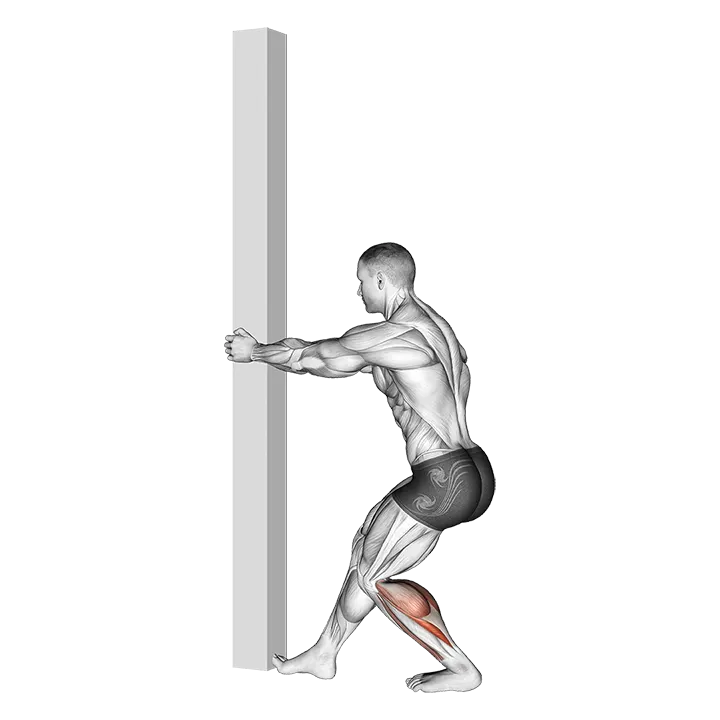
Tibial Stretch With Semi Flexed Knee
- Target muscle
- —
- Equipment
- Body weight
- Body part
- Calves
- Type
- Stretching
The Tibial Stretch With Semi Flexed Knee is a bodyweight stretch that targets the anterior tibialis (the muscle along the front of the shin) and the extensor tendons over the top of the foot. Pointing the foot down and sinking your hips lengthens the front of the lower leg, while the slight knee bend keeps you balanced and takes strain off the knee — making it a useful lower-leg release for runners, cyclists, and anyone who experiences shin tightness.
How to do the Tibial Stretch With Semi Flexed Knee
- 1Stand tall near a wall or sturdy surface for balance. Shift your weight onto your left foot.
- 2Step your right foot back and place the top of the right foot flat on the floor, toes pointing directly behind you.
- 3Soften your right knee so it is slightly bent — this is the semi-flexed position that defines the stretch.
- 4Keeping your torso upright, slowly press your right shin and ankle toward the floor by gently sinking your hips downward.
- 5Stop when you feel a firm, comfortable stretch along the front of the right shin and into the top of the foot. You should not feel sharp pain.
- 6Hold the position for 20–30 seconds, breathing slowly and steadily throughout.
- 7Ease out of the stretch by lifting your foot, returning to a standing position.
- 8Repeat on the opposite side, then perform 2–3 rounds per leg as needed.
Form tips
- Ease into the stretch gradually — the anterior tibialis is a thin muscle that responds poorly to aggressive or sudden loading.
- Breathe slowly and consistently during the hold; exhaling fully on each breath helps the tissue relax deeper into the stretch.
- Keep the stretched knee tracking in line with your foot rather than collapsing inward, to avoid placing unwanted stress on the ankle joint.
- Use a wall or chair for balance so you can focus entirely on controlling the stretch depth rather than staying upright.
- If you feel numbness or sharp pain in the foot or ankle, reduce the depth immediately and check that the top of the foot is flat, not rolled to one side.
Common mistakes
- Locking the knee fully straight — the movement is defined by a soft, semi-flexed knee; forcing it straight strains the joint and makes it harder to sink your hips and control the stretch depth.
- Dropping into the stretch too fast — rushing the movement spikes tension in the ankle ligaments before the muscle has relaxed, increasing the risk of a sprain or strain.
- Letting the foot roll to one side instead of keeping the top of the foot flat on the floor — this concentrates stress on the outer or inner ankle rather than the front of the shin where it belongs.
- Holding the breath — breath-holding increases overall muscle tension and prevents the anterior tibialis from releasing fully during the hold.
- Placing too much body weight through the stretched foot — the goal is gentle pressure from gravity and hip position, not full compression; overloading the foot can irritate the small bones and tendons on its dorsal surface.
Frequently asked questions
What muscles does the tibial stretch with semi-flexed knee target?
It primarily stretches the anterior tibialis — the muscle that runs along the front of the shin — as well as the extensor tendons and soft tissue on the top of the foot. Pointing the toes back and pressing the top of the foot toward the floor is what lengthens these tissues.
Why is the knee kept semi-flexed instead of straight?
The slight bend isn't about recruiting a different muscle — it keeps you balanced, lets you drop your hips to deepen the ankle stretch, and takes pressure off the knee compared with locking it straight. Since the stretch works the front of the shin, a fully straight knee adds strain without improving it.
How long should I hold the tibial stretch?
Hold for 20–30 seconds per side. This duration is long enough to allow the muscle and connective tissue to relax and lengthen without overstressing them. Perform 2–3 rounds per leg for the best results.
When is the best time to do this stretch?
It works well as part of a post-workout cooldown, particularly after running, cycling, or any activity that loads the shin repeatedly. You can also use it as a daily mobility exercise if you experience anterior shin tightness or are recovering from shin splints — always avoid performing it on acutely painful or inflamed tissue without medical clearance.
Can this stretch help with shin splints?
It may provide relief for mild tightness associated with shin splints by releasing tension in the anterior tibialis, but it is not a treatment for shin splints. If you have been diagnosed with medial tibial stress syndrome or experience significant shin pain, consult a physiotherapist before adding any stretching to your routine.







