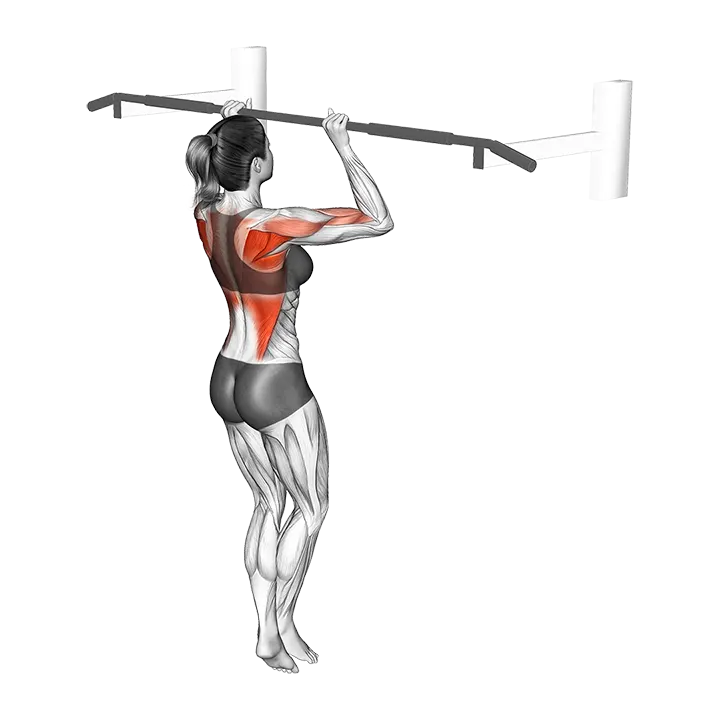
Top Pull-up Hold
- Target muscle
- —
- Equipment
- Body weight
- Body part
- Back
- Type
- Strength
The top pull-up hold is an isometric bodyweight exercise performed at the top position of a pull-up, with your chin above the bar and elbows fully flexed. It builds static strength and endurance in the back — particularly the lats — along with the biceps and rear shoulders. It is an effective accessory drill for improving pull-up lockout strength and grip endurance.
How to do the Top Pull-up Hold
- 1Grip an overhead bar slightly wider than shoulder-width with an overhand grip, thumbs wrapped fully around the bar.
- 2Jump or step up so that your chin clears the bar and your chest is close to it — this is your starting position.
- 3Pull your shoulder blades down and together, keeping your chest open and your torso from swinging.
- 4Hold your elbows at full flexion with your chin above the bar, maintaining a slight forward lean of the torso.
- 5Breathe steadily throughout the hold without letting your shoulders shrug up toward your ears.
- 6Aim to hold the position for the target duration — typically 5 to 30 seconds depending on your strength level.
- 7Lower yourself under control until your arms are fully extended, then release the bar.
Form tips
- Actively depress and retract your shoulder blades throughout the hold — letting them elevate shifts stress away from the lats and onto the neck and traps.
- Squeeze the bar hard and engage your core to prevent your body from swaying or kipping during the hold.
- Start with shorter holds (5–10 seconds) and add time progressively rather than struggling through a long hold with poor position.
- Use a box or band to assist if you cannot yet pull yourself to the top position independently — partial-range holds are still beneficial.
Common mistakes
- Letting the chin drop below the bar partway through the hold, which means you are no longer training the top-position strength the exercise is designed for.
- Shrugging the shoulders up toward the ears, which reduces lat engagement and places unnecessary strain on the neck and upper traps.
- Holding the breath, which spikes intra-thoracic pressure and accelerates fatigue — breathe steadily throughout.
- Allowing the body to swing or kip to maintain position, which turns a controlled isometric drill into a momentum-dependent movement.
Frequently asked questions
What muscles does the top pull-up hold work?
It primarily works the back — especially the latissimus dorsi — along with the biceps, rear deltoids, and forearms isometrically. Because no movement occurs, all tension is sustained statically throughout the hold.
How long should I hold the top pull-up position?
Beginners typically aim for 5–10 second holds, while intermediate and advanced athletes can work up to 20–30 seconds. Accumulate multiple shorter holds rather than grinding through a single poor-form hold.
Is the top pull-up hold good for building pull-up strength?
Yes. Holding at the top develops the lockout strength and back engagement that often limits pull-up performance. Pairing it with full pull-up training accelerates overall progress.
Can I do this exercise if I cannot do a full pull-up yet?
Yes — use a box, step, or resistance band to get yourself into the top position, then hold for as long as form allows. This isometric drill can be a useful stepping stone toward your first full pull-up.
How is the top pull-up hold different from a regular pull-up?
A pull-up is a dynamic movement through the full range of motion, while the top hold is a static isometric contraction at the end range only. The hold isolates and builds strength specifically in the most demanding portion of the pull-up.







