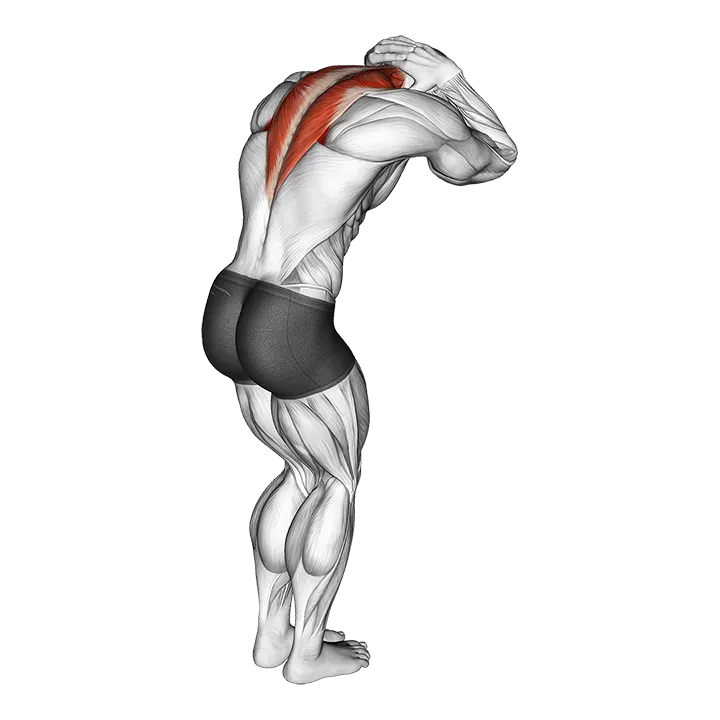
Trap and Neck Stretch
- Target muscle
- —
- Equipment
- Body weight
- Body part
- Back
- Type
- Stretching
The Trap and Neck Stretch is a bodyweight stretching exercise that targets tension held in the upper trapezius and the muscles along the side of the neck. Performed seated or standing, it uses a gentle lateral head tilt combined with light hand-assisted pressure to elongate these often-tight areas. It is well suited for desk workers, athletes, and anyone looking to reduce upper-back and neck stiffness.
How to do the Trap and Neck Stretch
- 1Sit upright in a chair or stand with your feet hip-width apart, shoulders relaxed and arms resting at your sides.
- 2Slowly tilt your head to the right, bringing your right ear toward your right shoulder until you feel a gentle pull along the left side of your neck and upper trapezius.
- 3Reach your right hand over the top of your head and rest it lightly on the left side of your head, just above the ear — do not pull; allow the weight of your relaxed hand alone to deepen the stretch gradually.
- 4Actively press your left shoulder downward, away from your ear, to increase the stretch through the upper trapezius and the side of the neck.
- 5Hold this position for 20–30 seconds, breathing slowly and allowing the muscles to lengthen with each exhale.
- 6Gently lift your head back to center, remove your hand, and pause for a few seconds before switching sides.
- 7Tilt your head to the left, place your left hand lightly on the right side of your head, and hold for another 20–30 seconds.
- 8Return to the starting position and repeat for 2–3 sets per side.
Form tips
- Apply only the weight of a relaxed, resting hand — any active pulling overloads the cervical spine and causes the very muscles you are trying to release to contract defensively.
- Keep your chin level rather than letting it drop or rise; a neutral chin position ensures the stretch is distributed evenly across the upper trapezius and the lateral neck muscles.
- Use your exhale to release into the stretch — breathe in to prepare, and breathe out to allow the head to sink slightly deeper without any muscular effort.
- To shift emphasis toward the upper trapezius, keep your chin level or angle it very slightly upward as you tilt; to bias the levator scapulae, rotate your head to look down toward the armpit on the side you are tilting toward.
- The neck area contains sensitive structures — stop immediately if you experience sharp pain, numbness, or tingling, as these sensations can indicate nerve involvement and require medical evaluation before continuing.
Common mistakes
- Pulling the head down with the hand, which compresses the cervical vertebrae and can strain the ligaments of the neck — the hand is there only to add the gentle weight of a relaxed arm, not to force a greater range of motion.
- Allowing the opposite shoulder to shrug upward toward the ear, which shortens the trapezius fibers you are trying to lengthen and significantly reduces the effectiveness of the stretch.
- Holding the breath or tensing the jaw during the hold, which keeps the surrounding musculature contracted and prevents the upper trapezius and neck muscles from fully releasing.
- Releasing too quickly and holding for fewer than 15–20 seconds, which does not give the muscle time to pass the initial stretch reflex — meaningful lengthening requires a sustained hold of at least 20–30 seconds per side.
- Starting the stretch with rounded shoulders or a pronounced forward-head posture, which places the cervical spine in a compromised position and reduces the range of motion available for the targeted muscles.
Frequently asked questions
What does the trap and neck stretch target?
The stretch primarily targets the upper trapezius — the thick muscle running from the base of the skull to the outer shoulder — along with the lateral neck muscles such as the sternocleidomastoid and scalenes. These are among the most commonly overloaded muscles in people who sit at a desk, drive frequently, or carry tension in the shoulders.
How often should I do the trap and neck stretch?
For general maintenance and tension relief, performing 2–3 sets per side daily is appropriate for most people. If you experience chronic tightness from prolonged sitting or repetitive overhead work, stretching twice a day — once in the morning and once in the evening — can accelerate improvement. Always stretch after a gentle warm-up or at the end of a workout when the muscles are already warm.
Can the trap and neck stretch help with tension headaches?
Many tension headaches originate from tightness in the upper trapezius and the suboccipital muscles at the base of the skull. Regularly releasing these areas with a lateral neck stretch can reduce the frequency and intensity of tension headaches for some people. However, if headaches are severe, frequent, or accompanied by other symptoms, consult a healthcare provider before relying on stretching as a remedy.
Is the trap and neck stretch safe if I have neck pain or a previous neck injury?
Mild, chronic neck tightness is generally well tolerated with a gentle, unassisted lateral tilt. However, if you have a diagnosed cervical condition, a recent injury, or you experience pain, numbness, or tingling during the stretch, you should consult a physiotherapist or doctor before performing it. They can confirm whether the movement is appropriate for your specific situation and suggest modifications if needed.
How long should I hold the trap and neck stretch to see results?
Research on static stretching suggests that holds of 20–30 seconds per repetition are the practical minimum for eliciting a meaningful reduction in muscle tension. Holds of 30–60 seconds may produce greater increases in range of motion over time. Performing 2–3 repetitions per side daily for several weeks is generally needed to see lasting improvements in flexibility and a sustained reduction in tightness.







