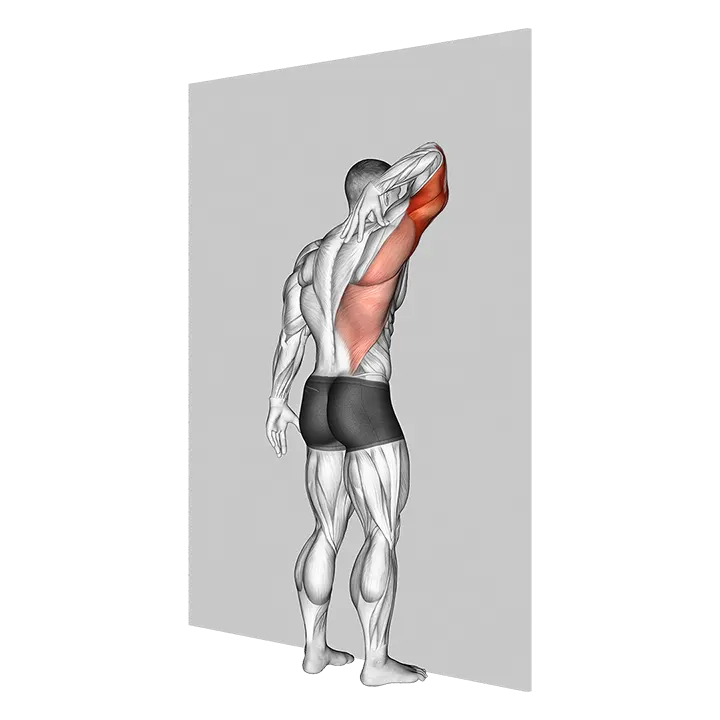
Triceps Stretch Against Wall
- Target muscle
- —
- Equipment
- Body weight
- Body part
- Upper Arms
- Type
- Stretching
The triceps stretch against wall is a standing upper-arm stretch that targets the back of the upper arm by using a wall as a fixed anchor. You place one bent arm overhead with the palm or forearm against the wall, then lean or rotate your body to deepen the stretch along the back of the upper arm — making it a simple, effective way to improve flexibility and ease tightness after pushing exercises.
How to do the Triceps Stretch Against Wall
- 1Stand facing a wall at arm's length. Keep your feet about hip-width apart and your posture tall.
- 2Raise one arm overhead and bend the elbow so your palm and forearm press flat against the wall, with your upper arm close to your ear.
- 3Adjust your position so the bent elbow sits as high on the wall as is comfortable, roughly at or above head height.
- 4Without moving your forearm off the wall, slowly rotate your body away from the wall — turning your chest and torso to the opposite side.
- 5Continue rotating until you feel a firm stretch along the back of your upper arm. Do not force the position past the point of mild tension.
- 6Hold the stretch for 20–30 seconds, breathing steadily. Avoid holding your breath or shrugging your shoulder.
- 7Rotate back to the starting position, lower your arm, and repeat on the opposite side.
Form tips
- Keep your shoulder down and away from your ear throughout the stretch — letting it shrug reduces the tension on the back of the upper arm.
- Press the forearm evenly into the wall rather than only the palm; this keeps the elbow angle stable and distributes the stretch more effectively.
- Initiate the rotation from your hips and torso, not by leaning sideways — rotating gives a cleaner stretch and keeps your spine neutral.
- Move into the stretch gradually over the first few seconds rather than twisting sharply; this allows the tissue to relax and accept a deeper range.
- Breathe out slowly as you rotate into the stretch — exhaling helps the body release tension and makes the stretch feel more effective.
Common mistakes
- Placing the elbow too low on the wall: if the elbow sits at or below shoulder height, the angle is wrong and the back of the upper arm gets little to no stretch.
- Shrugging the shoulder up toward the ear: this compresses the shoulder joint and shifts tension away from the intended area, reducing the effectiveness of the stretch.
- Rotating too fast or forcing the end position: moving aggressively into the stretch can strain the shoulder or elbow rather than producing a productive lengthening sensation.
- Bending at the waist instead of rotating the torso: side-bending throws off your alignment and turns the movement into a lat stretch rather than a targeted upper-arm stretch.
- Holding your breath: breath-holding increases overall tension in the body and makes it harder for the target area to relax into the stretch.
Frequently asked questions
What does the triceps stretch against wall target?
It targets the back of the upper arm — specifically the triceps area — by holding the arm in an overhead bent position against a fixed surface while rotating the torso away to create tension through that region.
Is the triceps stretch against wall good for beginners?
Yes. It requires no equipment and is easy to control because you set your own rotation depth. Beginners should start with a gentle rotation and a shorter hold time (15–20 seconds), then progress as flexibility improves.
How long should I hold the triceps stretch against wall?
Hold each side for 20–30 seconds. For general flexibility maintenance, one or two holds per side is sufficient. If you are working on improving range of motion, two to three holds per side with a short rest between them is a common approach.
When is the best time to do this stretch?
It works best as part of a cool-down after upper-body training, especially after exercises that involve heavy pushing or overhead work. Stretching a warm muscle is safer and tends to produce better results than stretching cold tissue.
How is this different from an overhead triceps stretch done without a wall?
The freestanding overhead triceps stretch has you use the opposite hand to pull the elbow behind the head. The wall version replaces the pulling hand with a fixed surface, which provides a more stable anchor and lets you control the intensity through body rotation rather than arm force — making it useful when shoulder mobility or grip discomfort limits the freestanding version.







