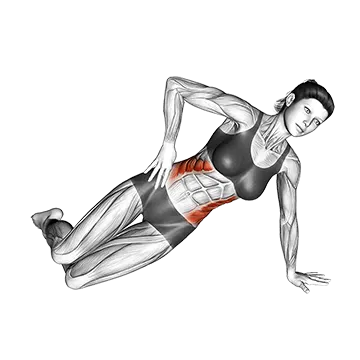
Twist Side Bridge
- Target muscle
- Obliques
- Synergist muscles
- Adductor Brevis, Adductor Longus, Deltoid Anterior, Deltoid Posterior, Gluteus Medius, Iliopsoas, Pectineous, Rectus Abdominis, Sartorius, Tensor Fasciae Latae
- Equipment
- Body weight
- Body part
- Shoulders
- Type
- Strength
The twist side bridge is a side plank variation that challenges the obliques through dynamic rotation while demanding full-body stabilization. From a forearm side bridge, you sweep the top arm under the torso and return, engaging the rectus abdominis, deltoids, gluteus medius, iliopsoas, adductors, sartorius, and tensor fasciae latae as stabilizers. It builds rotational core strength, lateral core endurance, and shoulder stability using only body weight.
How to do the Twist Side Bridge
- 1Lie on your side on the floor and prop yourself up on your forearm, elbow directly beneath your shoulder, forearm perpendicular to your body.
- 2Stack your feet on top of each other and lift your hips until your body forms a straight line from head to heels.
- 3Extend your top arm straight toward the ceiling, palm facing forward, to establish your starting position.
- 4Brace your core and inhale to prepare for the rotation.
- 5Exhale and rotate your top arm down and under your torso, threading it through the gap between your body and the floor as far as you comfortably can.
- 6Keep your hips lifted and your supporting elbow firmly planted throughout the movement.
- 7Inhale and unwind your arm back to the overhead starting position in a controlled arc.
- 8Complete all reps on one side, then switch to the other side and repeat.
Form tips
- Keep your hips elevated and level throughout the twist — letting them drop or rotate eliminates the oblique challenge and stresses the lower back.
- Drive through the supporting forearm and brace through the entire core before initiating each rotation.
- Move your arm in a slow, deliberate arc; momentum reduces muscle engagement and increases joint strain.
- Keep your neck neutral and in line with your spine — avoid craning upward to follow your hand or tucking your chin.
- If you feel shoulder discomfort, reduce your range of motion on the thread-through until shoulder stability improves.
Common mistakes
- Letting the hips sag during the rotation: sagging breaks the lateral plank alignment, shifts load off the obliques, and compresses the lumbar spine.
- Rotating the hips instead of the thorax: twisting from the hips turns this into a rolling balance drill rather than the controlled thoracic rotation the obliques are meant to drive.
- Rushing through the thread-through: using momentum bypasses the obliques and increases the risk of shoulder impingement.
- Placing the supporting elbow away from directly under the shoulder: a misaligned elbow creates lateral shoulder stress and reduces a stable base for the movement.
- Holding the breath during the twist: breath-holding spikes intra-abdominal pressure unpredictably; exhale on the thread-through and inhale on the return.
Frequently asked questions
What is the difference between a twist side bridge and a regular side plank?
A regular side plank is an isometric hold that trains lateral core endurance. The twist side bridge adds a dynamic rotation — threading the top arm under the torso — which trains the obliques through active movement and challenges rotational control that a static hold cannot.
How many reps and sets should I do for the twist side bridge?
For core endurance and stability, 2–4 sets of 8–15 controlled reps per side works well. Because the movement is technique-dependent, prioritize full range of motion and hip stability over high rep counts, especially when learning the exercise.
Can beginners do the twist side bridge?
Beginners should first build comfort with a standard forearm side plank before adding the rotation. Once you can hold a side plank with level hips for 20–30 seconds without difficulty, the twist side bridge is an appropriate next step.
Why do my hips drop when I thread my arm under?
Hip drop during the twist is usually caused by insufficient core pre-tension or hip abductor weakness. Focus on squeezing through the obliques and gluteus medius before initiating the rotation, and shorten your range of motion until the pattern becomes stable.
Which muscles does the twist side bridge work?
The obliques are the primary target. The rectus abdominis, deltoids (anterior and posterior), gluteus medius, iliopsoas, adductor brevis, adductor longus, pectineus, sartorius, and tensor fasciae latae all contribute as stabilizers to maintain the side bridge position during the rotation.