
Twisting Crunch
- Target muscle
- Obliques
- Synergist muscles
- Rectus Abdominis
- Equipment
- Body weight
- Body part
- Waist
- Type
- Strength





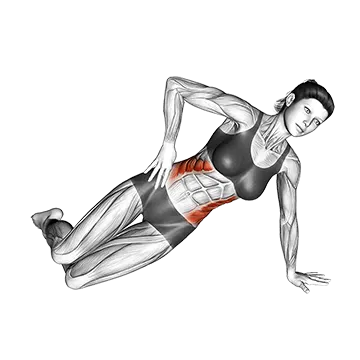

The Twisting Crunch is a bodyweight core exercise that targets the obliques by adding a rotational component to a standard crunch, with the rectus abdominis engaged as a synergist throughout the movement. By rotating the torso toward the opposite knee at the top of each rep, it develops rotational strength and core stability along the waist. It is well-suited for building oblique definition and improving functional trunk rotation without any equipment.
How to do the Twisting Crunch

- 1Lie flat on your back on a mat with your knees bent and feet planted hip-width apart on the floor.
- 2Place your hands lightly behind your head, elbows flared out to the sides, without interlacing your fingers.
- 3Engage your core by drawing your navel gently toward your spine.
- 4Inhale to prepare, then exhale and curl your upper back off the mat, initiating the movement from your abs rather than pulling on your neck.
- 5As you rise, rotate your right shoulder toward your left knee, keeping the left elbow stationary and the movement controlled.
- 6Hold the rotated position at the top for one count, feeling the contraction in your obliques.
- 7Slowly lower your torso back to the starting position on an inhale.
- 8Repeat the movement on the opposite side, rotating your left shoulder toward your right knee, to complete one full rep.
- 9Continue alternating sides for the desired number of repetitions.
Form tips
- Keep your chin slightly tucked and your gaze directed upward to avoid straining your neck — imagine holding a tennis ball under your chin.
- Focus on rotating your ribcage toward the opposite hip rather than simply moving your elbow, to maximise oblique engagement.
- Exhale sharply at the top of the crunch to increase intra-abdominal pressure and deepen the contraction.
- Control the lowering phase rather than dropping back down — the eccentric portion builds as much strength as the lift.
- Keep both feet flat on the floor throughout; avoid letting one foot lift off, which reduces core tension and stability.
Common mistakes
- Pulling on the neck: yanking the head forward with the hands shifts strain onto the cervical spine and removes work from the obliques, increasing injury risk to the neck.
- Using momentum instead of muscle: swinging the torso up rapidly bypasses the slow, controlled contraction needed to effectively target the obliques and reduces time under tension.
- Only moving the elbow: rotating the elbow across rather than rotating the entire ribcage toward the opposite hip turns the exercise into a lateral elbow swing that provides little oblique stimulus.
- Holding the breath: failing to exhale on the way up prevents the deep core from fully engaging and limits the quality of the contraction.
- Rushing through reps: performing reps too quickly sacrifices range of motion and control, meaning the obliques never reach sufficient tension to produce an effective training stimulus.
Frequently asked questions
What is the difference between a Twisting Crunch and a regular crunch?
A regular crunch moves purely in the sagittal plane, targeting the rectus abdominis. The Twisting Crunch adds a transverse rotation at the top of the movement, which directly engages the obliques as the primary muscle while keeping the rectus abdominis as a supporting synergist.
How many reps of Twisting Crunches should I do?
For most people, 3–4 sets of 12–20 repetitions per side is an effective range for building oblique endurance and definition. Because this is a bodyweight exercise, higher rep counts with strict form tend to produce better results than short sets with sloppy technique.
Can Twisting Crunches help reduce side fat or slim the waist?
Twisting Crunches strengthen and tone the obliques and rectus abdominis, which can improve the appearance of the waist over time. However, fat loss in any specific area is determined by overall calorie balance and total body fat reduction, not by the exercises performed on that area alone.
Are Twisting Crunches safe for people with lower back pain?
For many people, crunches place less spinal load than full sit-ups and can be performed comfortably, but anyone with existing lower back issues should consult a healthcare professional first. Keeping the lower back in contact with the mat during the movement and avoiding excessive range of motion helps minimise lumbar stress.
How do Twisting Crunches differ from bicycle crunches?
Both exercises involve trunk rotation to target the obliques, but bicycle crunches also incorporate alternating leg drives that add hip flexor involvement and increase the cardio demand. Twisting Crunches keep the feet planted, isolating the rotational component and allowing a more focused oblique contraction with less total-body fatigue.