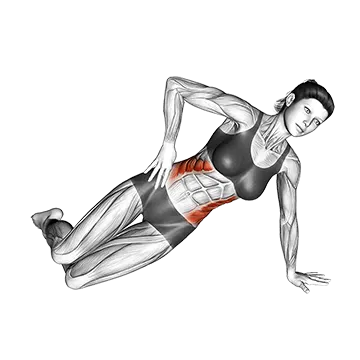
Twisting Crunch
- Target muscle
- Obliques
- Synergist muscles
- Rectus Abdominis
- Equipment
- Body weight
- Body part
- Waist
- Type
- Strength
The Twisting Crunch is a bodyweight strength exercise that primarily targets the obliques (the muscles running diagonally along the sides of your waist), with the rectus abdominis providing synergistic support to flex the spine on each rep. By adding torso rotation at the peak of the crunch, it places far greater rotational demand on the obliques than a standard crunch. It requires no equipment and can be performed anywhere.
How to do the Twisting Crunch
- 1Lie on your back with your knees bent and feet flat on the floor, hip-width apart.
- 2Place your hands lightly behind your head, elbows wide and pointing out to the sides. Do not interlace your fingers.
- 3Brace your core and press your lower back gently into the floor — maintain this contact throughout the set.
- 4Exhale and curl your upper back off the floor, lifting your shoulder blades while keeping your lower back in contact with the ground.
- 5At the top of the crunch, rotate your right elbow toward your left knee by twisting through your ribcage, not by pulling your neck.
- 6Pause briefly in the contracted position to feel the squeeze in your obliques.
- 7Slowly lower your upper back to the floor under control, inhaling on the way down.
- 8On the next rep, rotate your left elbow toward your right knee to work the opposite side.
- 9Continue alternating sides for the target number of repetitions.
Form tips
- Drive the rotation from your ribcage, not your elbow — think of bringing your shoulder blade toward the opposite knee rather than leading with your arm.
- Keep a fist-width of space between your chin and chest throughout every rep to avoid loading your neck instead of your core.
- Move slowly on the descent — the eccentric phase builds as much oblique strength as the crunch itself, so resist the urge to drop back down quickly.
- Keep your feet flat on the floor and do not hook them under furniture; anchoring your feet shifts the workload from your obliques to your hip flexors.
Common mistakes
- Pulling on your neck instead of bracing your core — this strains the cervical spine and removes tension from the obliques, which are the target muscle.
- Rotating only the elbow rather than twisting the ribcage — the obliques only contract when the torso rotates; swinging the arm alone produces almost no useful stimulus.
- Lifting the lower back off the floor during the twist — this shortens the effective range of motion and can compress the lumbar spine under load.
- Using momentum to bounce through reps rather than controlling each contraction — bouncing reduces time under tension and cheats the obliques of the work they need to adapt.
- Holding your breath throughout the set — exhaling on the way up helps create intra-abdominal pressure and produces a stronger, safer core contraction.
Frequently asked questions
What muscles does the Twisting Crunch work?
The Twisting Crunch primarily targets the obliques — the diagonal muscles along the sides of your waist — with the rectus abdominis (the front abdominal wall) acting as a synergist to flex the spine on each rep.
How is the Twisting Crunch different from a regular crunch?
A standard crunch flexes the spine straight forward, working mainly the rectus abdominis. The Twisting Crunch adds torso rotation at the top, which activates the obliques far more and makes it a better choice for building rotational core strength and waist definition.
Is the Twisting Crunch good for beginners?
Yes. Because it uses only body weight and requires a short, controlled range of motion, it suits beginners well. Start with 2–3 sets of 10–12 alternating reps, focus on feeling the obliques contract, and add sets or slow the tempo as it becomes easy.
How many sets and reps should I do for the Twisting Crunch?
For strength and definition, aim for 3–4 sets of 12–15 reps per side with 30–60 seconds of rest between sets. Rather than simply adding more reps, progress by slowing the tempo or pausing longer at the top when the exercise feels easy.
Where should I feel the Twisting Crunch?
You should feel the obliques on both sides of your waist, most strongly on the side of the elbow you are driving across — rotating your right elbow toward your left knee loads the right side hardest — with secondary tension across the front of your abdomen. If you feel it mainly in your neck, ease the pressure of your hands on your head and focus on lifting with your core.