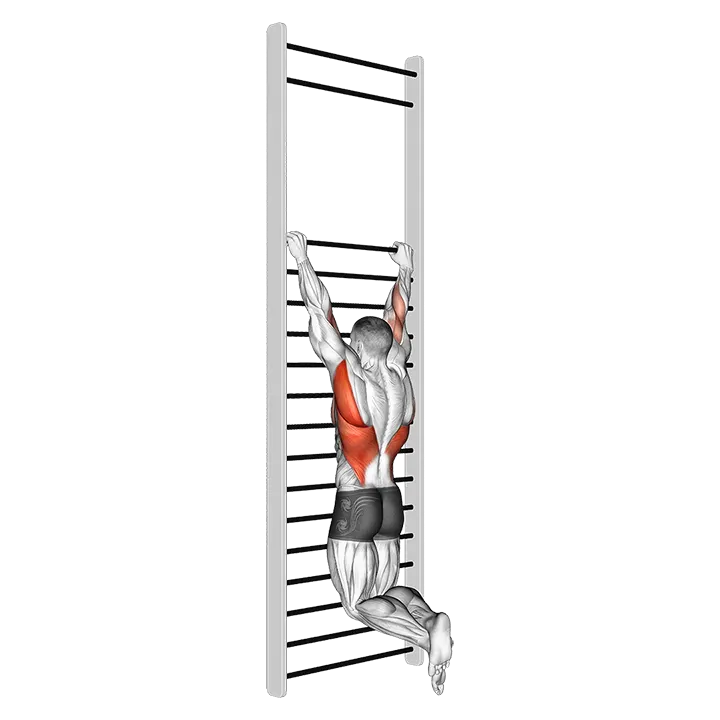
Two handed hang back stretch (with Training Wall Bars)
- Target muscle
- —
- Equipment
- Body weight
- Body part
- Back
- Type
- Stretching
The two handed hang back stretch uses wall bars to let you hang and lean away from the apparatus, creating a sustained passive stretch through the entire back. It decompresses the spine, opens up the thoracic and lumbar regions, and improves spinal mobility. This stretch is commonly used in warm-up or cool-down routines and in rehabilitation contexts to relieve back tension.
How to do the Two handed hang back stretch (with Training Wall Bars)
- 1Stand facing the wall bars and grasp a bar at approximately chest to shoulder height with both hands, palms facing away from you (overhand grip).
- 2Step your feet back from the wall bars until your arms are fully extended and your body is angled away from the bars.
- 3Allow your hips to drop back and down, shifting your weight onto your heels so you create a gentle backward lean.
- 4Let your head drop between your arms and relax your neck and shoulders completely.
- 5Round your upper back slightly, allowing the stretch to travel through the thoracic spine and into the lower back.
- 6Breathe slowly and deeply, using each exhale to relax further into the stretch without forcing additional range.
- 7Hold the position for 20 to 60 seconds, maintaining a passive hang rather than actively pulling.
- 8To release, walk your feet forward toward the wall bars, return to an upright position, and release the bar.
Form tips
- Choose a bar height that lets you achieve a straight-arm hang with a noticeable pull through the back — too high reduces the stretch, too low limits the lean angle.
- Keep your grip relaxed rather than white-knuckling the bar; the goal is to let gravity do the work, not to pull yourself toward the bars.
- Breathe into the stretch — inhale to expand the ribcage, exhale to release tension and settle deeper into the position.
- Adjust foot placement to control intensity: feet further from the bars increase the lean angle and deepen the stretch.
- If any sharp pain appears in the lower back or shoulders, return to upright immediately and reduce the angle of your lean.
Common mistakes
- Holding tension in the shoulders and neck: shrugging or bracing the neck prevents the upper back from releasing and defeats the purpose of a passive stretch.
- Standing too close to the wall bars: insufficient distance means your body cannot lean back far enough to load the back effectively, resulting in minimal stretch stimulus.
- Holding the breath: shallow or held breathing keeps the muscles guarded; relaxed diaphragmatic breathing is essential for the tissues to lengthen.
- Bending the elbows: bent arms reduce the traction through the spine and shift the stretch focus away from the back; keep the arms straight throughout.
- Rushing through the hold: a back stretch held for only a few seconds provides little benefit; the tissues need sustained time under a low-load to release.
Frequently asked questions
What does the two handed hang back stretch do for your back?
Hanging from wall bars while leaning away creates gentle traction along the spine, helping to decompress the intervertebral spaces and relieve accumulated tension in the thoracic and lumbar muscles. Over time it can contribute to improved spinal mobility and reduced stiffness, particularly after prolonged sitting or loaded training sessions.
How long should I hold this stretch?
Aim for 20 to 60 seconds per set. Passive connective tissue stretching benefits from sustained holds rather than brief ones. You can perform 2 to 3 sets, resting briefly between holds. If you are using it as a warm-up, stay on the shorter end; for cool-down or recovery, longer holds are appropriate.
Can I do this stretch if I have lower back pain?
Many people find gentle spinal traction relieving for non-acute back discomfort, but this stretch is not suitable for everyone. If you have a herniated disc, acute spinal injury, or any condition that worsens with flexion, consult a healthcare professional before attempting it. Stop immediately if you experience sharp or radiating pain.
What bar height should I use on the wall bars?
Start with a bar at approximately chest to shoulder height. This allows your arms to extend fully while your body leans back at a comfortable angle. A lower bar creates a more pronounced hip hinge and deeper lumbar stretch; a higher bar tends to emphasize the upper back and lats. Experiment to find what feels most beneficial for your back.
Is this the same as a dead hang?
No. A dead hang involves hanging vertically with your full bodyweight suspended from a bar above you. In the two handed hang back stretch you remain partially weight-bearing through your feet while leaning away from the wall bars, which allows you to control the amount of traction applied and makes the stretch more accessible for those who lack the grip strength for a full dead hang.







