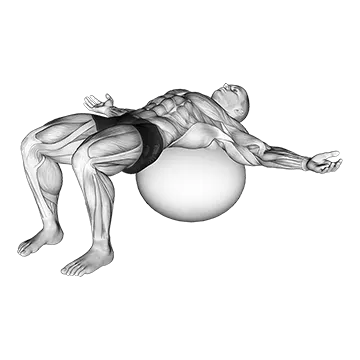
V-Up Down (with Stability ball)
- Target muscle
- —
- Equipment
- Stability ball
- Body part
- Waist
- Type
- Strength
The V-Up Down with Stability Ball is a core exercise that challenges the entire abdominal region by simultaneously raising the upper and lower body while controlling a stability ball between the feet or hands, then lowering back down in a controlled arc. The instability of the ball intensifies engagement across the waist and deep core stabilizers compared to a standard V-up. It is an effective movement for building core strength, balance, and body-control.
How to do the V-Up Down (with Stability ball)
- 1Lie flat on your back on a mat with your legs extended and arms stretched overhead, holding the stability ball in both hands.
- 2Press your lower back gently into the mat and engage your core before beginning the movement.
- 3Exhale and simultaneously lift your arms (with the ball) and both legs off the floor, curling your torso and hips upward to form a V shape.
- 4At the top of the movement, transfer the stability ball from your hands to your feet by squeezing it between your ankles.
- 5Slowly lower both your arms and legs back toward the floor in a controlled descent, keeping the ball gripped between your feet.
- 6Without allowing your legs or upper back to touch the floor completely, reverse the motion: raise both arms and legs again to form the V shape.
- 7At the top, transfer the ball back from your feet to your hands.
- 8Lower back down with control to complete one full repetition.
- 9Repeat for the desired number of reps, maintaining a tight core and steady breathing throughout.
Form tips
- Keep your neck neutral and avoid pulling it with your hands — let your abs do the work of lifting your torso.
- Move slowly on the way down; the eccentric phase is where much of the core strengthening occurs.
- Squeeze the ball firmly between your ankles during the transfer to prevent it from slipping and to maintain tension.
- If your lower back arches excessively at the bottom, reduce the range of motion by not lowering your legs all the way to the floor.
- Breathe out on the way up and in on the way down to reinforce intra-abdominal pressure and stability.
Common mistakes
- Using momentum to swing up: rushing the ascent shifts work away from the abs and onto hip flexors and lower back, reducing effectiveness and risking lumbar strain.
- Letting the lower back arch off the mat at the bottom: an excessive arch places compressive load on the lumbar spine; keep the core braced even at the lowest point of the rep.
- Dropping the legs too fast on the descent: an uncontrolled lower removes time under tension and can cause the lower back to hyperextend as the legs fall.
- Losing grip on the stability ball during the transfer: rushing or imprecise transfers cause the ball to drop and disrupt rhythm — practice the transfer slowly before adding speed.
- Holding the breath throughout the set: breath-holding spikes intra-thoracic pressure and causes early fatigue; exhale on the way up and inhale on the way down to stay controlled.
Frequently asked questions
What muscles does the V-Up Down with Stability Ball work?
The exercise primarily targets the entire core, including the rectus abdominis, transverse abdominis, and obliques. The ball-transfer element also recruits the hip flexors for leg elevation and the shoulder stabilizers to control the ball overhead, making it a comprehensive waist and core movement.
Is the V-Up Down with Stability Ball suitable for beginners?
It is generally an intermediate-to-advanced exercise due to the coordination required to transfer the ball while maintaining a V position. Beginners should first build core strength with standard crunches and leg raises before attempting this variation, or they can practice the V-up motion without the ball first.
How is the stability ball used in this exercise?
The stability ball is held overhead in both hands at the start of each rep. As you reach the top of the V-up, you transfer the ball to between your feet, then lower down. On the next rep, you raise back up and return the ball to your hands. This ball-pass adds coordination demand and keeps the core under continuous tension.
How many reps should I do for the V-Up Down with Stability Ball?
Aim for 3–4 sets of 8–12 repetitions, counting each full pass of the ball as one rep. Because this is a technically demanding movement, quality of form matters more than volume — stop the set if your lower back begins to arch excessively or you can no longer control the ball.
What size stability ball should I use for this exercise?
A standard 55 cm ball is suitable for most individuals under 5'8", while a 65 cm ball works well for those between 5'8" and 6'2". The ball should be inflated firmly enough to hold its shape when squeezed between the ankles but not so hard that it becomes difficult to grip with the feet.