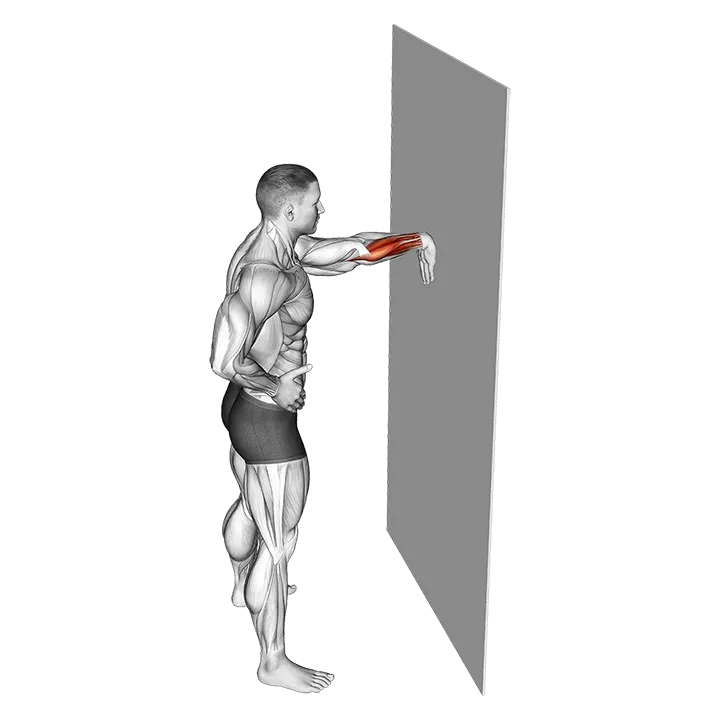
Wall Flexors Stretch
- Target muscle
- —
- Equipment
- Body weight
- Body part
- Forearms
- Type
- Stretching
The wall flexors stretch targets the wrist flexors and forearm flexors — including the flexor carpi radialis and flexor carpi ulnaris — by pressing your hand flat against a wall and gently leaning away. It requires no equipment beyond a wall and your bodyweight. It is particularly useful for relieving tightness after grip-heavy work, typing, or any activity that keeps the wrist in a flexed position.
How to do the Wall Flexors Stretch
- 1Stand facing a wall at arm's length and raise one arm so it is roughly parallel to the floor.
- 2Place your palm flat on the wall with your fingers pointing straight down toward the floor.
- 3Straighten your elbow fully so your arm is extended but not locked with tension.
- 4Slowly rotate your body away from the wall — turning your torso and shoulder away from your hand — until you feel a stretch along the inside of your forearm and wrist.
- 5Keep your palm pressed firmly against the wall throughout; do not let the heel of your hand peel off.
- 6Hold the stretch for 20–30 seconds while breathing steadily.
- 7Release gently, shake out your wrist, then repeat on the opposite arm.
Form tips
- Press the entire palm into the wall, not just the fingertips, to distribute the stretch evenly across the wrist flexors.
- Control the depth of the stretch by how far you rotate your torso — start with a small rotation and increase only as far as comfort allows.
- Keep your elbow straight but not forcefully hyperextended; a soft lock is enough to transmit the stretch into the forearm.
- Breathe normally throughout the hold — tensing up or holding your breath will limit how far the muscles can relax into the stretch.
Common mistakes
- Bending the elbow during the stretch, which shifts the tension away from the forearm flexors and reduces the effectiveness of the movement.
- Letting the heel of the hand lift off the wall, which collapses the wrist angle and eliminates much of the stretch on the flexors.
- Rotating too aggressively before the tissue has warmed up, which can strain the wrist joint or flexor tendons.
- Rushing through the hold — less than 15–20 seconds rarely allows enough time for the muscle to relax and lengthen.
- Shrugging the shoulder of the stretching arm, which adds unnecessary tension at the neck and shoulder rather than isolating the forearm.
Frequently asked questions
What muscles does the wall flexors stretch target?
It primarily stretches the wrist flexors of the forearm — the flexor carpi radialis and flexor carpi ulnaris — along with the surrounding forearm flexor musculature on the inside of the arm.
When is a good time to do this stretch?
It is most effective after activities that load the wrist flexors, such as weightlifting, rock climbing, racket sports, or extended keyboard use. Avoid performing it on a completely cold wrist; a few minutes of light movement first is enough.
Can I do this stretch if I have wrist pain?
Mild tightness is normal, but sharp or shooting pain during the stretch is a signal to stop. If you have a diagnosed wrist condition or tendinopathy, consult a physiotherapist before adding wrist stretches to your routine.
How long should I hold the stretch?
Aim for 20–30 seconds per side. You can repeat 2–3 times on each arm, particularly if the forearms feel especially tight.
Does the direction my fingers point change the stretch?
Yes. Fingers pointing straight down creates the deepest stretch for most people. Pointing fingers to the side slightly shifts emphasis across different parts of the flexor group, so you can experiment to find where you feel the most tension.







