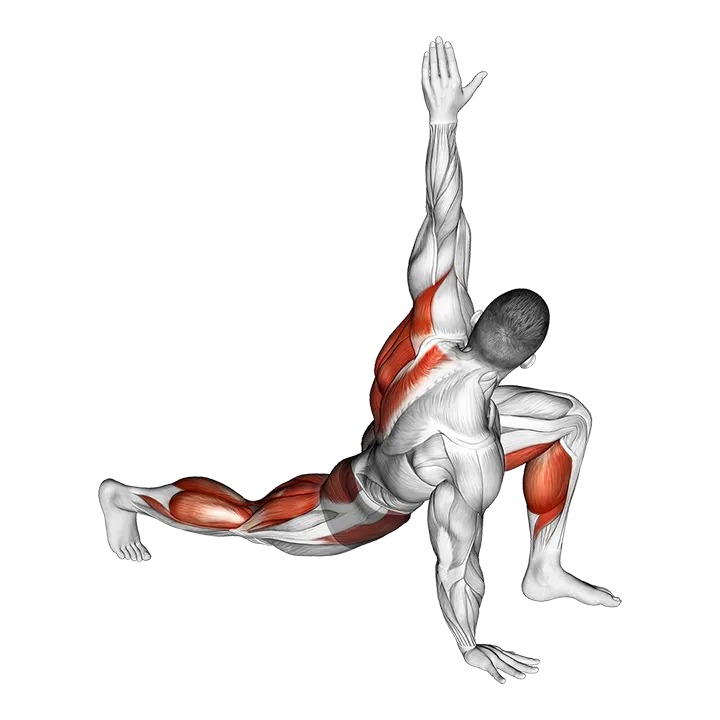
Warming-up in Lunge (five)
- Target muscle
- —
- Equipment
- Body weight
- Body part
- Back, Hips, Thighs
- Type
- Stretching
Warming-up in Lunge (five) is a dynamic five-move lunge sequence that mobilizes the back, hips, and thighs before training. Moving through forward, rotational, reaching, lateral, and reverse lunge positions, it progressively increases range of motion across the lower body and spine. Use this routine as a pre-workout warmup to prepare joints and muscles for heavier movement patterns.
How to do the Warming-up in Lunge (five)
- 1Stand tall with feet hip-width apart, arms relaxed at your sides, and core lightly braced.
- 2Step your right foot forward into a forward lunge, lowering your back knee toward the floor until both legs reach roughly 90 degrees; hold for one breath, then return to standing.
- 3Step forward again into a lunge and add a torso rotation toward the lead knee, extending both arms to the side to open the thoracic spine; return to standing.
- 4Lunge forward a third time and reach both arms overhead and slightly back to open the hip flexors and extend the lumbar spine; hold for one breath, then return to standing.
- 5Step your right foot out wide to the side into a lateral lunge, pushing the hips back and keeping the opposite leg straight to stretch the inner thigh and groin; return to standing.
- 6Step your right foot behind you into a reverse lunge, lowering the back knee toward the floor to stretch the front of the hip; hold for one breath, then push through the front heel to stand.
- 7Repeat the entire five-move sequence on the left leg, matching the same order of movements.
- 8Complete 2–3 full rounds per side, moving at a controlled, rhythmic pace throughout.
Form tips
- Keep your front knee tracking over your second toe in every lunge variation to protect the knee joint.
- Maintain an upright torso and tall spine — avoid hunching forward, especially during the overhead reach and rotation steps.
- Move deliberately through each position rather than rushing; the goal is increased range of motion, not speed.
- Breathe out as you rotate or reach to help release tension and deepen the mobilization.
- If hip flexor tightness limits your depth, place your back knee on the floor for extra stability during the reverse and forward lunge steps.
Common mistakes
- Letting the front knee cave inward: this places harmful stress on the medial knee ligaments and reduces the effectiveness of the hip mobilization.
- Taking too short a step: a shallow lunge fails to stretch the hip flexors and thighs adequately, defeating the purpose of the warmup.
- Rounding the lower back: collapsing the lumbar spine during the reach or rotation steps limits thoracic mobility gains and can irritate the back.
- Rushing through the sequence: moving too quickly prevents the nervous system from registering the new range of motion and reduces warmup effectiveness.
- Skipping the lateral lunge step: the side lunge is the primary mobilizer for the inner thigh and groin — omitting it leaves those tissues unprepared for lateral loading.
Frequently asked questions
What does the 'five' in Warming-up in Lunge (five) mean?
The 'five' refers to a sequence of five distinct lunge variations performed consecutively on each leg: a forward lunge, a lunge with thoracic rotation, a lunge with overhead reach, a lateral lunge, and a reverse lunge. Together they cover the major movement planes of the hips, back, and thighs.
When should I do this lunge warmup routine?
Perform it immediately before lower-body strength sessions, squat or deadlift days, or any workout involving hip-dominant movements. Two to three rounds per side over about five minutes is typically sufficient to elevate tissue temperature and joint mobility.
Can this routine replace a full warmup?
It works best as part of a broader warmup rather than a complete replacement. Pair it with a few minutes of light cardiovascular activity (e.g., brisk walking or cycling) to raise heart rate before moving into the lunge sequence.
Is Warming-up in Lunge (five) suitable for beginners?
Yes — because it uses only bodyweight, beginners can control depth and range of motion freely. Those with limited hip or ankle mobility can shorten the stride length and reduce depth until flexibility improves over time.
How many reps should I do per side?
One complete pass through all five moves on each leg counts as one round. Two to three rounds per side is the standard recommendation for a pre-workout warmup; experienced athletes may add a fourth round if targeting intensive hip or leg training.







