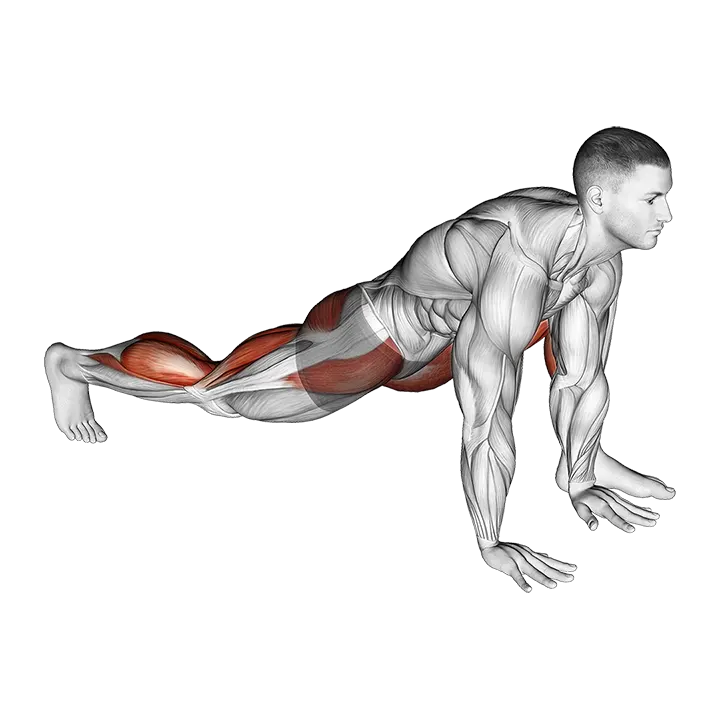
Warming-up in Lunge (four)
- Target muscle
- —
- Equipment
- Body weight
- Body part
- Hips, Thighs
- Type
- Stretching
Warming-up in Lunge (four) is a bodyweight mobility warm-up that cycles through four lunge directions — forward, lateral, reverse, and rotational — to dynamically stretch and activate the hip flexors, quadriceps, glutes, and hip adductors. It progressively opens the hips and increases range of motion in the thighs, making it an ideal pre-workout primer before lower-body training, sports, or any activity requiring hip mobility.
How to do the Warming-up in Lunge (four)
- 1Stand tall with your feet hip-width apart, core lightly braced and arms relaxed at your sides.
- 2Step your right foot forward into a forward lunge, lowering your left knee toward the floor until both knees form roughly 90-degree angles. Hold for one breath, then return to standing.
- 3Step your right foot out to the side into a lateral lunge, pushing your hips back and bending the right knee while keeping the left leg straight. Hold for one breath, then return to standing.
- 4Step your right foot behind you into a reverse lunge, lowering the right knee toward the floor while keeping your torso upright. Hold for one breath, then return to standing.
- 5Step your right foot forward again and, at the bottom of the lunge, rotate your torso toward your right (lead) leg, reaching your right arm toward the ceiling. Hold for one breath.
- 6Return to standing and repeat the same four-direction sequence on the left side, stepping the left foot forward, lateral, reverse, and then rotating left at the bottom of the forward lunge.
- 7Continue alternating sides for the prescribed number of rounds, moving with deliberate control through each direction.
Form tips
- Keep your front knee tracking over your second toe and avoid letting it cave inward during any lunge direction.
- Maintain an upright torso throughout — resist the urge to lean forward excessively, especially in the forward and reverse lunges.
- Move slowly and with control; this is a warm-up, not a speed drill. Pause briefly at the bottom of each direction to feel the stretch.
- In the lateral lunge, push your hips back as if sitting onto a box to maximize the inner-thigh and hip stretch.
- Breathe steadily — exhale as you lower into the lunge and inhale as you return to standing.
Common mistakes
- Letting the front knee shoot past the toes, which increases shear force on the knee joint and reduces the hip stretch benefit.
- Rushing through the four directions without pausing, which turns a mobility exercise into cardio and eliminates the stretching effect.
- Allowing the torso to collapse or round forward, which compresses the hip flexors rather than lengthening them.
- Skipping the lateral direction, which is often the least comfortable; this omits crucial hip adductor and groin mobilization.
- Taking too small a step on the forward or reverse lunge, preventing a full range of motion and reducing the stretch on the hip flexors and quads.
Frequently asked questions
What does the 'four' in Warming-up in Lunge (four) refer to?
It refers to the four lunge directions performed in sequence: forward, lateral (side), reverse, and rotational. Together they cover the full range of hip movement planes and prepare the body for multi-directional lower-body activity.
What muscles does this exercise stretch and activate?
The four-direction lunge warm-up targets the hip flexors, quadriceps, glutes, hip adductors (inner thigh), and hip abductors. The rotational step also engages the obliques and thoracic spine.
How many rounds should I do as a warm-up?
Two to three full rounds per side (eight to twelve total lunge sequences) is typically enough to raise hip temperature and mobility before training. Adjust based on how your hips feel on a given day.
Can I do this warm-up before running or sports?
Yes. The four-direction lunge is particularly effective before running, soccer, basketball, or any sport that demands multi-directional hip movement. It activates the same muscles you will rely on during the activity.
Is this exercise suitable for beginners?
Yes. Because it uses only body weight and moves at a controlled pace, it is accessible to beginners. Those with limited hip flexibility can take a slightly shorter step and reduce the depth of each lunge until mobility improves.







