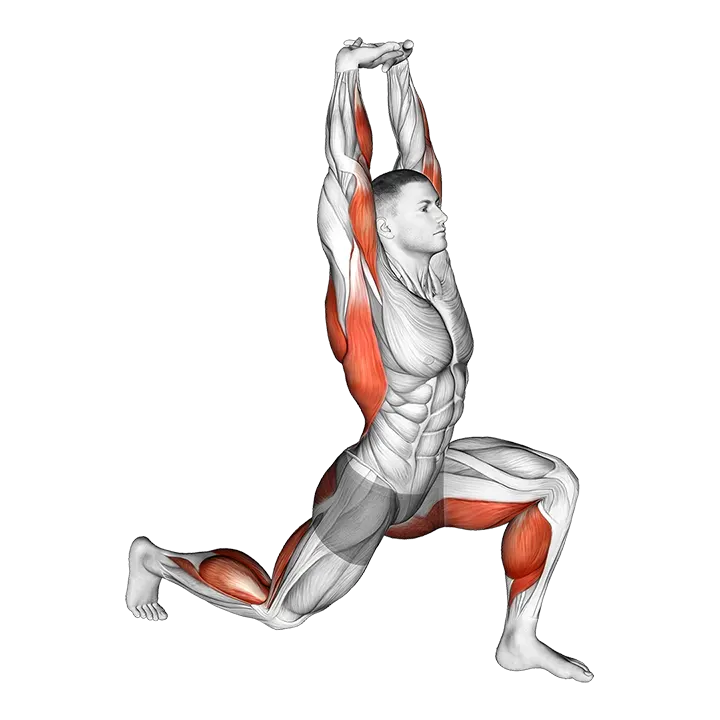
Warming-up in Lunge (one)
- Target muscle
- —
- Equipment
- Body weight
- Body part
- Back, Hips, Thighs, Upper Arms
- Type
- Stretching
Warming-up in Lunge (one) is a single-side bodyweight stretching exercise that mobilizes the hip flexors, thighs, and lower back while opening the upper arms and shoulders. Performed by stepping into a deep lunge and reaching the arms overhead or to the side, it primes the hips, back, and legs for more demanding training. It is particularly useful as a dynamic warm-up before lower-body or full-body workouts.
How to do the Warming-up in Lunge (one)
- 1Stand tall with your feet hip-width apart, core lightly braced, and arms relaxed at your sides.
- 2Step your right foot forward roughly two to three feet and lower your body until your right thigh is approximately parallel to the floor and your left knee hovers just above the ground.
- 3Ensure your right knee tracks directly over your right foot and does not cave inward or push past your toes.
- 4Keep your torso upright and your hips squared forward — avoid rotating toward the lead leg.
- 5From this lunge position, raise both arms straight overhead, pressing your palms together or keeping them shoulder-width apart, to stretch the upper arms, shoulders, and back.
- 6Hold the end position for 20–30 seconds, breathing steadily and sinking slightly deeper into the lunge on each exhale to increase the hip-flexor stretch.
- 7Lower your arms, push through your right heel, and return to the starting standing position.
- 8Repeat the movement on the same side for the desired number of holds before switching legs, or switch sides each set as directed.
Form tips
- Keep your rear heel lifted and your back leg extended so the hip flexor of the trailing leg receives a full stretch throughout the hold.
- Reach actively through your fingertips when the arms are overhead — passive hands reduce the stretch on the upper arms and thoracic spine.
- Breathe in through the nose and exhale through the mouth on each hold; use the exhale to relax deeper into the position rather than forcing the range.
- Squeeze the glute of your trailing leg gently during the hold — this increases anterior pelvic tilt and deepens the hip-flexor stretch.
- If balance is challenging, perform the lunge next to a wall and use one hand for light support while the other arm reaches overhead.
Common mistakes
- Allowing the front knee to cave inward or drift far past the toes, which stresses the knee joint instead of loading the hip and thigh muscles as intended.
- Rounding the lower back or leaning the torso forward, which reduces the stretch on the hip flexors and back and can strain the lumbar spine.
- Holding the breath during the stretch — this increases tension throughout the body and prevents the hip flexors and thighs from releasing into a deeper range of motion.
- Placing the rear knee on the floor immediately, which removes the hip-flexor lengthening that a hovering knee provides; keep the knee just above the ground.
- Rushing through the hold without spending adequate time in the stretched position — a minimum of 20 seconds per hold is needed to meaningfully improve mobility.
Frequently asked questions
What muscles does Warming-up in Lunge (one) stretch?
The exercise primarily stretches the hip flexors (iliopsoas and rectus femoris) of the trailing leg and the quadriceps and hamstrings of the lead leg. Reaching the arms overhead simultaneously lengthens the triceps, biceps, and the muscles along the back, making it a multi-region warm-up stretch.
When should I include Warming-up in Lunge (one) in my workout?
It works best as part of a dynamic warm-up before lower-body or full-body training sessions — after light cardio but before loaded exercises such as squats, deadlifts, or lunges. It can also be used as a standalone mobility drill on rest days.
How long should I hold each lunge position?
For a warm-up, hold each side for 20–30 seconds per rep and perform 2–3 repetitions per side. For active recovery or flexibility work, extend the hold to 30–60 seconds. Avoid bouncing; a steady, sustained hold produces the best results.
Is Warming-up in Lunge (one) safe for people with knee pain?
Many people with mild knee discomfort can perform this stretch safely by ensuring the front knee tracks over the second toe and does not exceed the toes. If pain increases during the movement, shorten the stride length or place the rear knee gently on a folded mat to reduce joint stress.
What is the difference between Warming-up in Lunge (one) and a standard lunge stretch?
The key difference is the overhead arm reach included in this variation, which adds a stretch of the upper arms, triceps, and thoracic back on top of the standard hip-flexor and quad stretch. This turns what would otherwise be a lower-body-only stretch into a full-body mobilization movement.







