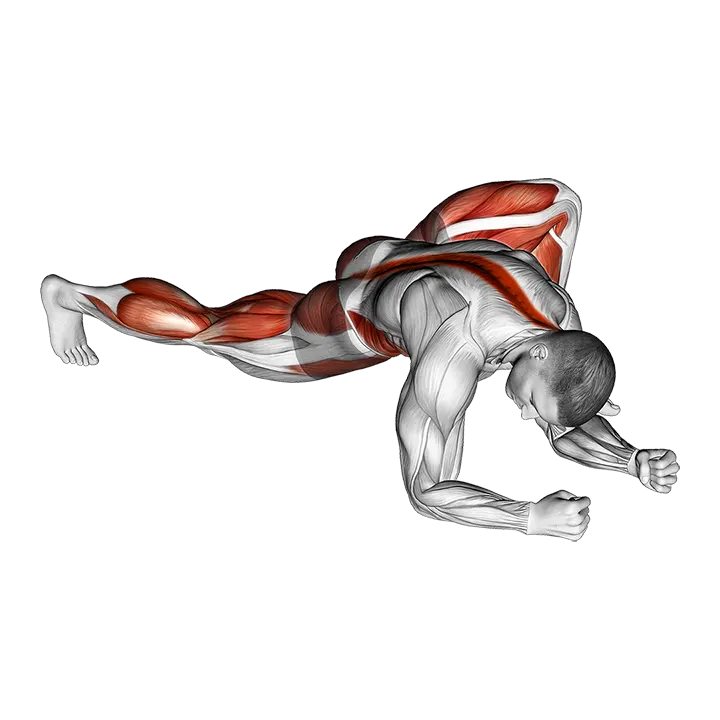
Warming-up in Lunge (six)
- Target muscle
- —
- Equipment
- Body weight
- Body part
- Hips, Thighs, Waist
- Type
- Stretching
Warming-up in Lunge (six) is a six-position body-weight flow that progressively mobilizes the hips, thighs, and waist before training or sport. Moving through six linked positions from a single lunge stance, it raises tissue temperature, improves range of motion, and prepares the lower-body joints for more demanding movement. No equipment is needed, making it an efficient pre-workout primer or active-recovery drill.
How to do the Warming-up in Lunge (six)
- 1Stand tall with feet hip-width apart and hands relaxed at your sides.
- 2Step your right foot forward into a lunge, lowering your left knee toward the floor until both knees are bent at roughly 90°. Keep your torso upright. This is your base position for all six moves.
- 3Position 1 — Hip sink: Press your hips gently downward to open the front of the left hip. Hold 2–3 seconds.
- 4Position 2 — Thoracic rotation: Place both hands on your right thigh and rotate your torso to the right, reaching your right arm overhead toward the ceiling. Hold 2–3 seconds.
- 5Position 3 — Side reach: Return to center and extend your left arm up and over to the right, stretching the left side of your waist. Hold 2–3 seconds.
- 6Position 4 — Elbow drop: Lower your right elbow to the floor inside your right foot, opening the hip further. Hold 2–3 seconds.
- 7Position 5 — Hamstring shift: Straighten your right leg and hinge your hips back with a flat back to stretch the back of the right thigh. Hold 2–3 seconds.
- 8Position 6 — Rotation return: Rebend the right knee, rotate your torso back to center, and push through your right foot to return to standing.
- 9Repeat the full six-position flow on the left side, stepping the left foot forward.
Form tips
- Move through each position slowly and with intention — this is a mobilization drill, not a competition for depth. Gradual, controlled transitions yield more range of motion than rushed ones.
- Keep your front knee tracking over your second toe throughout; do not let it cave inward, especially during the hip sink and elbow drop positions.
- Exhale as you move into each stretch and inhale as you transition to the next position to help the body release tension progressively.
- If your back knee is uncomfortable on a hard floor, place a folded mat or towel under it for padding.
Common mistakes
- Collapsing the front knee inward during the hip sink and elbow drop — this adds lateral stress to the knee and limits the hip-opening effect the drill is designed to create.
- Rushing between positions without pausing — skipping the 2–3 second holds means connective tissue does not have time to lengthen, significantly reducing the warm-up benefit.
- Rounding the lower back during the hamstring shift — a curved spine moves the stretch out of the back of the thigh and into the lumbar area, increasing strain on the lower back.
- Planting the back foot with toes pointing to the side — this misaligns the hip and makes the thoracic rotation and side-reach positions asymmetrical and less effective.
- Standing up between positions — resetting your footing after each move interrupts the flow and shortens the accumulated mobilization effect of the sequence.
Frequently asked questions
What does the six-position lunge warm-up target?
It mobilizes the hips, thighs, and waist through a linked sequence of positions. Rather than isolating one muscle, the flow addresses the front and back of the thigh, the hip rotators, the hip flexors, and the lateral muscles of the waist in a single continuous drill.
How many times should I run through this before a workout?
One to two passes on each leg — roughly 1–2 minutes total — is sufficient as part of a broader warm-up. If you are particularly tight on one side, add a third pass on that side before moving on.
Is this drill suitable for beginners?
Yes. The sequence is low-impact and requires no equipment. Beginners should move slowly and reduce the depth of each position until their range of motion improves with consistent practice.
Can I use this as a cool-down drill too?
Yes. Performed at a slower tempo with longer holds of 5–10 seconds per position, it works well post-workout to ease hip and thigh tension and support recovery.
What workouts pair best with this warm-up?
It pairs naturally with any lower-body session that demands hip mobility and thoracic rotation — squats, lunges, deadlifts, kettlebell swings, or sprint-based training.







