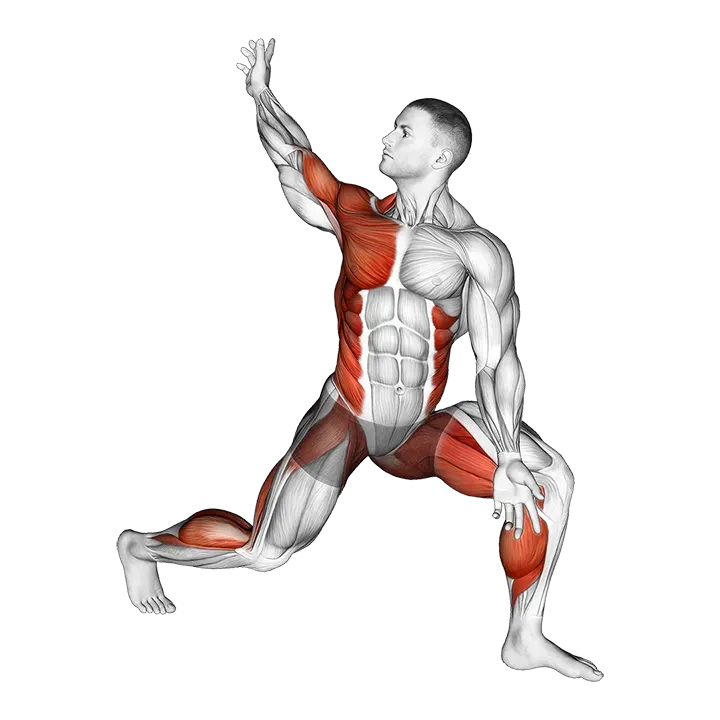
Warming-up in Lunge (three)
- Target muscle
- —
- Equipment
- Body weight
- Body part
- Chest, Hips, Shoulders, Thighs, Waist
- Type
- Stretching
Warming-up in Lunge (three) is a bodyweight mobility sequence performed in a deep lunge stance that simultaneously stretches the chest, hip flexors, shoulders, thighs, and waist through a combination of a forward lunge, torso rotation, and overhead arm reach. As the third variation in the lunge warm-up series, it progressively challenges spinal rotation and lateral flexibility to prepare the entire kinetic chain for training. No equipment is required, making it an effective pre-workout warm-up for virtually any lower- or upper-body session.
How to do the Warming-up in Lunge (three)
- 1Stand tall with feet hip-width apart, core lightly braced, and arms relaxed at your sides.
- 2Step your right foot forward into a deep lunge, lowering your left knee toward the floor while keeping your right knee stacked directly over your right ankle.
- 3Place both hands on the floor inside your right foot for stability.
- 4Rotate your torso to the right, lifting your right arm toward the ceiling and opening your chest to the side — hold for one to two seconds.
- 5Return your right hand to the floor, then extend your right arm forward and your left arm back, creating a T-shape with your upper body to stretch the shoulders and waist.
- 6From there, reach both arms overhead, interlacing your fingers or pressing palms together, and gently side-bend to the left to stretch the right hip flexor and waist.
- 7Hold the end position for two to three seconds, feeling a full stretch through the chest, shoulder, thigh, and hip.
- 8Return to the starting standing position and repeat the entire sequence on the opposite side, stepping the left foot forward.
- 9Complete two to three controlled repetitions per side before your main workout.
Form tips
- Keep your front knee tracking over your second toe throughout the lunge to protect the knee joint and maintain balance.
- Move through each rotation and reach slowly and deliberately — momentum reduces the stretch stimulus and increases the risk of losing balance.
- Breathe out as you rotate or reach to help your thoracic spine and shoulder girdle open further into the stretch.
- Allow your back heel to lift naturally during the lunge; forcing it flat limits hip flexor range of motion.
- If your hips feel tight, reduce the depth of the lunge until your hip flexors allow a full torso rotation without compensation.
Common mistakes
- Letting the front knee cave inward: valgus collapse at the knee during the lunge reduces hip stability and places shear stress on the knee ligaments, undermining the stretch and risking injury.
- Rushing through the rotation: swinging the arm into the rotation instead of controlled movement bypasses thoracic mobility and fails to achieve the intended chest and shoulder stretch.
- Losing lumbar control during the side bend: over-arching the lower back while reaching overhead compresses the lumbar spine rather than stretching the waist and hip flexors; keep the core lightly engaged.
- Placing the front foot too close to the body: a short stride prevents the hip flexor of the back leg from reaching a stretched position, defeating a key purpose of the lunge warm-up.
- Holding the breath: breath-holding increases muscular tension and restricts the range of motion available; exhale fully during each rotation or reach to maximize mobility gains.
Frequently asked questions
What is the difference between Warming-up in Lunge (three) and the other lunge warm-up variations?
The lunge warm-up series progressively adds movement complexity with each variation. The third variation typically combines the forward lunge with both a thoracic rotation and an overhead reach or side bend, making it the most comprehensive of the three for mobilizing the chest, shoulders, waist, and hip flexors simultaneously.
When should I do Warming-up in Lunge (three) in my workout?
Perform it as part of your dynamic warm-up before strength training, cardio, or sport practice. Two to three repetitions per side are sufficient to elevate joint temperature, improve tissue extensibility, and activate the muscles used in the main session.
Can beginners perform this exercise?
Yes. Beginners can shorten the lunge stride and limit the range of rotation or reach until their balance and hip flexibility improve. Holding a wall or door frame with the non-reaching hand provides additional stability while learning the movement pattern.
Does Warming-up in Lunge (three) help with hip flexor tightness?
It is an effective dynamic stretch for the hip flexors of the back leg, which are often tight from prolonged sitting. The deep lunge position places the hip flexor under load through a functional range of motion, helping restore extensibility before lower-body training.
How many reps and sets are recommended for this warm-up movement?
Two to three slow, controlled repetitions on each side are typically sufficient as a warm-up drill. Because the goal is mobility and activation rather than fatigue, performing more than three sets per side is unnecessary and should be reserved for specific flexibility work.







