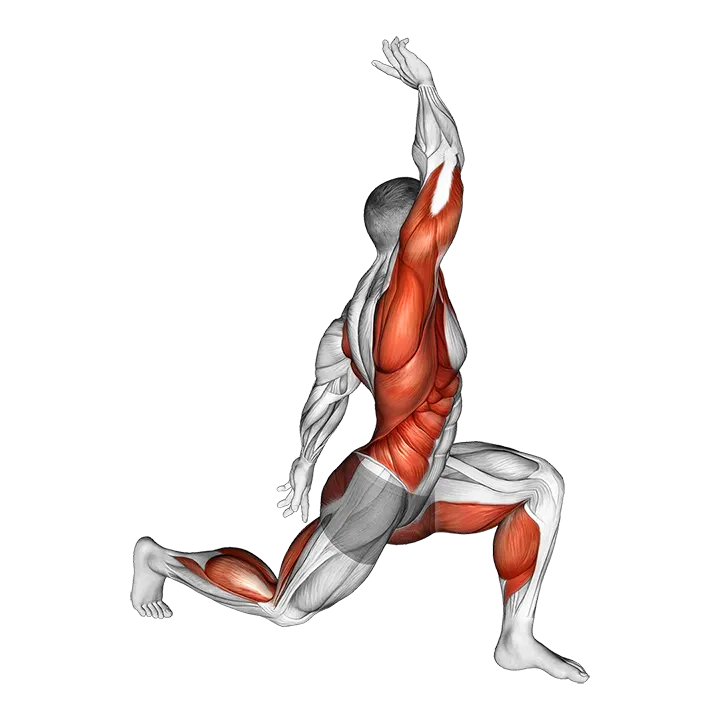
Warming-up in Lunge (two)
- Target muscle
- —
- Equipment
- Body weight
- Body part
- Back, Hips, Thighs, Waist
- Type
- Stretching
Warming-up in Lunge (two) is a bodyweight mobility drill performed in a split-stance position that simultaneously warms up the hips, thighs, back, and waist. By combining a deep lunge with controlled reaches or rotations, it increases blood flow and range of motion through multiple joints before training. It is particularly useful as a pre-workout primer for lower-body or compound movements that demand hip and thoracic mobility.
How to do the Warming-up in Lunge (two)
- 1Stand tall with your feet hip-width apart, arms relaxed at your sides.
- 2Step your right foot forward into a lunge, lowering your left knee toward the floor until both knees are bent at roughly 90 degrees.
- 3Keep your front shin vertical and your torso upright, with your core lightly braced.
- 4Reach both arms overhead or extend them out to the sides to lengthen the waist and open the hips further.
- 5Hold the stretched position for two to three seconds, breathing steadily.
- 6Return your arms to a neutral position and push through your front heel to stand back up.
- 7Repeat the lunge on the opposite leg, stepping the left foot forward and performing the same reach.
- 8Alternate legs for the prescribed number of repetitions on each side, moving with control throughout.
Form tips
- Keep your front knee tracking over your second toe — avoid letting it collapse inward, which reduces hip engagement and strains the knee.
- Think of growing tall through the crown of your head as you lunge, rather than leaning forward, to maintain an upright torso and protect the lower back.
- Breathe out as you reach or rotate at the top of the stretch to encourage greater range of motion through the waist and back.
- Move deliberately — this is a warm-up, not a race; controlled movement activates the target areas more effectively than rushing through reps.
- If your back knee hovers painfully close to the floor, place a folded mat beneath it until hip flexor mobility improves.
Common mistakes
- Letting the front knee drift past the toes: this shifts excessive load onto the knee joint rather than the hip and thigh, reducing the stretch benefit and stressing the patellar tendon.
- Leaning the torso forward: collapsing the chest toward the front thigh shortens the hip flexor stretch and prevents the waist and back from opening fully.
- Taking too short a stride: a narrow lunge keeps the hips stacked rather than split, which limits hip flexor length and diminishes the warm-up effect on the thighs and hips.
- Holding the breath: failing to breathe rhythmically during the stretch increases tension in the back and waist, working against the mobility goal of the exercise.
- Rushing the movement: bouncing in and out of the lunge turns a mobility drill into a momentum-driven motion that bypasses the target tissues and offers little warm-up value.
Frequently asked questions
What muscles does Warming-up in Lunge (two) target?
This drill primarily warms up the hips, thighs, lower back, and waist. The lunge position lengthens the hip flexors and engages the quadriceps, while the reach or rotation mobilizes the thoracic spine and stretches the lateral waist musculature.
How many reps should I do before a workout?
Six to ten repetitions per leg is a practical range for a warm-up context. Aim for smooth, controlled movement rather than high volume — the goal is to raise tissue temperature and increase range of motion, not to fatigue the muscles.
Can I do this exercise if I have tight hip flexors?
Yes, and it is particularly beneficial for people with tight hip flexors. Start with a slightly shorter stride and do not force the stretch; over several sessions, gradually increase the stride length as flexibility improves.
What is the difference between Warming-up in Lunge (one) and Warming-up in Lunge (two)?
The two variations typically differ in the arm action or torso movement performed during the lunge — for example, one may use a forward reach while the other incorporates a lateral reach or rotation. Both target the same body regions but challenge mobility from slightly different angles.
Is this exercise suitable as a standalone warm-up before leg day?
It works well as part of a broader warm-up routine alongside hip circles, leg swings, and light cardio. On its own, a few sets are a solid start, but pairing it with other dynamic movements ensures all lower-body joints are fully prepared for loading.







