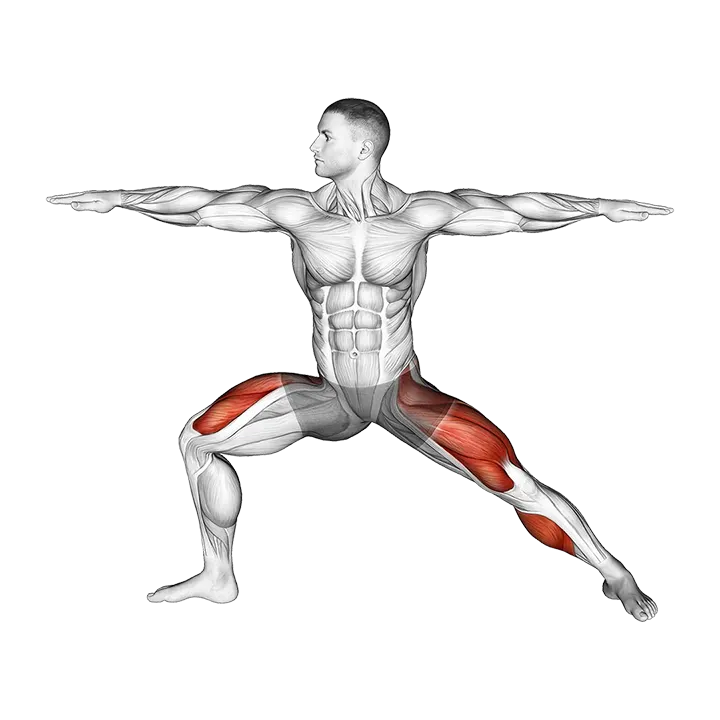
Warrior II Yoga Pose
- Target muscle
- —
- Equipment
- Body weight
- Body part
- Stretching
- Type
- Stretching
Warrior II Yoga Pose is a standing yoga posture that opens the hips and groin, strengthens the legs and core, and builds shoulder and arm endurance. Holding the wide-legged stance with arms extended engages the hips, inner thighs, quadriceps, glutes, and trunk stabilizers simultaneously, making it a foundational pose for improving both flexibility and balance.
How to do the Warrior II Yoga Pose
- 1Stand at the top of your mat with feet together and arms at your sides.
- 2Step your feet wide apart — roughly 3.5 to 4 feet — so your stance is stable but not so wide that your hips cannot level.
- 3Turn your right foot out 90° so the toes point to the short end of the mat, then pivot your left foot slightly inward (about 15°). Align your right heel with the arch of your left foot.
- 4Exhale and bend your right knee until your thigh is roughly parallel to the floor, tracking your knee over the middle of your right foot without letting it collapse inward.
- 5Press evenly through the outer edge of your back (left) foot to keep the back leg straight and grounded.
- 6Raise both arms to shoulder height and extend them actively in opposite directions — right arm forward, left arm back — palms facing the floor.
- 7Turn your gaze over your right fingertips. Keep your torso upright and directly over your hips, not leaning toward the bent knee.
- 8Hold the pose for 5 to 10 steady breaths, maintaining length through the crown of your head and relaxed shoulders.
- 9To release, straighten your right leg on an inhale, lower your arms, and return your feet to parallel. Repeat the full pose on the opposite side.
Form tips
- Keep your front knee tracking over the middle of your foot — not caving inward or pushing past your toes — to protect the knee joint and maximize hip engagement.
- Lengthen through the crown of your head and keep your torso tall and upright throughout the hold; leaning forward over the bent leg reduces the hip-opening benefit.
- Press firmly through the outer edge of your back foot to anchor the pose and keep the back leg strong and active.
- Allow your hips to open gradually with each exhale rather than forcing the range; consistent practice builds flexibility over time.
- Draw your shoulders down and away from your ears as you extend your arms, keeping the neck long and relaxed.
Common mistakes
- Letting the front knee collapse inward — this reduces hip engagement and puts excessive strain on the inner knee ligaments.
- Leaning the torso forward over the bent leg — this shortens the hip flexors on the back leg and diminishes the lateral hip-opening effect of the pose.
- Raising the shoulders toward the ears while extending the arms — creates tension in the neck and upper trapezius and limits shoulder mobility.
- Not bending the front knee deeply enough — a shallow bend reduces the strengthening demand on the quadriceps and the stretch across the inner thighs and hip flexors.
- Lifting or rolling the back heel off the floor — destabilizes the stance and removes the grounding that supports balance and back-leg engagement.
Frequently asked questions
What does Warrior II stretch?
Warrior II primarily opens the hips and groin, stretching the hip flexors of the back leg and the inner thighs (adductors) of the front leg. It also engages the quadriceps, glutes, core stabilizers, and shoulders, giving it a full-body character despite being classified as a stretching pose.
How long should I hold Warrior II?
Hold for 5 to 10 slow, steady breaths per side — roughly 30 to 60 seconds. As you build hip strength and flexibility, you can extend the hold or repeat the pose several times in a flow sequence.
Is Warrior II good for beginners?
Yes. Warrior II is accessible to most beginners. If the full pose feels challenging, shorten your stance slightly, keep the front knee at less than a 90° bend, or rest your hands on your hips until you develop more leg and hip strength.
What is the difference between Warrior I and Warrior II?
In Warrior I, both hips face forward and both arms reach overhead, giving it a forward-facing, more closed-hip orientation. In Warrior II, the hips open to the side and the arms extend in opposite directions parallel to the floor, making it a lateral hip-opening posture.
Can Warrior II help with tight hips?
Yes. Regular practice of Warrior II stretches the hip flexors on the back leg and the adductors on the front leg, and can gradually improve hip mobility and range of motion over time. Holding the pose consistently and breathing into areas of tightness accelerates the release.







