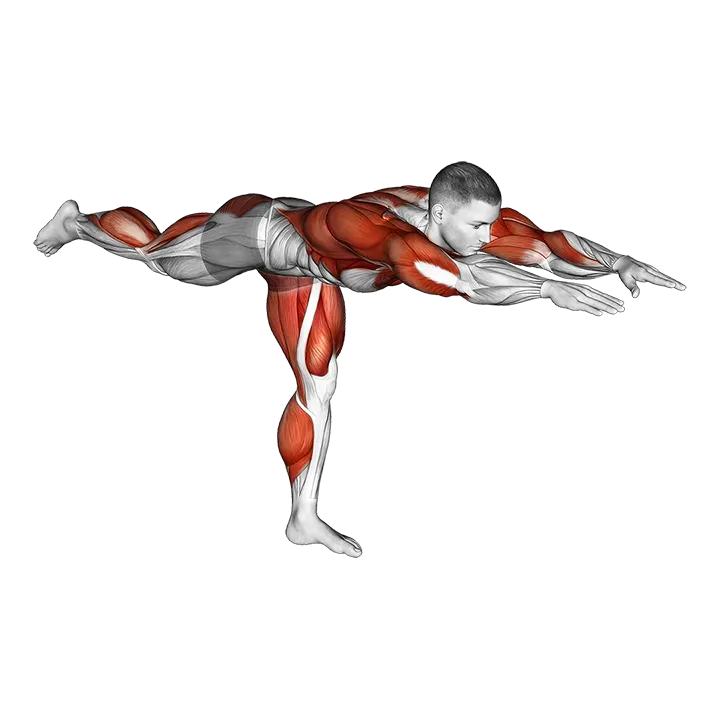
Warrior Pose
- Target muscle
- —
- Equipment
- Body weight
- Body part
- Back, Hips, Thighs
- Type
- Stretching
Warrior Pose (Virabhadrasana I) is a standing stretch that opens the hip flexors, thighs, and back by combining a deep lunge with an overhead arm reach and squared hips. Performed with body weight only, it builds lower-body stability and mobility simultaneously. It is well suited for improving hip flexor flexibility, thoracic extension, and postural awareness.
How to do the Warrior Pose
- 1Stand tall with your feet together and your arms at your sides.
- 2Step your right foot forward about three to four feet, keeping your toes pointing straight ahead.
- 3Turn your left foot out approximately 45 degrees and press the outer edge of your left foot firmly into the floor.
- 4Bend your right knee until it is directly over your right ankle, with your shin vertical and your thigh approaching parallel to the floor.
- 5Square your hips forward by drawing your left hip toward the front and your right hip slightly back until both hip bones face the same direction as your front foot.
- 6On an inhale, raise both arms overhead with your palms facing each other and your shoulders drawing away from your ears.
- 7Lengthen your spine upward, gently lifting through the crown of your head while keeping your lower back from overarching.
- 8Hold the position for the desired duration, breathing steadily, then lower your arms, straighten your front leg, and step your feet back together.
- 9Repeat on the opposite side by stepping your left foot forward.
Form tips
- Press through the outer edge of your back foot to keep it from rolling inward — this stabilizes the hip and protects the knee.
- Keep your front shin vertical rather than letting the knee drift past the ankle, which reduces strain on the knee joint.
- Reach actively through your fingertips to create length through the sides of your torso and prevent the arms from going slack.
- If squaring your hips fully is not yet possible, reduce the width of your stance slightly — a narrower step makes hip alignment easier to achieve.
- Breathe into your chest and abdomen rather than holding your breath, as steady breathing helps the hip flexors release over time.
Common mistakes
- Letting the front knee cave inward: this places lateral stress on the knee and reduces hip engagement — track the knee over the second toe throughout the hold.
- Allowing the back heel to lift: losing heel contact shortens the hip flexor stretch and destabilizes the base — press the heel down firmly.
- Overarching the lower back: when the hip flexors are tight, the pelvis tips forward and the lumbar spine compresses — tuck the tailbone slightly to maintain a neutral spine.
- Shrugging the shoulders toward the ears: tension in the upper traps limits thoracic extension and reduces the stretch — actively draw the shoulder blades down and back.
- Rotating the hips open to the side: allowing the back hip to swing outward turns the pose into a lateral stretch rather than a forward hip-flexor opener — keep both hip bones facing forward.
Frequently asked questions
What muscles does Warrior Pose stretch?
Warrior Pose primarily stretches the hip flexors of the back leg (including the psoas and rectus femoris), the front thigh (quadriceps) of the back leg, and the muscles along the back, particularly the thoracic extensors. The front leg's hip and thigh muscles are also engaged isometrically.
How long should you hold Warrior Pose?
For a flexibility benefit, hold each side for 30 to 60 seconds. If you are using it as part of a dynamic warm-up, 5 to 10 breaths per side is sufficient. Beginners can start with shorter holds and build duration as hip flexibility improves.
What is the difference between Warrior I and Warrior II?
In Warrior I (covered here), the hips are squared to face the front and the arms reach straight overhead. In Warrior II, the hips and torso open to the side, the front arm reaches forward and the back arm reaches to the rear, and the gaze follows the front hand. The two poses stretch different planes of the hip.
Can Warrior Pose help with lower back pain?
Tight hip flexors are a common contributor to lower back pain because they pull the pelvis into an anterior tilt. By lengthening the hip flexors, Warrior Pose can help reduce that pull and ease lumbar tension. However, if you have an acute back injury, consult a healthcare professional before including it in your routine.
Is Warrior Pose suitable for beginners?
Yes. Warrior Pose requires no equipment and can be modified by taking a shorter stance or placing hands on the front thigh rather than raising them overhead. Beginners should focus on maintaining an upright torso and a stable back foot before worrying about deepening the lunge.







