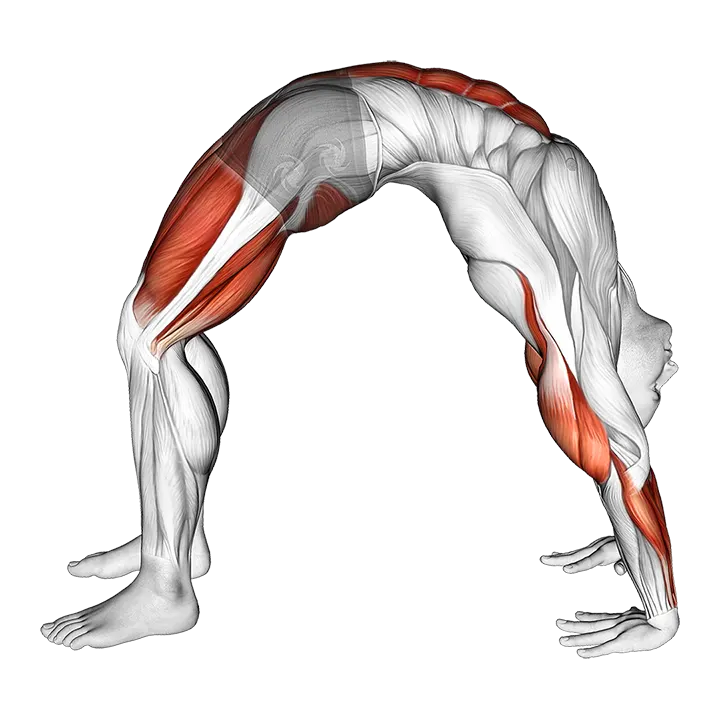
Wheel Pose Yoga Pose
- Target muscle
- —
- Equipment
- Body weight
- Body part
- Waist
- Type
- Stretching
Wheel Pose (Urdhva Dhanurasana) is a full-body backbend yoga pose that deeply stretches the spine, hip flexors, chest, and shoulders while strengthening the arms, legs, and core. Performed with bodyweight on the floor, it builds spinal mobility and opens the front of the body. It is a foundational deep backbend in yoga practice, suitable for intermediate and advanced practitioners.
How to do the Wheel Pose Yoga Pose
- 1Lie on your back with your knees bent and feet flat on the floor, hip-width apart and close to your glutes.
- 2Place your palms flat on the floor beside your ears, fingers pointing toward your shoulders and elbows stacked above your wrists.
- 3Press firmly through your feet and engage your glutes to lift your hips off the floor.
- 4Press into your palms to lift your head and shoulders, pausing with the crown of your head lightly resting on the mat as a checkpoint.
- 5Continue pressing through hands and feet to fully extend your arms and lift your head clear of the floor, arching your back into a full bridge.
- 6Roll your inner thighs toward the floor to keep your knees hip-width apart and avoid splaying outward.
- 7Breathe steadily in the pose for 5–10 seconds, keeping your arms and legs actively engaged.
- 8To exit, tuck your chin toward your chest and slowly lower yourself vertebra by vertebra back to the floor.
Form tips
- Warm up your spine thoroughly with gentler backbends such as Bridge Pose before attempting Wheel Pose.
- Press the floor away evenly through all four corners of both hands to distribute load across your wrists, not just the heels of the palms.
- Engage your quadriceps actively to keep the knees tracking over the toes and protect the knee joints.
- Draw your shoulder blades toward each other to open the chest and prevent the elbows from flaring outward.
Common mistakes
- Letting the feet turn outward, which strains the lower back and prevents proper hip extension — keep feet parallel and hip-width apart.
- Collapsing the elbows outward, which reduces stability and stresses the wrists — keep upper arms roughly parallel throughout.
- Holding the breath, which increases tension and limits how deeply you can open — breathe smoothly throughout the hold.
- Rushing into the pose without a warm-up, which risks straining the lumbar spine or shoulder joints — always prep with lighter backbends first.
- Positioning the feet too far from the glutes, which makes it difficult to push fully into the arch — start with feet close to the body.
Frequently asked questions
What muscles does Wheel Pose stretch and strengthen?
Wheel Pose stretches the spine, hip flexors, chest, and shoulders while strengthening the arms, legs, glutes, and core. It is a full-body pose, with the greatest demand on the spinal extensors and on opening the front of the body.
Is Wheel Pose safe for beginners?
Wheel Pose is generally considered an intermediate-to-advanced pose. Beginners should build up through Bridge Pose and supported backbends first, and should avoid it if they have wrist, shoulder, or lower-back injuries.
How long should I hold Wheel Pose?
Start with 5–10 seconds and gradually work toward 30 seconds or more as your strength and flexibility improve. Quality and breath control matter more than duration.
What is a good modification if I cannot lift into full Wheel Pose?
Bridge Pose is the most direct modification — keep your hips lifted without placing weight on the hands. You can also use yoga blocks under your hands to reduce the range of motion required.







