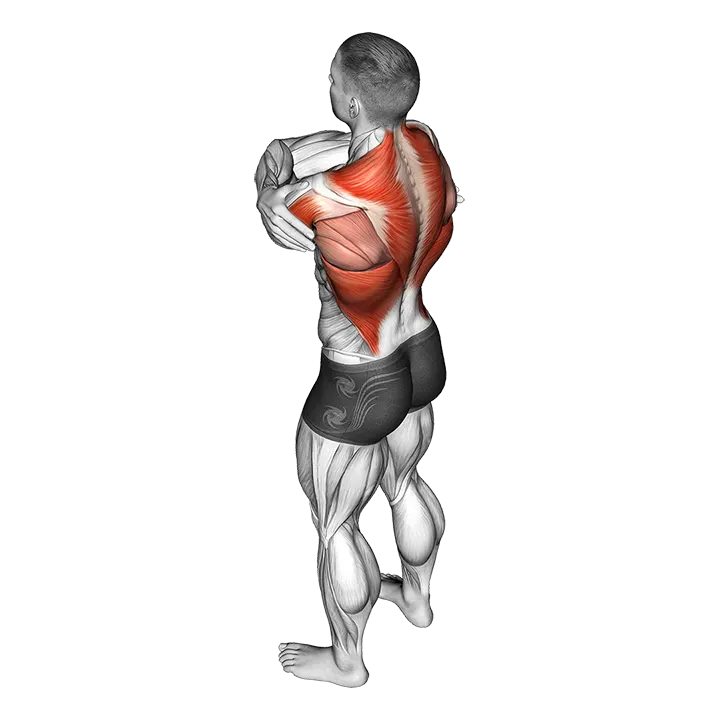
Wrap around shoulder stretch
- Target muscle
- —
- Equipment
- Body weight
- Body part
- Back
- Type
- Stretching
The Wrap Around Shoulder Stretch is a body-weight mobility exercise that releases tension in the posterior shoulder and upper back, improving flexibility and range of motion in those areas. By drawing one arm across the chest and gently pulling it toward the opposite shoulder, it lengthens the rear shoulder and upper back muscles. It fits naturally into a warm-up, cool-down, or recovery session and requires no equipment.
How to do the Wrap around shoulder stretch
- 1Stand tall with your feet hip-width apart, spine long, and shoulders relaxed away from your ears.
- 2Extend your right arm straight out in front of you at approximately shoulder height.
- 3Sweep the right arm horizontally across your chest toward the left side of your body.
- 4Hook your left forearm or hand under your right upper arm, just above the elbow — avoid gripping or pulling at the wrist.
- 5Gently draw the right arm closer to your chest until you feel a firm but comfortable stretch in the back of the right shoulder and upper back.
- 6Keep your right shoulder pressed down; do not allow it to rise toward your ear.
- 7Hold the position for 20–30 seconds, breathing slowly and steadily.
- 8Release the arm, shake it out briefly, then mirror the movement on the left side for the same duration.
Form tips
- Keep the stretching arm at or slightly below shoulder height — raising it too high shifts tension away from the posterior shoulder and onto the neck.
- Exhale slowly during the hold; a long exhale encourages the muscles to relax further into the stretch.
- Let the pull come entirely from your forearm — do not torque your torso toward the pulling side, as that substitutes spinal rotation for shoulder mobility.
- Perform both sides for equal time to maintain symmetry between the left and right shoulder.
- If you feel a pinching sensation at the front of the shoulder, lower the arm an inch or two and reduce the pull until the discomfort resolves.
Common mistakes
- Allowing the stretching shoulder to shrug upward: shoulder elevation reduces tension on the posterior shoulder muscles and transfers stress to the neck, negating the benefit of the stretch.
- Pulling from the wrist or hand instead of the forearm: using the wrist as the anchor bends the elbow joint under load rather than stretching the shoulder, and can cause elbow discomfort.
- Rotating the torso to force a deeper reach: trunk rotation substitutes spinal mobility for shoulder flexibility, reducing the stimulus on the intended area.
- Bouncing or pulsing at end range: ballistic movement through a tight shoulder risks micro-tears in unprepared soft tissue — a steady, sustained hold is both safer and more effective.
- Holding for fewer than 15 seconds: short holds do not give the viscoelastic connective tissue enough time to lengthen; aim for at least 20–30 seconds per side.
Frequently asked questions
What muscles does the Wrap Around Shoulder Stretch target?
The stretch works the muscles at the back of the shoulder and upper back — primarily the rear deltoid, rhomboids, and mid-trapezius fibers. Because no target muscle is designated in the exercise database and the movement is classified as bodyweight stretching, it is appropriate for all fitness levels as a general posterior shoulder and upper back mobility exercise.
When is the best time to do the Wrap Around Shoulder Stretch?
It works well at any point in a session. As a warm-up, perform it after 5 minutes of light cardio when the tissues are warm. As a cool-down, hold each side for 30 seconds to aid recovery. It is also effective as a standalone mobility break during extended periods of sitting or desk work.
How long should I hold the Wrap Around Shoulder Stretch?
Hold each side for 20–30 seconds and repeat 2–3 times per side. Avoid bouncing or pulsing; a slow, sustained hold allows the soft tissue to lengthen progressively and safely.
Is the Wrap Around Shoulder Stretch safe if I have a shoulder injury?
For most cases of minor shoulder tightness it is gentle and well-tolerated. However, if you have a diagnosed shoulder condition such as a rotator cuff tear, impingement, or instability, consult a physiotherapist before attempting it. Stop immediately if you feel sharp pain rather than a mild pulling sensation.
What are good alternatives to the Wrap Around Shoulder Stretch?
The sleeper stretch (lying on your side with the arm pinned beneath you) and the eagle-arm stretch (wrapping one arm under the other and lifting the elbows) are the closest alternatives targeting the same posterior shoulder and upper back area. The sleeper stretch in particular addresses the posterior shoulder capsule and is a useful progression if you need deeper mobility work.







