Wrist Extensor Stretch
- Target muscle
- Wrist Extensors
- Equipment
- Body weight
- Body part
- Forearms
- Type
- Stretching


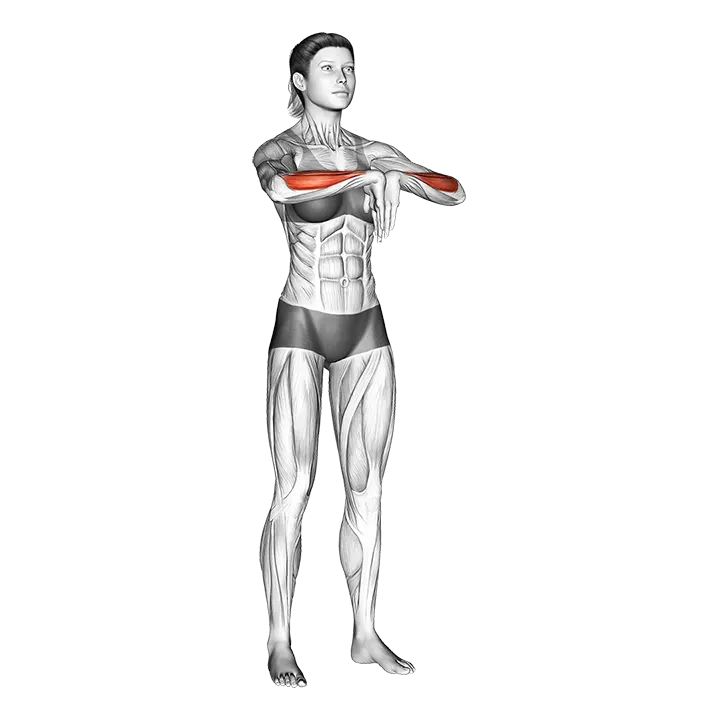
The Wrist Extensor Stretch targets the wrist extensors along the back of the forearm, gently lengthening muscles that become tight from typing, gripping, and repetitive overhead work. It is a go-to recovery move for desk workers, climbers, and racket-sport athletes alike. Performed with body weight alone, it relieves forearm tightness and helps reduce the risk of repetitive strain injuries such as tennis elbow.
How to do the Wrist Extensor Stretch
- 1Stand or sit tall with your spine neutral and shoulders relaxed.
- 2Extend one arm straight in front of you at shoulder height, palm facing down.
- 3Use your free hand to gently grasp the fingers of the extended hand from above.
- 4Curl the fingers and wrist of the extended arm downward, pointing your fingertips toward the floor.
- 5Apply light steady pressure with your free hand to deepen the bend until you feel a mild stretch along the top of the forearm.
- 6Keep the elbow of the extended arm straight but not locked throughout the stretch.
- 7Hold the position for 20–30 seconds while breathing slowly and steadily.
- 8Gradually release the pressure, straighten the wrist, and return to the starting position.
- 9Repeat on the opposite arm, performing 2–3 rounds per side.
Form tips
- Breathe out as you apply pressure and keep each breath slow — tension in the forearm decreases noticeably with each exhale.
- Aim to feel a gentle pulling sensation along the top of the forearm, not sharp pain; back off immediately if you feel discomfort in the wrist joint itself.
- Perform the stretch with a straight elbow to isolate the wrist extensors; a bent elbow shifts emphasis and reduces effectiveness.
- Warm up the forearms with light movement or a few wrist circles before stretching — cold muscles are less pliable and more prone to micro-tears.
- For an added neural component, gently tuck your chin to your chest while holding the stretch to increase tension through the forearm fascia.
Common mistakes
- Bending the elbow during the stretch: a flexed elbow allows the forearm muscles to go slack, significantly reducing the stretch on the wrist extensors.
- Pulling too hard or bouncing: forcing the wrist into a deeper range with jerky pressure can irritate tendons and aggravate existing strain rather than relieving it.
- Holding the breath: breath-holding increases overall tension in the body, making it harder to release tightness in the forearm.
- Skipping the opposite arm: forearm imbalances are common, and neglecting one side can perpetuate asymmetry and uneven injury risk.
- Rushing through the hold: cutting the hold time short to under 15 seconds does not give the muscle enough time to relax and lengthen, limiting the benefit of the stretch.
Frequently asked questions
How often should I do the Wrist Extensor Stretch?
For general maintenance, stretching the wrist extensors 2–3 times per day works well — once in the morning, once after a long period of typing or gripping, and once before bed. If you are managing early-stage tennis elbow or forearm tightness, daily stretching combined with rest and gradual loading is typically recommended. Always stop if symptoms worsen and consult a healthcare professional.
Can this stretch help with tennis elbow?
Yes, the Wrist Extensor Stretch is one of the primary conservative interventions recommended for lateral epicondylitis (tennis elbow). The wrist extensors attach at the lateral epicondyle of the elbow, and gently lengthening them can reduce tension on that attachment point. However, it should be performed pain-free and is most effective as part of a broader program that includes eccentric strengthening and load management.
Should I stretch my wrists before or after a workout?
Dynamic wrist movements (circles, controlled flexion and extension) are best before a workout to increase blood flow and joint mobility. Static stretches like the Wrist Extensor Stretch are most beneficial after training, when muscles are warm and more receptive to lengthening. Stretching a cold forearm aggressively before heavy lifting can temporarily reduce grip strength.
I feel the stretch more in my fingers than my forearm — is that normal?
It can be. The finger extensors share the same muscle group and tendon pathway as the wrist extensors, so some sensation in the fingers is expected. If the sensation is overwhelming in the fingers but minimal in the forearm, try reducing how far you curl the fingers downward and focus the bend at the wrist level. You can also isolate the stretch by curling only the wrist without pulling on the fingers.
Can I do this stretch at a desk without standing up?
Absolutely. The Wrist Extensor Stretch requires no equipment and can be done seated. Rest your forearm on the desk with your hand hanging just past the edge, palm facing down, then use your other hand to gently press the back of the hand downward so the wrist curls toward the floor. Alternatively, perform the standard version described in the instructions while seated upright. Taking a 30-second stretch break every hour is a practical habit for anyone doing sustained keyboard work.