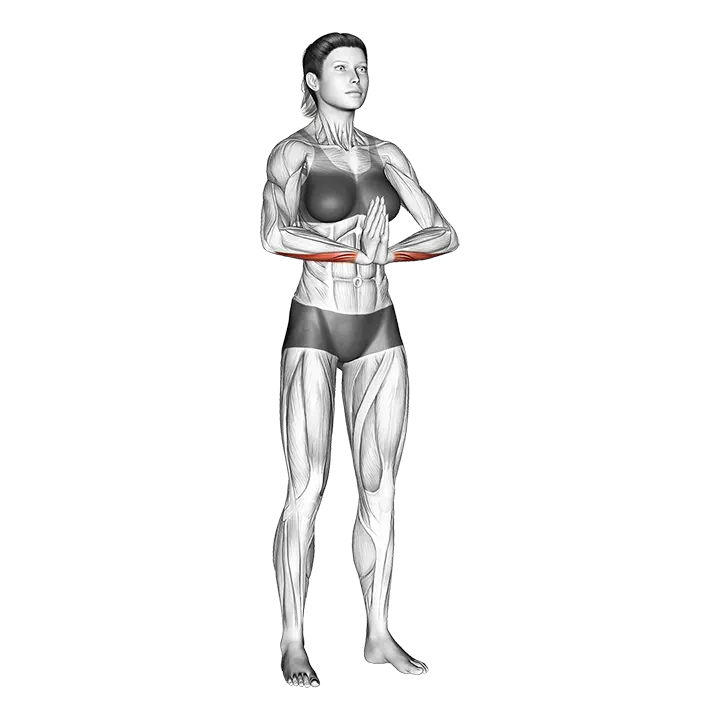
Wrist Flexor Stretch
- Target muscle
- Wrist Flexors
- Equipment
- Body weight
- Body part
- Forearms
- Type
- Stretching

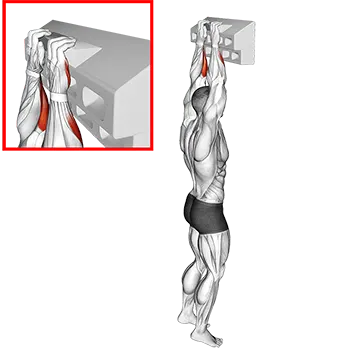
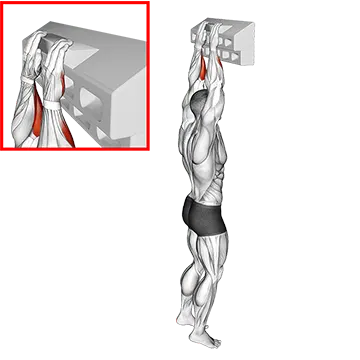

The wrist flexor stretch is a bodyweight stretching exercise that targets the wrist flexors along the inner forearm. It counteracts the tightness that builds from prolonged typing, gripping, and pulling movements, and fits equally well as a warm-up before upper-body training or as a cooldown and desk-break routine.
How to do the Wrist Flexor Stretch
- 1Stand or sit tall with your working arm extended straight in front of you at shoulder height, palm facing up.
- 2With your free hand, grasp the fingers of the extended hand and gently pull them down toward the floor and back toward your body, extending the wrist so the palm turns to face away from you.
- 3Keep your elbow fully extended so the stretch travels through the entire length of the forearm rather than bending at the joint.
- 4Apply only light, steady pressure — you should feel a moderate pull along the inner forearm, not sharp pain.
- 5Hold the stretch for 20–30 seconds while breathing slowly and letting the tissue relax into the position.
- 6Release gradually, lower your arm, and give your wrist a brief shake to clear tension.
- 7Repeat on the opposite side, then perform 2–3 rounds per side.
Form tips
- Keep your shoulder relaxed and level — shrugging the shoulder reduces the stretch on the forearm and loads the neck unnecessarily.
- Apply pressure through the fingers, not the palm, so the stretch is distributed across the entire wrist flexor group rather than concentrated at one point.
- Increase intensity gradually over successive rounds by pulling the fingers slightly further back as the tissue warms up — never force the end range in the first set.
- Breathe steadily throughout the hold; exhaling slowly as you settle into the stretch helps the muscles release more completely.
- If you perform this stretch as a warm-up, use a shorter hold of 10–15 seconds; reserve the full 20–30 second hold for cooldown and maintenance work.
Common mistakes
- Bending the elbow during the hold, which shortens the kinetic chain and removes most of the tension from the wrist flexors — keep the arm fully extended to stretch the full muscle length.
- Jerking or bouncing the fingers back to force a deeper stretch, which triggers the stretch reflex, causes the muscles to contract rather than lengthen, and risks straining the tendons.
- Gripping the palm instead of the fingers, which concentrates force at the wrist joint rather than distributing it along the forearm musculature and can cause joint discomfort.
- Rotating the torso away from the extended arm to compensate for limited range of motion, which gives a false sense of depth while reducing the actual stretch on the target muscles.
- Holding for only a few seconds and moving on, which does not give the wrist flexors enough time to relax and lengthen — holds under 15 seconds produce minimal lasting change in tissue extensibility.
Frequently asked questions
What muscles does the wrist flexor stretch target?
The stretch targets the wrist flexors — the group of muscles running along the inner (palmar) side of the forearm, including the flexor carpi radialis, flexor carpi ulnaris, and palmaris longus. These muscles control wrist flexion and are commonly tight in people who type, grip tools, or perform pulling movements regularly.
How long should I hold the wrist flexor stretch?
Hold each repetition for 20–30 seconds. Research on static stretching consistently shows that holds shorter than 15 seconds produce little lasting change in muscle extensibility, while 20–30 seconds allows the tissue to relax and lengthen. If you are stretching before training, keep holds to 10–15 seconds to avoid excessive relaxation of the tissue before loading it.
When should I do wrist flexor stretches?
Wrist flexor stretches work well as a light warm-up before upper-body sessions, as a cooldown after pulling or grip-intensive work, and as a desk break during long periods of typing or mouse use. For people with chronic forearm tightness, a daily session of 2–3 rounds per side in the morning can meaningfully improve baseline flexibility over several weeks.
Is it normal to feel tingling during the wrist flexor stretch?
Mild tingling in the fingers can occur if the stretch compresses nerves running alongside the flexor tendons, particularly the median nerve. If this sensation is faint and resolves immediately when you release, it is typically harmless. However, strong tingling, numbness, or pain that radiates up the arm suggests you are applying too much pressure or stretching at an angle that stresses the nerve — ease off the intensity and consult a healthcare professional if the sensation persists.
How often should I stretch my wrist flexors?
For general maintenance and desk-break relief, stretching once or twice a day is sufficient. If you are working through chronic forearm tightness or recovering from a grip-heavy training block, two to three short sessions per day spread across the day are more effective than a single long session. Allow at least a few hours between sessions so the tissue can recover from the mechanical stimulus.