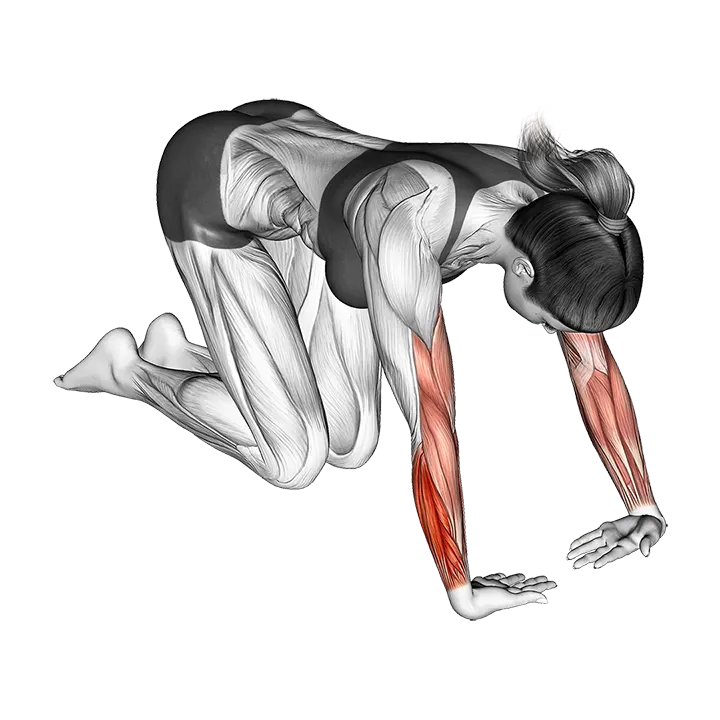
Wrist Radial Deviator And Extensor Stretch
- Target muscle
- —
- Equipment
- Body weight
- Body part
- Forearms
- Type
- Stretching
The Wrist Radial Deviator And Extensor Stretch is a bodyweight forearm stretching exercise that lengthens the muscles along the back and radial (thumb) side of the forearm — the wrist extensors and radial deviators. It is commonly used to relieve forearm tightness, reduce repetitive-strain discomfort, and maintain wrist mobility for pressing, pulling, and racquet sports.
How to do the Wrist Radial Deviator And Extensor Stretch
- 1Stand or sit upright with your arm extended in front of you at roughly shoulder height, palm facing down.
- 2Gently curl your fingers and wrist downward so the back of your hand faces forward and your fingers point toward the floor.
- 3With your free hand, lightly grasp the back of the stretched hand and guide it into further wrist flexion and slight ulnar deviation (toward the pinky side), until you feel a comfortable pull along the back and thumb side of the forearm.
- 4Hold the stretch for 20–30 seconds, breathing steadily and allowing the forearm muscles to relax into the position.
- 5Release slowly and return the wrist to neutral.
- 6Repeat on the other side.
Form tips
- Work within a pain-free range — a mild pulling sensation in the forearm is normal, but sharp or pinching pain in the wrist joint means you should ease off.
- Keep the elbow of the stretched arm nearly straight to maximize the stretch along the forearm extensors; a bent elbow reduces the effect.
- Perform this stretch after forearm-intensive work (rows, deadlifts, tennis, typing) when the tissues are warm and pliable.
- Breathe out as you apply the overpressure with your free hand — exhaling helps the muscles release passively.
Common mistakes
- Forcing the wrist into a deeper bend too quickly, which can irritate the wrist joint rather than stretch the forearm muscles — progress gently over several seconds.
- Only bending the wrist straight down without adding ulnar deviation, so the radial deviators (ECRL/ECRB) never get lengthened and half the target is missed.
- Holding the breath during the hold, which increases muscle tension and makes the stretch less effective.
- Skipping the stretch on the non-dominant arm — forearm tightness is often bilateral, especially with keyboard or grip-heavy work.
Frequently asked questions
What muscles does the Wrist Radial Deviator And Extensor Stretch target?
It lengthens the wrist extensor group (extensor carpi radialis longus and brevis, extensor digitorum) and the radial deviators along the back and thumb side of the forearm.
When should I do this stretch?
After sessions involving heavy gripping, pulling, or pressing — such as deadlifts, rows, or climbing — and after prolonged keyboard or mouse use. Avoid stretching a cold, unwarmed forearm aggressively.
How long should I hold the Wrist Extensor Stretch?
Hold each side for 20–30 seconds and repeat 2–3 times per arm. Consistent daily stretching for a few weeks produces the most noticeable improvement in wrist mobility and forearm tension.
Is this stretch useful for tennis elbow or repetitive strain?
It is commonly prescribed as part of conservative management for lateral epicondylalgia (tennis elbow), but severity varies — consult a physiotherapist if you have diagnosed tendon pain before adding stretching to your routine.
Why does this stretch combine wrist flexion with ulnar deviation?
The radial wrist extensors (ECRL and ECRB) both extend the wrist and deviate it toward the thumb. Flexing the wrist lengthens their extensor action, while ulnar deviation (tilting toward the pinky) lengthens their deviator action, so combining both stretches them more completely than flexion alone.







