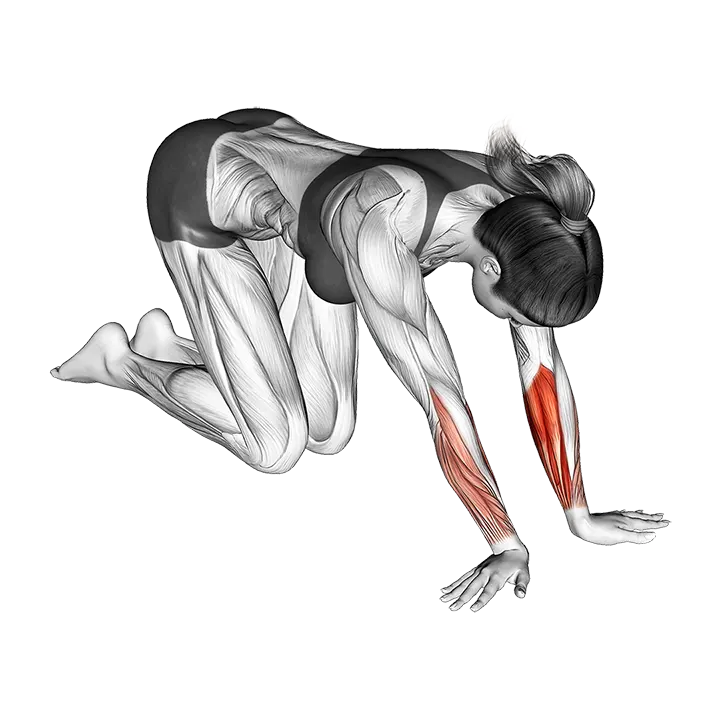
Wrist Radial Deviator And Flexor Stretch
- Target muscle
- —
- Equipment
- Body weight
- Body part
- Forearms
- Type
- Stretching
Wrist Radial Deviator And Flexor Stretch is a static forearm stretch that simultaneously targets the radial deviators and flexor muscles of the wrist by extending and ulnar-deviating the hand while the opposite hand supplies gentle overpressure. It is particularly useful for desk workers, climbers, and racket-sport athletes who repeatedly load the wrist in flexion and radial deviation, and it requires no equipment beyond your own bodyweight.
How to do the Wrist Radial Deviator And Flexor Stretch
- 1Stand or sit upright and extend one arm straight in front of you at roughly shoulder height, elbow fully locked out.
- 2Rotate your forearm so your palm faces upward (supinated position).
- 3Relax your wrist and let gravity begin to extend it so your fingers drop toward the floor.
- 4With your free hand, gently grasp the back of the fingers on the stretching arm.
- 5Apply light downward pressure with your free hand to deepen the wrist extension.
- 6While maintaining that extension, guide the hand slightly toward the little-finger side — this is the ulnar deviation that stretches the radial deviators.
- 7Hold the end position for 20–30 seconds, breathing steadily and allowing the forearm muscles to relax into the stretch.
- 8Release the overpressure gradually, return your wrist to neutral, and repeat on the opposite arm.
Form tips
- Keep the elbow of the stretching arm fully extended throughout — bending it releases tension on the forearm muscles and reduces the stretch.
- Apply overpressure gradually; the sensation should be mild to moderate tension, not sharp or shooting pain.
- Breathe slowly and consciously during the hold — holding your breath increases overall muscle tension and prevents the tissue from relaxing.
- Keep the shoulder of the stretching arm relaxed and slightly pulled down from your ear; shrugging shortens the range available at the wrist.
- Set the wrist extension first, then layer in the tilt toward the little finger — stacking the two angles in that order targets the radial deviators without forcing either component to its extreme.
Common mistakes
- Bending the elbow during the stretch, which offloads the forearm flexors and significantly reduces effectiveness — keep the arm straight.
- Using aggressive overpressure from the start rather than easing in gradually, which can irritate the wrist joint capsule and tendons instead of stretching the muscles.
- Omitting ulnar deviation and treating this as a plain wrist flexor stretch — without guiding the hand toward the little-finger side, the radial deviators receive little to no lengthening.
- Holding the position for fewer than 15 seconds — static stretches require at least 15–30 seconds for meaningful tissue relaxation.
- Stretching into pain rather than tension — discomfort that radiates up the forearm or into the fingers is a signal to reduce the range immediately.
Frequently asked questions
What muscles does the wrist radial deviator and flexor stretch target?
The stretch primarily targets the forearm flexors (including flexor carpi radialis) and the radial deviators (including extensor carpi radialis longus and brevis). By combining wrist extension with ulnar deviation, it lengthens both muscle groups in a single position rather than isolating one at a time.
How long should I hold the wrist radial deviator and flexor stretch?
Hold each side for 20–30 seconds per rep and perform 2–3 reps per side. Research on static stretching generally supports holds of at least 15–30 seconds to achieve meaningful tissue relaxation, with diminishing returns beyond 60 seconds.
When is the best time to do this stretch — before or after exercise?
Static stretches like this one are best performed after activity when the tissue is warm, or as part of a dedicated mobility session. Stretching cold muscle before exercise has not been shown to reduce injury risk and may temporarily reduce force output. A dynamic wrist warm-up is a better pre-workout choice.
Can this stretch help relieve wrist pain from typing or desk work?
Regularly stretching the forearm flexors and radial deviators can reduce cumulative tension built up from repetitive wrist-flexion and radial-deviation tasks such as typing or mouse use. However, persistent or sharp wrist pain should be evaluated by a clinician before relying on stretching alone as a remedy.
How is this different from a standard wrist flexor stretch?
A standard wrist flexor stretch extends the wrist with the palm facing forward, targeting the flexor group along the underside of the forearm. This variation adds ulnar deviation — angling the hand toward the little finger — which also places the radial deviators on stretch, making it a two-in-one movement for the thumb-side forearm musculature.







