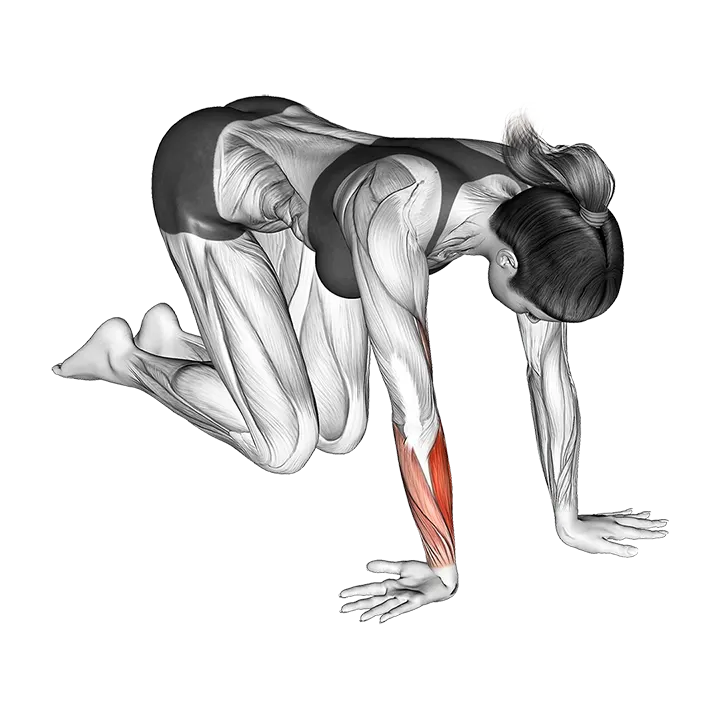
Wrist Ulnar Deviator And Extensor Stretch
- Target muscle
- —
- Equipment
- Body weight
- Body part
- Forearms
- Type
- Stretching
The wrist ulnar deviator and extensor stretch targets the ulnar deviator muscles and wrist extensors along the forearm, lengthening the tissues that run along the outer and back of the wrist. Performed with body weight only, it is a useful addition to warm-ups, cool-downs, or recovery sessions for anyone who spends extended time gripping, typing, or performing overhead work.
How to do the Wrist Ulnar Deviator And Extensor Stretch
- 1Stand or sit upright with your working arm extended in front of you at roughly chest height, elbow straight but not locked.
- 2Turn your palm to face downward so the back of your hand faces the ceiling.
- 3With your free hand, gently grasp the back of the fingers of your extended hand.
- 4Slowly bend your wrist downward — curling the fingers toward the floor — until you feel a mild stretch along the top and outer side of your forearm.
- 5At the same time, guide the hand slightly toward the thumb side (radial deviation) to increase the tension on the ulnar deviators along the outer forearm.
- 6Hold the stretched position for 20 to 30 seconds, breathing steadily and allowing the forearm muscles to relax into the stretch.
- 7Release the hand slowly and return the wrist to a neutral position.
- 8Switch arms and repeat the same sequence on the other side.
Form tips
- Use your free hand to guide the stretch passively — do not force the wrist into a painful range; a mild pulling sensation is enough.
- Keep your elbow fully extended throughout the hold; bending the elbow will reduce tension on the wrist extensors.
- Relax your fingers and hand rather than tensing them, as gripping actively during the stretch reduces how far the target muscles can lengthen.
- Move into the stretch position slowly and avoid any quick, jerking motion at the wrist joint.
- If you feel sharp or shooting pain rather than a dull pulling sensation, ease out of the stretch immediately and consult a healthcare professional before continuing.
Common mistakes
- Bending the elbow during the stretch, which slackens the extensor tendons and removes most of the lengthening effect from the target muscles.
- Forcing the wrist into maximum range immediately, which can irritate the wrist joint and surrounding tendons rather than producing a productive stretch.
- Holding the stretch for only a few seconds — shorter holds do not give the muscle sufficient time to relax and lengthen; aim for at least 20 seconds.
- Neglecting the ulnar-deviation component by pulling the hand straight down rather than also guiding it toward the thumb side, which reduces the stretch on the ulnar deviators.
- Tensing the hand and gripping with the fingers during the hold, which creates active muscle contraction and counteracts the passive lengthening you are trying to achieve.
Frequently asked questions
What does the wrist ulnar deviator and extensor stretch target?
It primarily targets the ulnar deviator muscles and wrist extensors located along the outer and dorsal side of the forearm. These muscles control side-to-side wrist movement and wrist extension, and they are commonly tight in people who type, grip tools, or perform repetitive arm movements.
When should I do this stretch?
It works well as part of a warm-up before grip-intensive training such as deadlifts, rows, or climbing, and as a cool-down or recovery stretch afterward. It can also be done during prolonged typing or computer work to relieve forearm tension.
How long should I hold the stretch?
Hold each side for 20 to 30 seconds to allow the muscles and connective tissue time to relax into the lengthened position. Two to three rounds per arm is a reasonable starting point.
Who benefits most from this stretch?
It is particularly useful for office workers, climbers, weightlifters, racquet sport players, and anyone who performs repetitive wrist or forearm movements. People recovering from mild forearm tightness or tennis elbow may also find it helpful, though they should clear any rehabilitation stretching with a physiotherapist first.
Are there alternatives to this stretch?
A standard wrist extensor stretch — palm facing down, fingers bent toward the floor — is a close alternative that emphasizes the extensors without the ulnar-deviation component. Wrist circles and forearm foam rolling can also complement this stretch for broader forearm mobility work.







