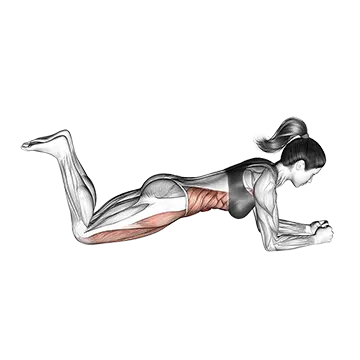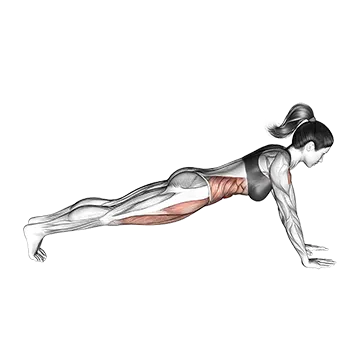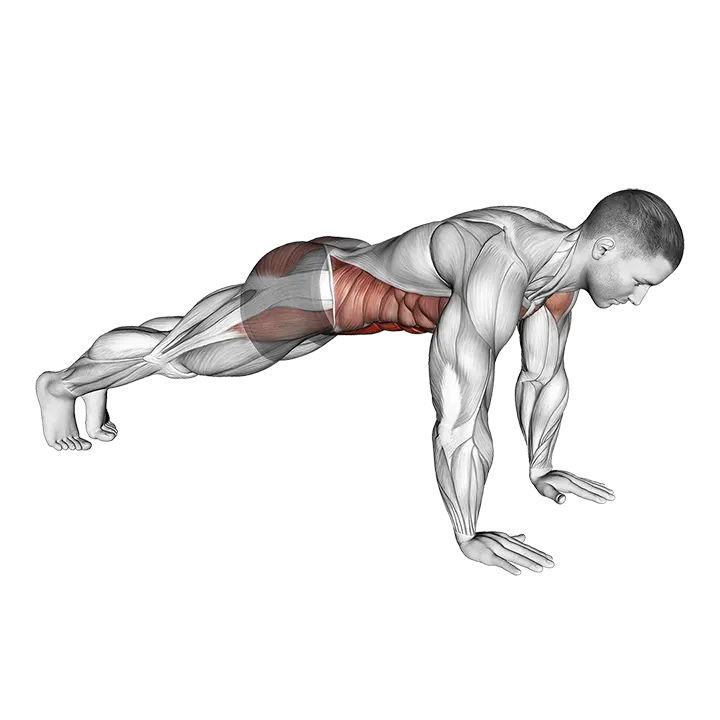
Plank on Hands
- Zielmuskel
- Rectus Abdominis
- Synergistenmuskeln
- Deltoid Anterior, Gluteus Maximus, Obliques, Pectoralis Major Clavicular Head, Pectoralis Major Sternal Head, Serratus Anterior, Tensor Fasciae Latae
- Equipment
- Body weight
- Körperregion
- Waist
- Typ
- Strength




The Plank on Hands is a bodyweight core-stability exercise that primarily targets the rectus abdominis, with significant support from the obliques, anterior deltoids, pectoralis major (both clavicular and sternal heads), serratus anterior, gluteus maximus, and tensor fasciae latae. Performed in a straight-arm position — the top of a push-up hold — it builds isometric core strength and full-body tension without any equipment.
Plank on Hands: So führst du sie aus
- 1Start on all fours with your hands directly under your shoulders, fingers spread wide and pressing firmly into the floor.
- 2Step your feet back one at a time until your body forms a straight line from head to heels, resting on the balls of your feet.
- 3Lock your elbows fully and push the floor away so your shoulder blades spread slightly apart, engaging the serratus anterior.
- 4Brace your core hard as if bracing for a punch, drawing your navel gently toward your spine without holding your breath.
- 5Squeeze your glutes and press your heels back to keep your hips level — neither sagging toward the floor nor piking up toward the ceiling.
- 6Keep your head in a neutral position, gaze at a spot on the floor about 30 cm in front of your hands.
- 7Breathe steadily in and out while maintaining full-body tension throughout the hold.
- 8When the set is complete, lower your knees to the floor with control.
Technik-Tipps
- Think of your body as a rigid plank of wood — any sag or pike breaks the tension and reduces core engagement.
- Push actively through your palms as if trying to slide them apart; this activates the serratus anterior and stabilizes the shoulder blades.
- Keep your neck neutral by looking slightly ahead of your hands, not tucked to your chest or craned upward.
- Start with shorter holds (15–20 seconds) and build duration gradually rather than sacrificing form to hit a longer time.
Häufige Fehler
- Letting the hips sag toward the floor, which dumps load onto the lower back instead of the core and can cause lumbar strain.
- Piking the hips up toward the ceiling, which reduces core tension and shifts the work away from the rectus abdominis.
- Holding your breath, which spikes intra-abdominal pressure and shortens the time you can hold the position.
- Placing hands too far forward of the shoulders, which destabilizes the wrist and shoulder joints and shifts the load off the core.
- Letting the head drop or jut forward, which creates neck tension and breaks the neutral-spine alignment the exercise depends on.
Häufig gestellte Fragen
What muscles does the Plank on Hands work?
The primary target is the rectus abdominis. The obliques, anterior deltoids, clavicular and sternal heads of the pectoralis major, serratus anterior, gluteus maximus, and tensor fasciae latae all act as synergists to maintain the straight-arm position.
What is the difference between the Plank on Hands and the forearm plank?
The Plank on Hands is held at full arm extension (the top of a push-up), which adds more demand on the anterior deltoids, pectorals, and serratus anterior. The forearm plank places the elbows on the ground and typically feels more stable, making it a common starting point for beginners.
Is the Plank on Hands good for beginners?
Yes, it is a beginner-accessible exercise requiring no equipment. Start with holds of 15–20 seconds and rest as needed, focusing on a flat back and steady breathing before increasing duration.
How long should I hold the Plank on Hands?
A useful working range is 20–60 seconds per set for 2–4 sets. Quality of position matters more than raw time — stop the set when your hips sag or your form breaks down, regardless of the clock.
Where should I feel the Plank on Hands?
You should feel steady tension across your entire core — particularly the front of your abdomen — along with your glutes and the backs of your upper arms. If you feel it mainly in your lower back, your hips are likely sagging; reset your position.