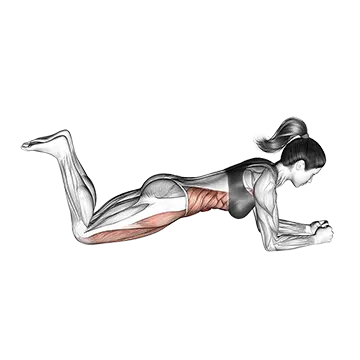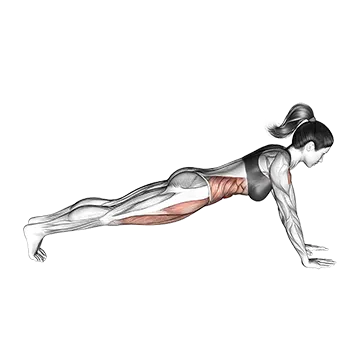
Quarter Sit-up
- Zielmuskel
- Rectus Abdominis
- Synergistenmuskeln
- Obliques
- Equipment
- Body weight
- Körperregion
- Waist
- Typ
- Strength




The Quarter Sit-up is a bodyweight core exercise that targets the rectus abdominis with support from the obliques. By limiting the range of motion to roughly 25–30 degrees, it keeps constant tension on the abs while reducing strain on the hip flexors and lower back, making it a solid choice for building foundational core strength.
Quarter Sit-up: So führst du sie aus
- 1Lie on your back on a flat surface with your knees bent and feet flat on the floor, hip-width apart.
- 2Cross your arms over your chest or place your fingertips lightly behind your ears — do not pull on your neck.
- 3Press your lower back gently into the floor to establish a neutral spine.
- 4Take a breath in, then exhale and brace your core as if bracing for a punch.
- 5Curl your head, neck, and shoulders off the floor by contracting your abs, lifting only until your shoulder blades clear the surface — roughly 25–30 degrees.
- 6Pause for one count at the top, keeping the tension in your abdominals.
- 7Inhale and slowly lower yourself back to the starting position under control.
- 8Repeat for the desired number of repetitions without letting your head fully drop to the floor between reps.
Technik-Tipps
- Keep your chin slightly tucked as if holding a tennis ball under it — this protects your neck and keeps the movement driven by your abs.
- Focus on shortening the distance between your ribs and your hips rather than trying to sit up tall; that cue keeps the rectus abdominis doing the work.
- Control the lowering phase — taking 2–3 seconds on the way down doubles the time under tension without adding any reps.
- Exhale on the way up and inhale on the way down; matching your breath to the movement helps you brace properly and maintain rhythm.
- Keep your feet flat and unanchored; anchoring your feet shifts load onto the hip flexors and away from the abs.
Häufige Fehler
- Pulling on the neck: Clasping hands behind the head and yanking the chin forward strains the cervical spine and removes tension from the abs — use the abs to initiate the movement, not arm momentum.
- Rising too high: Lifting past the point where the shoulder blades clear the floor turns the quarter sit-up into a partial crunch or sit-up, recruiting the hip flexors and reducing the intended stimulus on the rectus abdominis.
- Losing lower-back contact at the bottom: Allowing the lumbar spine to arch away from the floor between reps reduces core stability and can create shear stress on the lower back — maintain light contact throughout.
- Moving too fast: Using momentum rather than muscular control shortens the effective range and reduces tension on the target muscles; slow, deliberate repetitions produce better results.
- Holding the breath: Failing to exhale on the way up raises intra-abdominal pressure unnecessarily and prevents the abs from contracting fully — breathe consistently with each rep.
Häufig gestellte Fragen
What muscles does the quarter sit-up work?
The quarter sit-up primarily works the rectus abdominis — the muscle that runs vertically down the front of your abdomen. The obliques act as synergists, helping stabilize the torso throughout the movement.
What is the difference between a quarter sit-up and a full sit-up?
A full sit-up brings your torso all the way up until your chest is near your knees, which heavily involves the hip flexors. The quarter sit-up stops once your shoulder blades leave the floor, keeping the emphasis on the rectus abdominis and taking most hip-flexor involvement out of the equation.
Is the quarter sit-up good for beginners?
Yes. The limited range of motion makes it more accessible than a full sit-up, and the lower mechanical load on the lower back and hip flexors means beginners can learn proper bracing and core-activation technique before progressing to more demanding variations.
How many quarter sit-ups should I do per set?
A common starting point is 3 sets of 12–15 reps with controlled tempo. Once you can complete those sets with good form and no neck strain, you can increase reps, add a pause at the top, or slow the lowering phase before moving to a harder variation.
Can the quarter sit-up help reduce belly fat?
No single exercise reduces fat in a specific area. The quarter sit-up builds and strengthens the rectus abdominis and obliques, which can improve core definition, but fat loss comes from an overall calorie deficit through diet and exercise — not from targeted ab work.