
Bodyweight Standing Calf Raise
- Músculo objetivo
- Gastrocnemius
- Músculos sinergistas
- Soleus
- Equipamiento
- Body weight
- Parte del cuerpo
- Calves
- Tipo
- Strength

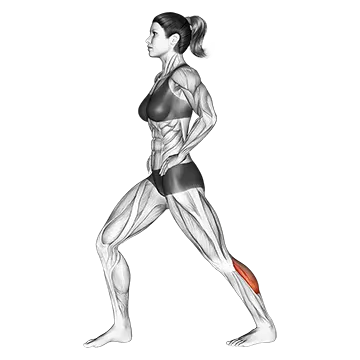




The bodyweight standing calf raise is a simple lower-leg strength exercise that primarily targets the gastrocnemius, the large muscle on the back of your calf, with the soleus assisting underneath. Performed by rising onto the balls of your feet with no equipment, it builds calf strength, ankle stability, and endurance, and works well as a warm-up, finisher, or daily mobility staple.
Cómo hacer el Bodyweight Standing Calf Raise
- 1Stand tall with your feet hip-width apart and your weight balanced evenly over the balls of your feet.

- 2Keep your knees straight but not locked, brace your core, and rest your hands lightly on a wall or rail for balance if needed.
- 3Press through the balls of your feet and lift your heels as high as you can, rising onto your toes.
- 4Pause at the top and squeeze your calves for a brief moment with your ankles fully extended.
- 5Lower your heels back down slowly and under control until they touch the floor.

- 6For a deeper stretch, stand with the balls of your feet on a step and let your heels drop just below the edge before each rep.
- 7Complete your reps, then step down and relax.
Consejos de técnica
- Move through the fullest range you can — heels as high as possible at the top, fully lowered at the bottom — to train the calf end to end.
- Use a slow, controlled tempo rather than bouncing, so the muscle does the work instead of momentum.
- Keep your knees straight to bias the gastrocnemius; bending the knees shifts more load to the soleus.
- Use a wall or rail only for balance, not to pull yourself up, so your calves do all the lifting.
Errores comunes
- Bouncing quickly through reps, which uses momentum and tendon recoil instead of muscular tension, reducing the training effect.
- Cutting the range of motion short by not lifting the heels fully or not lowering all the way, which leaves the calf undertrained.
- Letting the ankles roll outward onto the little-toe side, which is unstable and can strain the ankle.
- Leaning heavily on the wall or rail for support, which transfers the work away from the calves.
Preguntas frecuentes
What muscles does the bodyweight standing calf raise work?
It primarily works the gastrocnemius, the prominent muscle on the back of the calf, with the soleus underneath assisting. Keeping the knees straight emphasizes the gastrocnemius.
Is the bodyweight standing calf raise good for beginners?
Yes. It needs no equipment, is low-risk, and is easy to scale by adjusting reps or range of motion, making it a great starting point for building calf strength.
Should I do calf raises on the floor or on a step?
Both work. The floor is simplest, while standing on a step lets your heels drop below the edge for a deeper stretch and a fuller range of motion.
How many sets and reps should I do?
Because calves respond well to volume, aim for 3–4 sets of 15–25 slow, controlled reps. Add reps or a deficit step as they get easier.