
Lateral Side Plank
- Target muscle

- Gluteus Medius, Tensor Fasciae Latae
- Synergist muscles
- Iliopsoas, Obliques, Quadriceps
- Equipment
- Body weight
- Body part
- Hips
- Type
- Strength
The lateral side plank is a bodyweight hip-abductor exercise that directly targets the gluteus medius and tensor fasciae latae, with meaningful support from the iliopsoas, obliques, and quadriceps. Performed on your side in a plank position, it builds lateral hip strength, pelvic stability, and resistance to hip drop — making it a key drill for runners, lifters, and anyone working to correct hip imbalances.
How to do the Lateral Side Plank

- 1Lie on your side on a mat with your legs stacked and your forearm placed flat on the floor, elbow directly beneath your shoulder.
- 2Extend your top arm along your side or rest your hand on your hip to keep your torso from rotating.
- 3Brace your core and press through your forearm to lift your hips off the floor until your body forms a straight line from head to feet.
- 4Drive your bottom hip upward, actively contracting the gluteus medius to lift and hold the position — do not let the hip sag.
- 5Keep your feet stacked or stagger the top foot slightly in front for additional balance if needed.
- 6Hold the position for the prescribed duration, breathing steadily, without letting your hips pike upward or drop toward the floor.
- 7Lower your hips back to the mat in a controlled manner, then repeat on the opposite side.
Form tips
- Think about pushing the floor away with your forearm rather than just holding still — this activates the shoulder girdle and keeps the working hip elevated.
- Stack your hips vertically and avoid letting the top hip roll forward; a slight internal rotation at the pelvis can reduce gluteus medius engagement.
- Squeeze the glute of the bottom leg throughout the hold to reinforce lateral hip stability and maximize target-muscle activation.
- Keep your neck neutral — do not crane it upward or let it drop; your head should follow the line of your spine.
- If the full plank is too demanding, perform the hold from your knee (bent-knee side plank) to build base strength before progressing.
Common mistakes
- Letting the bottom hip sag toward the floor: this removes tension from the gluteus medius and places excessive stress on the shoulder and lumbar spine.
- Piking the hips too high: compensating with lateral trunk flexion instead of hip abductor strength reduces the training stimulus to the target muscles.
- Allowing the torso to rotate forward or backward: rotation shifts load off the hip abductors and destabilizes the lumbar spine.
- Placing the elbow too far in front of or behind the shoulder: misaligning the support arm reduces stability and can strain the shoulder joint.
- Holding the breath: breath-holding spikes intra-abdominal pressure and accelerates fatigue; breathe steadily throughout the hold.
Frequently asked questions
What muscles does the lateral side plank work?
The lateral side plank primarily targets the gluteus medius and tensor fasciae latae — the hip abductors responsible for preventing hip drop. The iliopsoas, obliques, and quadriceps assist in maintaining the straight-line position throughout the hold.
How long should I hold a lateral side plank?
Beginners can start with 15–20-second holds per side and work up to 45–60 seconds as strength improves. For endurance-focused training, accumulate 2–3 minutes per side across multiple sets rather than chasing a single long hold with poor form.
What is the difference between a side plank and a lateral side plank?
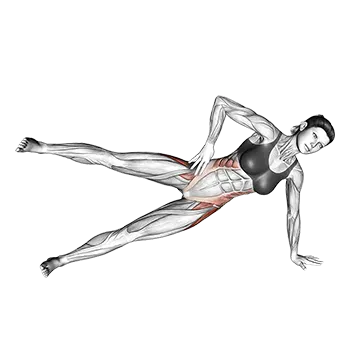
The terms are often used interchangeably, but a lateral side plank emphasizes keeping the body in strict lateral alignment to maximize gluteus medius activation. Some variations add a hip abduction raise (lifting the top leg) to increase the lateral demand further.
Can the lateral side plank help with hip pain or knee pain?
Strengthening the gluteus medius through exercises like the lateral side plank can reduce excessive hip drop during gait and loading activities, which is linked to both hip and knee pain. It is commonly used in rehabilitation for IT band syndrome, patellofemoral pain, and hip instability — consult a physiotherapist if you have an existing injury.
Is the lateral side plank good for beginners?
Yes. Beginners can scale it by performing the hold from the knees (bent-knee side plank) instead of the feet, which shortens the lever arm and reduces the load. Progress to the full version once you can hold the modified position for 30–45 seconds with good form.