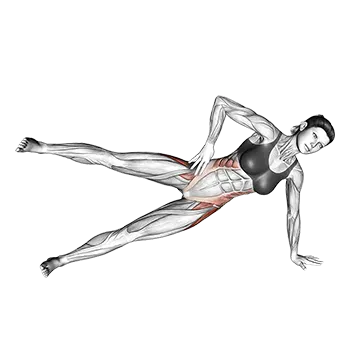
Lateral Side Plank (bent leg)
- Target muscle
- Gluteus Medius, Tensor Fasciae Latae
- Synergist muscles
- Iliopsoas, Obliques
- Equipment
- Body weight
- Body part
- Hips
- Type
- Strength
The Lateral Side Plank (bent leg) is a bodyweight strength exercise that targets the gluteus medius and tensor fasciae latae while engaging the iliopsoas and obliques as synergists. By bending the bottom knee, it reduces the lever arm and makes the movement accessible for beginners or those building hip stability. It is ideal for strengthening the lateral hip chain and improving frontal-plane stability.
How to do the Lateral Side Plank (bent leg)
- 1Lie on your side on a mat with your bottom knee bent to approximately 90 degrees and your top leg extended straight.
- 2Place your bottom forearm on the mat directly beneath your shoulder, elbow at 90 degrees, forearm pointing forward.
- 3Stack your top hip directly over your bottom hip so your body forms a straight diagonal line from your head to your top foot.
- 4Brace your core and squeeze your glutes, then press through your forearm and bent knee to lift your hips off the mat.
- 5Drive your top hip upward until your head, shoulders, hips, and top leg form a straight lateral line — do not let your hips sag or pike.
- 6Keep your top arm resting along your side or place your hand on your hip to help maintain balance.
- 7Hold the position for the prescribed duration, breathing steadily without letting your hips drop.
- 8Lower your hips back to the mat under control to complete one rep or one timed set.
- 9Switch sides and repeat for the same duration or number of reps.
Form tips
- Press the side of your bent knee firmly into the mat — this activates the gluteus medius more effectively than simply resting on it.
- Keep your neck neutral by looking straight ahead rather than up or down at the floor.
- Imagine pushing the floor away with your forearm to create tension through the entire lateral chain.
- Rotate your top hip slightly forward if you feel your hips rolling open; this helps stack them directly on top of each other.
- Progress hold time gradually — even 5-second increments build significant hip stability over time.
Common mistakes
- Letting the hips sag toward the floor: this removes tension from the gluteus medius and tensor fasciae latae, making the exercise far less effective and stressing the lumbar spine.
- Allowing the hips to pike upward: hiking the hips too high shifts the load away from the target muscles and creates an unstable, compensated position.
- Placing the elbow too far from the shoulder: an elbow that juts out in front of or behind the shoulder causes shoulder discomfort and reduces stability.
- Holding the breath: breath-holding spikes intra-abdominal pressure and accelerates fatigue; breathe steadily throughout the hold.
- Rushing through the set without full hip elevation: partial lifts fail to load the gluteus medius and obliques through their effective range, limiting strength gains.
Frequently asked questions
What is the difference between the bent-leg and straight-leg side plank?
Bending the bottom knee shortens the lever arm, reducing the load on the hips and obliques. This makes the bent-leg version more accessible for beginners or anyone who struggles to hold a full side plank. Once you can hold the bent-leg version for 45–60 seconds with good form, you can progress to the straight-leg variation.
How long should I hold a lateral side plank (bent leg)?
Beginners should aim for 15–20 seconds per side and build up to 45–60 seconds over several weeks. For strength endurance, perform 2–3 sets per side. Quality matters more than duration — stop the set the moment your hips begin to sag.
Can the lateral side plank (bent leg) help with hip pain?
Strengthening the gluteus medius and tensor fasciae latae through this exercise can improve lateral hip stability, which is often linked to conditions like IT band syndrome and hip abductor weakness. However, if you have existing hip pain, consult a healthcare professional before adding this movement to your routine.
Which muscles does the lateral side plank (bent leg) work?
The primary muscles targeted are the gluteus medius and tensor fasciae latae, which are responsible for hip abduction and frontal-plane stability. The iliopsoas and obliques act as synergists, helping to stabilize the pelvis and spine throughout the hold.
How often should I do the lateral side plank (bent leg)?
For most people, 2–4 sessions per week is sufficient. Because this is an isometric stability exercise rather than a heavy load movement, it recovers quickly and can be included in warm-ups, core circuits, or as accessory work on both upper- and lower-body training days.