Straight Leg Outer Hip Abductor
- Target muscle



- Gluteus Medius, Tensor Fasciae Latae
- Equipment
- Body weight
- Body part
- Hips
- Type
- Strength

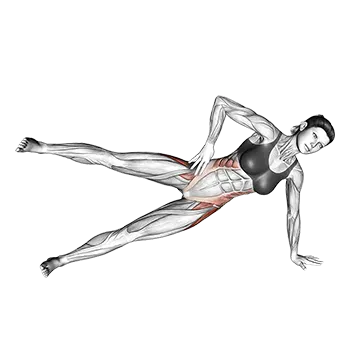
The Straight Leg Outer Hip Abductor is a bodyweight floor exercise that isolates the gluteus medius and tensor fasciae latae by lifting a fully extended leg away from the midline of the body. Performed lying on your side, it builds lateral hip strength and stability that supports walking, running, and single-leg movements. It is beginner-friendly and requires no equipment.
How to do the Straight Leg Outer Hip Abductor
- 1Lie on your side on a mat with your body in a straight line from head to feet, stacking your hips directly on top of each other.
- 2Rest your head on your bottom arm or prop it up on your hand for support, and place your top hand lightly on the floor in front of your chest for balance.
- 3Extend both legs fully and flex your top foot, drawing the toes back toward your shin.
- 4Brace your core to prevent your hips from rolling forward or backward during the movement.
- 5Keeping your top leg completely straight, slowly raise it toward the ceiling as high as you can without rotating your pelvis or hiking your hip.
- 6Pause for a full second at the top of the range of motion, squeezing the outer hip.
- 7Lower your leg back down with control, stopping just before it touches the bottom leg to keep tension on the muscle.
- 8Complete all reps on one side, then roll over and repeat on the other side.
Form tips
- Keep your top hip stacked directly over your bottom hip throughout the set — rolling the pelvis forward or backward turns the move into a hip flexor or glute exercise instead.
- Keep the toes of your top foot pointing straight ahead rather than rotating them up toward the ceiling — external rotation lets the hip flexors take over from the gluteus medius.
- Move slowly — a 2-second lift and 3-second lower puts far more tension on the outer hip than a fast kick.
- Once bodyweight reps feel easy, loop a light resistance band just above your knees to add resistance without changing the movement.
- Breathe out on the way up and in on the way down to stay braced and controlled through every rep.
Common mistakes
- Rolling the pelvis forward to lift the leg higher, which recruits the hip flexors and removes tension from the gluteus medius.
- Bending the knee during the lift, which shortens the lever arm and reduces the demand on the outer hip muscles.
- Letting the top leg drop quickly after each rep, which eliminates the eccentric phase where much of the strength gain occurs.
- Raising the leg too high by hiking the hip, which causes the quadratus lumborum (lower back) to take over and can strain the lumbar spine.
- Holding the breath, which destabilizes the core and allows the torso to wobble, reducing the effectiveness of each rep.
Frequently asked questions
What muscles does the Straight Leg Outer Hip Abductor work?
It primarily targets the gluteus medius and tensor fasciae latae — the muscles on the outer side of the hip responsible for moving the leg away from the midline and stabilizing the pelvis during walking and running.
Is this exercise suitable for beginners?
Yes. It requires no equipment, uses only body weight, and has a straightforward movement pattern. Beginners should focus on slow, controlled reps and make sure the hips stay stacked before adding volume or a resistance band.
How many sets and reps should I do?
A standard starting point is 3 sets of 12–15 reps per side with a slow tempo. Once that feels easy, add a resistance band above the knees or increase to 20 reps per side before moving to weighted variations.
What are good alternatives to this exercise?
Standing hip abductions, clamshells, lateral band walks, and cable hip abductions all target the same muscles. If you want to keep it bodyweight and floor-based, clamshells are the most common substitute.
Why do I feel this in my lower back instead of my outer hip?
This usually means your hips are rolling forward or you are hiking the hip to lift the leg higher. Focus on keeping both hips stacked, limiting the range of motion to what you can control, and engaging your core before each rep.