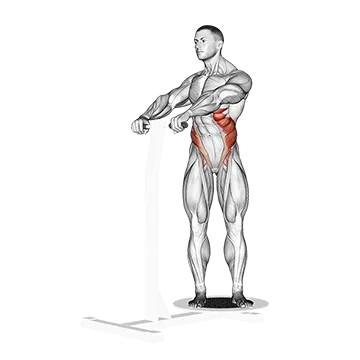
Lever Kneeling Twist
- Target muscle
- Obliques
- Equipment
- Leverage machine
- Body part
- Waist
- Type
- Strength
The Lever Kneeling Twist is a rotational strength exercise performed on a leverage machine that directly targets the obliques. By kneeling and rotating against the machine's resistance, you build rotational core strength and waist definition. It is a controlled, low-impact movement well suited for isolating the obliques without placing heavy axial load on the spine.
How to do the Lever Kneeling Twist
- 1Adjust the leverage machine seat or pad height so the handles sit at shoulder level when you are kneeling upright.
- 2Kneel facing the machine with your knees hip-width apart and your hips stacked directly over your knees.
- 3Grasp the machine handles firmly with both hands, arms extended or slightly bent at a comfortable angle.
- 4Brace your core and establish a tall, neutral spine before initiating any movement.
- 5Exhale and rotate your torso to one side, driving the movement from your obliques rather than your arms or hips.
- 6Pause briefly at the end range of the rotation, feeling the obliques on the working side fully contracted.
- 7Inhale and return slowly to the starting position under control, resisting the weight on the way back.
- 8Complete all reps on one side, then reposition or adjust the machine to work the opposite side.
Form tips
- Initiate the twist from your ribcage, not your arms — your hands should guide the handles, not pull them.
- Keep your hips square and stationary throughout the movement so the obliques bear the load rather than the lower back rotating.
- Move through a full but comfortable range of motion; forcing extra range by collapsing the lower back reduces effectiveness and risks injury.
- Control the return phase — the eccentric portion builds as much oblique strength as the rotation itself.
Common mistakes
- Rotating the hips along with the torso, which reduces oblique isolation and transfers load to the lower back.
- Using arm strength to pull the handles instead of twisting from the core, making the obliques a secondary mover rather than the primary target.
- Selecting too much weight and cutting the range of motion short, which limits oblique development and increases the risk of compensatory movement.
- Holding your breath throughout the set, which spikes blood pressure and makes it harder to keep a steady brace across reps — exhale on the rotation, inhale on the return.
- Letting the machine snap back quickly instead of controlling the eccentric, which eliminates time under tension and reduces muscle engagement.
Frequently asked questions
What muscles does the Lever Kneeling Twist work?
The primary target is the obliques (both internal and external). The kneeling position also requires engagement of the deep core stabilizers to keep the hips steady, but no additional synergist muscles are formally loaded by this movement.
Is the Lever Kneeling Twist good for beginners?
Yes. The leverage machine guides the movement path and makes it easy to control the load, making it beginner-friendly. Start with light resistance to learn proper torso rotation before increasing weight.
How many sets and reps should I do?
For strength and muscle development, 3–4 sets of 10–15 reps per side works well. For endurance and waist conditioning, higher rep ranges of 15–20 with lighter resistance are also effective.
What are good alternatives if I do not have a leverage machine?
Cable woodchops, band rotations, and dumbbell Russian twists all train the obliques through a similar rotational pattern and can be substituted when a leverage machine is unavailable.
Should I feel this in my lower back?
No. If you feel strain in your lower back, reduce the weight and focus on keeping your hips square and your spine neutral. Lower-back discomfort typically means the hips are rotating or the load is too heavy for controlled movement.