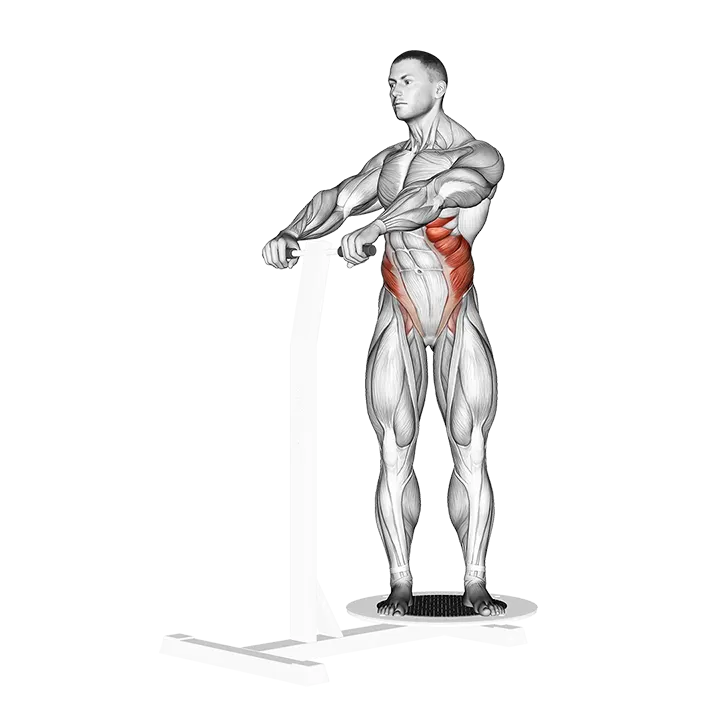
Lever Twist
- Target muscle
- Obliques
- Synergist muscles
- Iliopsoas
- Equipment
- Leverage machine
- Body part
- Waist
- Type
- Strength
The Lever Twist is a machine-based rotational strength exercise that isolates the obliques while recruiting the iliopsoas as a synergist. Performed on a leverage machine, it provides guided resistance through the rotational arc, making it an effective accessory movement for building lateral core strength and improving rotational power. It fits well as a finishing movement in core-focused sessions or as a complement to compound lifts.
How to do the Lever Twist
- 1Adjust the seat height so that the machine's pivot point aligns with your spine at shoulder level when seated upright.
- 2Sit down and secure your feet flat on the footrest or floor to anchor your lower body throughout the movement.
- 3Grasp the handles or pad in front of you with both hands, keeping your elbows slightly bent and your chest tall.
- 4Brace your core and sit upright with a neutral spine — avoid leaning forward or rounding your lower back.
- 5Exhale and rotate your torso to one side in a slow, controlled arc, turning only as far as comfortable range allows without forcing the movement.
- 6Pause briefly at the end of the range of motion to feel the obliques contract on the working side.
- 7Inhale and reverse the rotation in a controlled manner back to the starting position — do not let the resistance snap you back.
- 8Complete all reps on one side, then adjust the machine or switch grip to work the opposite side, or alternate sides per rep depending on machine design.
- 9After completing your set, let the machine return to its resting position and release your grip before standing.
Form tips
- Keep the movement initiated from your torso, not your arms — think of your hands as hooks and let your obliques drive the rotation.
- Control the return phase: a slow, resisted return (2–3 seconds) produces more time under tension and greater muscle stimulus than letting the machine pull you back.
- Keep your hips and lower body completely still throughout the set — anchoring the pelvis ensures the obliques do the work, not momentum.
- Use a lighter load that allows a full, pain-free range of motion; heavy loading on a restricted arc defeats the purpose of a rotational exercise.
- Breathe rhythmically — exhale on the rotation effort and inhale on the return — to maintain intra-abdominal pressure and protect the spine.
Common mistakes
- Using momentum to swing the weight: jerking into the rotation reduces oblique activation and puts shearing stress on the lumbar spine.
- Rotating too far past comfortable range: forcing the machine beyond natural end range can strain the spinal facet joints and surrounding soft tissue.
- Letting the hips twist along with the torso: hip rotation shifts the load away from the obliques and reduces the effectiveness of the exercise.
- Gripping the handles too tightly and pulling with the arms: this recruits the lats and arms instead of isolating the obliques, undermining the intent of the movement.
- Using excessive weight too soon: heavy loads tempt you into compensating with momentum and poor posture, increasing injury risk while limiting oblique development.
Frequently asked questions
What muscles does the Lever Twist work?
The Lever Twist primarily targets the obliques — both internal and external — which are responsible for rotating and laterally flexing the torso. The iliopsoas assists as a synergist: it attaches from the lumbar spine to the femur, so it helps anchor your pelvis and trunk against the rotational load. Everything else on the machine is setup — the obliques are doing the work.
How far should I rotate on the Lever Twist?
Rotate only as far as your natural, comfortable range of motion allows — typically 30–45 degrees to each side for most people. You should feel a strong contraction in the obliques at the end of the arc without any pinching or discomfort in the lower back. Forcing extra range by leaning or twisting the hips is counterproductive and risks injury.
Should I breathe on the Lever Twist?
Yes. Exhale as you rotate into the contraction and inhale as you control the return to the start position. Consistent breathing maintains intra-abdominal pressure, which helps stabilize the spine under rotational load and improves overall performance and safety during the set.
How does the Lever Twist differ from other oblique exercises like cable wood chops or Russian twists?
The Lever Twist uses a guided leverage machine that fixes the movement path, making it easier to isolate the obliques with consistent resistance throughout the arc — a benefit for beginners or those rehabbing. Cable wood chops involve a diagonal movement pattern and more full-body stabilization demand. Russian twists are bodyweight-based and harder to load progressively. The machine version trades athletic carryover for precise isolation and controlled overload.
How many sets and reps should I do for the Lever Twist?
For oblique hypertrophy and endurance, 3–4 sets of 12–20 reps per side work well. Use a load that allows you to maintain strict form for the full range throughout each set. Because the obliques respond well to moderate volume and controlled tempo, prioritize quality of contraction over heavy loading.