Modified Push Up to Forearms
- Target muscle
- Wrist Extensors, Wrist Flexors
- Synergist muscles
- Deltoid Anterior, Pectoralis Major Clavicular Head, Pectoralis Major Sternal Head, Triceps Brachii
- Equipment
- Body weight
- Body part
- Forearms
- Type
- Strength


The modified push up to forearms is a bodyweight strength exercise that transitions between a push-up position and a forearm plank, making the wrist extensors and wrist flexors work hard to control each hand-to-forearm shift. The anterior deltoid, pectoralis major, and triceps brachii assist throughout, keeping the upper body stable during every transition.
How to do the Modified Push Up to Forearms
- 1Start in a standard push-up position with your hands directly under your shoulders, arms straight, body in a straight line from head to heels.
- 2Brace your core, squeeze your glutes, and keep your hips level so your spine stays neutral throughout the movement.
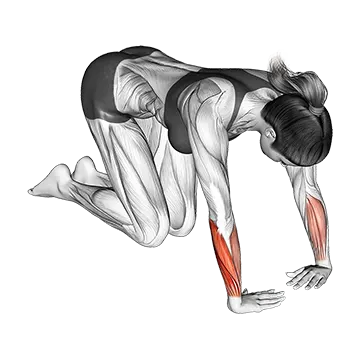

- 3Lower your right forearm to the floor, placing it where your right hand was, then lower your left forearm so both forearms are flat on the ground.
- 4Hold the forearm plank position for a moment, keeping your hips from rising or sagging.
- 5Press your right hand back to the floor, followed by your left hand, returning to the push-up position.
- 6Alternate the leading arm each rep to balance the workload evenly on both sides.
- 7Complete the target number of transitions, then lower your knees to the floor to rest.
Form tips
- Set your feet slightly wider than hip-width to widen your base of support, which makes it easier to resist rotation as each arm shifts.
- Keep your elbows tracking close to your sides as you lower each forearm to protect your shoulders and keep the wrist flexors under load.
- Grip the floor lightly with your fingers on the way up to engage the wrist extensors actively rather than relying on passive wrist extension.
- If your hips rotate when you shift your arm, slow down the transition and focus on bracing harder so your trunk resists the twist.
Common mistakes
- Letting the hips hike or sag during the forearm transition, which shifts load away from the target muscles and stresses the lower back.
- Dropping both forearms at once, which causes a loss of core stability and allows the hips to sway, reducing wrist extensor and flexor engagement.
- Placing the forearms too far forward, which flattens the shoulder angle and reduces anterior deltoid and pectoralis major tension.
- Always leading with the same arm, which creates a muscular imbalance in the wrist flexors and extensors over time.
- Letting the elbows flare wide when pressing back to the push-up position, which loads the wrist joints at an inefficient angle and increases injury risk.
Frequently asked questions
Why does the modified push up to forearms target the wrist extensors and flexors rather than just the chest?
Each time you lower a hand to a forearm or press back up, your wrist extensors and flexors must contract to stabilize and move the wrist joint through that transition. The chest and shoulders assist but the wrists are doing the primary control work, which is what makes this exercise useful for forearm strength.
Can I do this exercise on my knees to make it easier?
Yes. Dropping to your knees reduces the total load on the core and upper body, letting you focus on the wrist transition mechanics. It is a good starting point if you cannot yet maintain a rigid plank position through multiple transitions.
How is this different from a standard forearm plank or a regular push-up?
A forearm plank is static and a push-up only loads the hands. The modified push up to forearms combines both, repeatedly moving through the hand-to-forearm transition, which places repeated dynamic demand on the wrist extensors and flexors that neither exercise achieves on its own.
How many reps should I aim for per set?
Start with 3 sets of 6 to 8 transitions per side (12 to 16 total) and focus on keeping your hips level throughout. Add reps only after you can complete the set with no hip rotation or wrist discomfort.
Is this exercise safe if I have wrist pain?
It places meaningful demand on the wrist joints and surrounding musculature, so if you have an existing wrist injury or chronic wrist pain you should get clearance from a medical professional before attempting it. Building wrist extensor and flexor strength gradually is the goal, not working through pain.