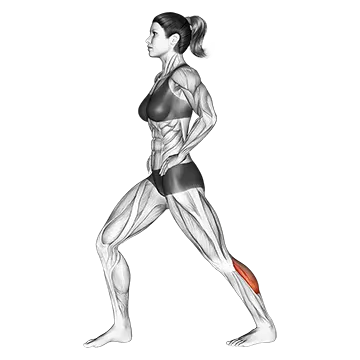
One Leg Donkey Calf Raise
- Target muscle
- Gastrocnemius
- Synergist muscles
- Soleus
- Equipment
- Body weight
- Body part
- Calves
- Type
- Strength
The one leg donkey calf raise is a unilateral calf exercise performed in a hip-hinged position, placing primary load on the gastrocnemius while the soleus acts as a synergist. Keeping the knee straight in the hinged position holds the gastrocnemius long across the knee, so it stays the main driver of plantarflexion. It is well suited for building single-leg calf strength and hypertrophy using only bodyweight.
How to do the One Leg Donkey Calf Raise
- 1Stand facing a bench, wall, or other stable support and hinge forward at the hips until your torso is roughly parallel to the floor, placing both hands on the support for balance.
- 2Position the ball of your working foot near the edge of a raised surface such as a step or weight plate to allow your heel to drop below your toes.
- 3Lift the non-working foot off the ground, crossing it loosely behind the working ankle or resting it lightly against your lower leg.
- 4Lower your working heel as far as comfortable to achieve a full stretch in the calf.
- 5Drive through the ball of your foot and raise your heel as high as possible in a smooth, controlled motion.
- 6Pause briefly at the top of the movement, concentrating on contracting the calf fully.
- 7Lower your heel back down under control to the fully stretched position, without letting it drop suddenly.
- 8Complete all reps on the working leg, then switch sides and repeat.
Form tips
- Use a raised surface under the ball of your foot — a step, platform, or weight plate — so the heel can drop below the toes and the gastrocnemius receives a full stretch at the bottom.
- Grip the support for balance only; resist pushing or pulling through your arms, as this reduces the load placed on the calf.
- Keep the descent slow and deliberate — a two-to-three second lowering phase increases time under tension and limits the temptation to bounce at the bottom.
- Maintain a consistent hip-hinge throughout each set; avoid letting your hips shift or your torso rise, which can reduce calf involvement and destabilize the movement.
- Point your foot straight ahead or experiment with slight inward and outward angles across sets to vary the stimulus within the gastrocnemius.
Common mistakes
- Shortening the range of motion by not lowering the heel fully, which reduces the gastrocnemius stretch and limits muscular development.
- Bouncing at the bottom to generate momentum, which transfers load away from the calf and places unnecessary stress on the Achilles tendon.
- Pushing through the arms on the support rather than relying on the calf, artificially reducing the demand on the working muscle.
- Allowing excessive knee bend during the raise, which shifts emphasis away from the gastrocnemius and onto the soleus.
- Rushing through repetitions without pausing at the top, sacrificing the full calf contraction that makes each rep effective.
Frequently asked questions
What muscles does the one leg donkey calf raise work?
The primary muscle is the gastrocnemius. The soleus acts as a synergist, assisting with plantarflexion throughout the movement.
What is the difference between the donkey position and a standard standing calf raise?
Both train the gastrocnemius through the same ankle range, but hinging forward with your hands on a support shifts your weight over the working foot and takes the load off your spine. The bent-over position also makes it easier to keep the knee straight, which keeps the gastrocnemius doing the work instead of handing it off to the soleus.
Do I need a raised surface under my foot?
A raised surface is strongly recommended. Without one, the heel cannot drop below the toes, which shortens the range of motion and reduces the stretch on the gastrocnemius. Even a low step or a weight plate makes a meaningful difference.
How many reps should I aim for on each leg?
Calf muscles generally respond well to moderate to high rep ranges. Sets of 10 to 20 reps per leg, performed with a controlled tempo and full range of motion, are a common starting point. Adjust based on how quickly you fatigue and your training goals.