
One Leg Floor Calf Raise
- Target muscle
- Gastrocnemius
- Synergist muscles
- Soleus
- Equipment
- Body weight
- Body part
- Calves
- Type
- Strength




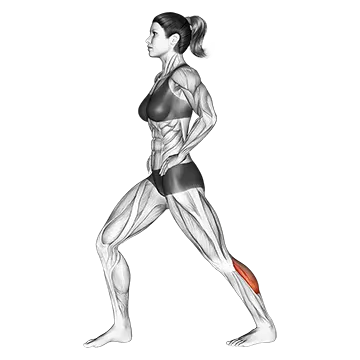



The one leg floor calf raise is a bodyweight exercise that isolates the gastrocnemius, with the soleus working as a synergist to plantar-flex the ankle. Performed standing on one foot on flat ground — with no step or raised edge — it challenges balance and unilateral calf strength at the same time, making it a practical movement for building lower-leg endurance and addressing side-to-side imbalances.
How to do the One Leg Floor Calf Raise
- 1Stand upright on a flat, non-slip surface with your feet hip-width apart.
- 2Shift your weight onto one foot and lift the other foot slightly off the floor, bending that knee to keep it out of the way.
- 3Place your hands lightly on a wall, doorframe, or sturdy surface for balance assistance if needed, or keep them at your sides for a greater stability challenge.
- 4Press through the ball of your standing foot and raise your heel as high as possible, rising onto your toes.
- 5Pause at the top for one count, squeezing your calf at full contraction.
- 6Lower your heel back toward the floor under control, stopping just before it touches to keep tension on the calf.
- 7Complete all reps on one leg, then switch sides and repeat.
Form tips
- Use a fingertip-light touch on a wall or surface for balance rather than gripping for support — the goal is to challenge the standing leg, not offload weight.
- Point your standing foot straight ahead and keep your hips level; letting the free-leg hip drop tilts the ankle and shifts load away from the calf.
- Control the descent over two to three counts — the eccentric phase builds strength and reduces injury risk more than a fast drop.
- Keep your standing knee straight but not forcibly locked — an extended knee keeps the gastrocnemius under stretch and maximizes its involvement, while a hard lock-out stresses the joint.
- Exhale as you rise and inhale as you lower to maintain a steady breathing rhythm and core brace.
Common mistakes
- Bouncing off the floor at the bottom instead of pausing just above it, which uses momentum to power the next rep and removes tension from the gastrocnemius.
- Leaning the torso forward or sideways to compensate for poor balance, which shifts load off the calf and can strain the lower back or ankle.
- Using a partial range of motion and not rising fully onto the toes, which reduces peak gastrocnemius contraction and limits strength gains.
- Allowing the ankle to roll outward during the raise, which stresses the lateral ankle ligaments and reduces the force going through the target muscles.
- Rushing through reps without pausing at the top, which sacrifices the peak contraction that drives calf development.
Frequently asked questions
What muscles does the one leg floor calf raise work?
The primary muscle is the gastrocnemius, which crosses both the knee and ankle and produces the bulk of the plantar-flexion force. The soleus acts as a synergist, assisting with the raise throughout the movement.
Is the one leg floor calf raise good for beginners?
Yes. It requires no equipment and can be done anywhere. Beginners can hold a wall for balance and work on a full range of motion before progressing to freestanding reps. Start with 2–3 sets of 10–15 reps per leg.
How many sets and reps should I do?
For strength and hypertrophy, 3–4 sets of 12–20 reps per leg with a controlled tempo works well. For endurance, higher rep ranges of 20–30 are effective. Rest 60–90 seconds between sets.
How is the one leg floor calf raise different from a two-leg calf raise?
The single-leg version doubles the load on each calf, exposes and corrects side-to-side strength imbalances, and adds a significant balance challenge. The two-leg version lets you handle more total volume but can mask asymmetries and provides less per-leg stimulus.
How is the one leg floor calf raise different from a calf raise on a step or raised edge?
A step allows your heel to drop below the level of your toes, increasing the range of motion and the stretch on the gastrocnemius at the bottom. The floor version has a shorter range because the heel cannot drop below foot level, so it emphasizes the contracted top portion. The floor variation is simpler and safer for beginners; the step version adds a deeper eccentric stretch for more advanced trainees.