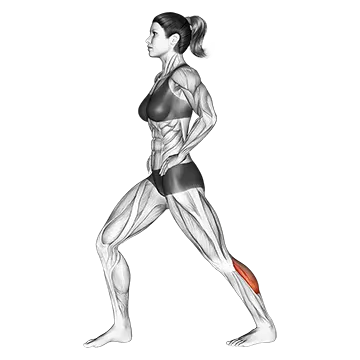
Standing Calf Raise (On a staircase)
- Target muscle
- Gastrocnemius
- Synergist muscles
- Soleus
- Equipment
- Body weight
- Body part
- Calves
- Type
- Strength
The Standing Calf Raise on a staircase is a bodyweight strength exercise that targets the gastrocnemius, with the soleus working as a synergist throughout the movement. Performing the raise on a stair step allows your heel to drop below the level of your toes, giving you a fuller range of motion than a flat-floor version and a deeper stretch at the bottom of each rep.
How to do the Standing Calf Raise (On a staircase)
- 1Stand near a staircase and place the balls of both feet on the edge of a step, with your heels hanging off freely over the drop.
- 2Lightly grip the railing or wall beside you for balance — use it only for stability, not to assist the lift.
- 3Let your heels lower slowly toward the ground until you feel a full stretch in your calves.
- 4Brace your core, keep your legs straight, and press through the balls of your feet to rise onto your toes as high as possible.
- 5Hold the top position for one second, squeezing your calves.
- 6Lower your heels back down in a controlled manner over two to three seconds until you reach the full bottom stretch.
- 7Repeat for the desired number of reps, then step back from the edge before releasing the railing.
Form tips
- Always keep at least one hand on the railing throughout the set — the edge of a stair step is narrow and a slip at full extension can cause a fall.
- Move through the complete range of motion on every rep: a full heel drop at the bottom and a maximum toe rise at the top. Cutting either end short reduces the training stimulus.
- Keep your knees straight but not locked out. Bending the knees shifts emphasis away from the gastrocnemius and toward the soleus.
- Control the descent — lower your heels slowly rather than letting gravity pull them down. The eccentric phase builds calf strength and reduces injury risk.
- Once two-legged raises become easy, switch to one foot at a time to increase the load and improve unilateral balance.
Common mistakes
- Rushing the downward phase — dropping your heels quickly eliminates the eccentric stimulus and places sudden stress on the Achilles tendon. Lower slowly under control.
- Gripping the railing too hard and using it to assist the raise — this reduces the load on your calves and undermines the exercise. Use the railing only to steady your balance.
- Not lowering the heel far enough below the step — partial range of motion at the bottom limits the stretch on the gastrocnemius and reduces long-term calf development.
- Allowing the knees to bend during the movement — this transfers tension away from the gastrocnemius. Keep your legs extended throughout each rep.
- Placing the toes too far back on the step — if not enough of the ball of your foot is on the step you risk slipping off the edge. Position the widest part of each foot securely on the step before starting.
Frequently asked questions
Why do calf raises on a staircase instead of on the floor?
A staircase lets your heels drop below the level of your toes at the bottom of each rep, which lengthens the gastrocnemius through its full range of motion. Flat-floor raises restrict this stretch, so the staircase version produces a more complete stimulus for calf development.
What muscles does the Standing Calf Raise on a staircase work?
The gastrocnemius is the primary muscle worked — it is the large, visible muscle at the back of the lower leg. The soleus, which lies beneath the gastrocnemius, acts as a synergist and is also engaged throughout the movement.
How many reps and sets should I do?
For most lifters, 3–4 sets of 15–25 reps with bodyweight works well. To make the sets harder without adding weight, use single-leg raises and drop the reps to 8–15 per side. Either way, prioritize full range of motion over rep count.
Is it safe to do this exercise without holding the railing?
It is not recommended. The edge of a step is a narrow surface and your foot is at full extension at the top of the rep, making a slip possible. Hold the railing lightly throughout every set to keep yourself stable.
How can I make this exercise harder over time?
Progress by moving to single-leg raises, then by slowing the lowering phase to 3–5 seconds per rep. Pausing for 2 seconds at both the top and the bottom stretch of each rep also increases the difficulty without any added equipment.