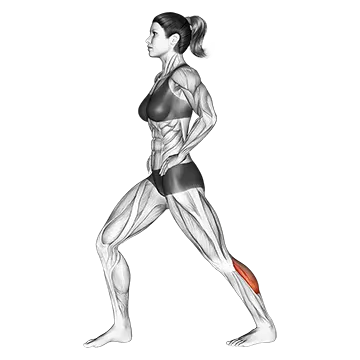
Standing Single Leg Calf Raise (On a staircase)
- Target muscle
- Gastrocnemius
- Synergist muscles
- Soleus
- Equipment
- Body weight
- Body part
- Calves
- Type
- Strength
The standing single leg calf raise on a staircase is a bodyweight strength exercise that targets the gastrocnemius, with the soleus working as a synergist. Performing it on a step edge allows a full range of motion — including a deep heel drop below the step — that a flat floor cannot provide. It is well suited for building calf strength and muscle unilaterally, and for addressing left-to-right imbalances.
How to do the Standing Single Leg Calf Raise (On a staircase)
- 1Stand on the edge of a step with the ball of one foot on the step and your heel hanging freely off the back edge.
- 2Lift your other foot off the step by bending that knee, so all your weight is on the working leg.
- 3Hold onto a wall, railing, or banister lightly with one hand for balance — use it only for stability, not to push yourself up.
- 4Lower your heel as far as comfortable below the level of the step to get a full stretch in the calf.
- 5Press through the ball of your foot and rise up onto your toes as high as possible, squeezing the calf at the top.
- 6Pause briefly at the top, then lower your heel back down slowly and with control.
- 7Complete all reps on one leg, then switch and repeat on the other side.
Form tips
- Keep the movement slow and controlled on the way down — a 2–3 second descent increases time under tension and reduces injury risk.
- Stay upright through your torso; avoid leaning forward or backward, which shifts load away from the calf.
- Touch the handrail only for balance — gripping it tightly and pulling upward reduces the work your calf has to do.
- Focus on reaching full plantar flexion at the top of each rep; a shortened range of motion limits gastrocnemius development.
- If the deep stretch at the bottom causes sharp pain in the Achilles tendon, reduce the range until you have built adequate tendon tolerance.
Common mistakes
- Rushing through the lowering phase — dropping the heel quickly eliminates the eccentric load, which is where a large portion of strength and muscle adaptation comes from.
- Using the handrail to assist the lift — pulling yourself upward offloads the calf and defeats the purpose of the single-leg variation.
- Letting the ankle roll outward during the raise — this places uneven stress on the ankle joint and reduces gastrocnemius activation.
- Not achieving full range of motion at the top — stopping short of full plantar flexion means the gastrocnemius never reaches peak contraction.
- Placing too little of the foot on the step — having only the toes on the edge is unstable; the ball of your foot should be firmly supported.
Frequently asked questions
What muscles does the standing single leg calf raise on a staircase work?
The primary muscle is the gastrocnemius. The soleus acts as a synergist throughout the movement. Both muscles cross the ankle and contribute to plantar flexion, but the gastrocnemius — which also crosses the knee — is the main driver when the knee is kept straight.
Why use a staircase instead of doing calf raises on flat ground?
A staircase lets your heel drop below the level of your foot, giving you a deeper stretch at the bottom of each rep. This extended range of motion places more mechanical tension on the gastrocnemius and soleus, which research suggests produces greater muscle growth compared to a partial range of motion on flat ground.
How many reps and sets should I do?
For strength and hypertrophy, 3–4 sets of 10–20 reps per leg is a practical starting point. The calves respond well to higher rep ranges and volume. Increase difficulty by slowing the eccentric phase or pausing at the bottom rather than by adding load, since you are limited to bodyweight.
Is it normal for calf raises to cause Achilles soreness?
Some mild soreness around the Achilles tendon after introducing the full range of motion is common, especially if you are not used to the deep heel drop. However, sharp or persistent pain is not normal. If that occurs, reduce your range of motion and progress the depth gradually over several weeks.
Can I do this exercise every day?
The calves recover relatively quickly compared to larger muscle groups, and many athletes train them daily. That said, if you are using a full range of motion and pushing close to failure, allow at least one rest day between sessions to let the gastrocnemius and Achilles tendon recover and adapt.