
Standing Single Leg Calf Raise with Support
- Target muscle
- Gastrocnemius
- Synergist muscles
- Soleus
- Equipment
- Body weight
- Body part
- Calves
- Type
- Strength




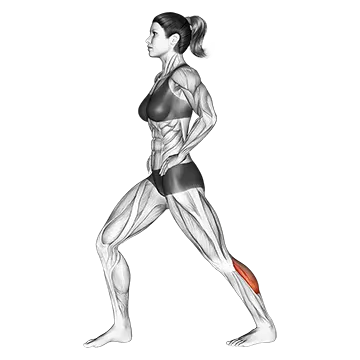


The Standing Single Leg Calf Raise with Support is a bodyweight strength exercise that isolates the gastrocnemius of the working leg while the soleus assists at the bottom of the range. Performed standing on one foot with a hand lightly resting on a stable surface for balance, it develops unilateral calf strength and exposes side-to-side imbalances that bilateral raises conceal.
How to do the Standing Single Leg Calf Raise with Support
- 1Stand facing a wall or sturdy support surface and place one hand on it lightly — use it only for balance, not to bear weight.
- 2Shift all of your weight onto one foot, positioning the ball of that foot at the edge of a step or flat on the floor.
- 3Bend the non-working knee slightly and hold it off the floor throughout the set.
- 4Press through the ball of the working foot to rise onto your toes as high as possible, squeezing the calf at the top.
- 5Pause briefly at the top of the movement with the heel fully elevated.
- 6Lower your heel in a slow, controlled manner until it is at or just below platform level if using a step, or until it gently contacts the floor if working flat.
- 7Repeat for the target number of reps, then switch legs and perform the same number on the other side.
Form tips
- Keep the contact with the support surface minimal — fingertip pressure only. Leaning heavily into the wall transfers load off the calf and defeats the purpose of the single-leg variation.
- Work through the full available range of motion: drive the heel as high as possible at the top and lower it as far as control allows at the bottom. Partial reps through the middle of the range significantly reduce the training stimulus.
- Keep the working knee slightly soft — a fully locked-out knee is fine, but do not actively hyperextend it as the calf fatigue accumulates.
- Point the toes straight ahead. Rotating the foot outward during the raise shifts tension unevenly across the gastrocnemius and places unwanted stress on the ankle joint.
- If balance is a limiting factor, start with two fingers on the wall and progressively reduce support over subsequent sessions rather than compensating by planting the non-working foot.
Common mistakes
- Rushing through reps — bouncing up from the bottom removes the stretch stimulus at the base of the range and reduces time under tension. Control each rep, especially the descent.
- Using the support arm to assist the lift — pressing into the wall or pulling a doorframe recruits the upper body and allows the calf to do less work than intended. The hand should do nothing more than steady your balance.
- Letting the ankle roll outward at the top — pronating or supinating through the heel at peak height reduces stability and concentrates stress on one side of the Achilles tendon. Drive straight up through the first and second toes.
- Stopping well short of the full range — cutting the range of motion both at the top and bottom shortens the gastrocnemius through less of its length, reducing strength and hypertrophy gains over time.
- Matching reps to the weaker leg by default — if one leg can perform fewer reps, complete the full set on the stronger leg too, rather than under-training it to match. Over time, bring the weaker side up.
Frequently asked questions
Is a single leg calf raise better than a two-legged calf raise?
Single-leg calf raises produce greater force demands on the gastrocnemius because the muscle must lift the full body weight alone, making them significantly harder than bilateral raises. They also reveal and address strength asymmetries between legs that double-leg raises allow the stronger side to mask. Both variations have a place in a program, but single-leg work is generally superior for building functional unilateral strength and fixing imbalances.
How many reps should I do for single leg calf raises?
Because the calves contain a high proportion of slow-twitch muscle fibers, they respond well to moderate-to-high rep ranges. Most people benefit from sets of 12–20 reps for hypertrophy, though beginners may start lower while they build the requisite strength and balance. If you can easily exceed 20 controlled reps, add load via a weighted vest or dumbbell held in the free hand.
Should I do single leg calf raises on a step or flat ground?
Performing the exercise on the edge of a step allows the heel to drop below the level of the toes, increasing the stretch on the gastrocnemius at the bottom of each rep. This extended range generally produces greater muscle development than flat-ground raises, which limit the bottom range. However, flat-ground raises are a valid starting point for beginners or anyone with Achilles sensitivity.
Why are my calves not growing from calf raises?
The most common reasons are insufficient range of motion, too much momentum, and not enough total weekly volume. The gastrocnemius responds best to slow, full-range repetitions performed through a stretched position at the bottom. Progressive overload — either adding reps, adding load, or slowing the tempo — is also necessary; the calves adapt quickly to a fixed routine.
Can single leg calf raises help with Achilles tendon rehabilitation?
Eccentric single-leg heel drops — specifically lowering slowly on one leg after rising on two — are a well-established protocol for Achilles tendinopathy rehabilitation, as described in research by Alfredson et al. However, any rehabilitation program for Achilles issues should be supervised by a physical therapist or sports medicine professional to ensure correct load progression and avoid further injury.