
Weighted Hyperextension (on stability ball)
- Target muscle
- Erector Spinae
- Equipment
- Weighted
- Body part
- Waist
- Type
- Strength




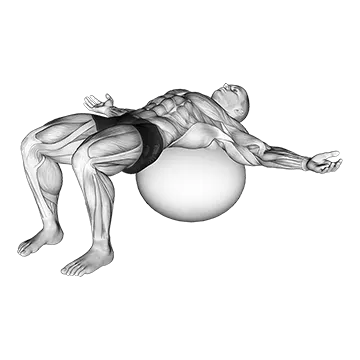
The weighted hyperextension on a stability ball is a lower-back strength exercise that targets the erector spinae through a full range of spinal extension. Holding a weight plate or dumbbell at your chest adds load to the movement, while the unstable surface means your hips and core work to keep you balanced through every rep. It suits lifters looking to build lower-back strength and endurance with added load.
How to do the Weighted Hyperextension (on stability ball)
- 1Place a stability ball on the floor and position your hips and lower abdomen on top of it, facing down. Walk your feet back until they are roughly hip-width apart, with your toes pressed into the floor for stability.
- 2Hold a weight plate or dumbbell at your chest with both hands. Keep the weight close to your body throughout the movement.
- 3Begin with your torso angled downward so your upper body hangs naturally over the front of the ball, spine in a neutral position.
- 4Squeeze your glutes and engage your lower back to raise your torso until your body forms a straight line from heels to head — do not hyperextend past neutral.
- 5Pause for one second at the top with your erector spinae fully contracted.
- 6Lower your torso slowly and under control back to the starting position over 2–3 seconds.
- 7Complete all reps without relaxing tension at the bottom — keep a slight brace through the lower back throughout the set.
Form tips
- Keep the weight pressed firmly against your chest so it does not shift forward and pull you off balance on the ball.
- Focus on moving through the lower back and hips rather than jerking your shoulders upward — the lift should feel controlled from start to finish.
- Press your feet into the floor throughout the set to anchor your position on the ball and prevent rolling.
- Start with a light plate until you feel confident balancing on the ball before progressing to heavier loads.
Common mistakes
- Hyperextending the lower back at the top of the rep, which compresses the lumbar vertebrae and increases injury risk under a loaded position.
- Using momentum to swing the torso up instead of lifting with the erector spinae, which reduces muscle engagement and destabilizes the ball.
- Holding the weight too far from the body, which shifts the center of gravity forward and makes it difficult to maintain balance on the ball.
- Rounding the upper back on the way up, which takes tension away from the erector spinae and places stress on the thoracic spine.
- Skipping the pause at the top, which cuts short the contraction of the erector spinae and reduces the training stimulus.
Frequently asked questions
What muscles does the weighted hyperextension on a stability ball work?
It primarily targets the erector spinae — the group of muscles that run along either side of the spine and are responsible for extending and stabilizing the lower back.
How is this different from a hyperextension on a Roman chair?
The stability ball removes the fixed hip pad of a Roman chair, so your core and hips must work harder to keep you balanced throughout each rep. This makes the movement less stable and generally limits how much weight you can use.
What weight should I start with?
Begin with a light plate — 5 to 10 lb — to learn the balance demands of the ball before adding more load. Increase weight only when you can complete all reps with controlled form and a stable position.
How many reps should I do?
Sets of 8–15 reps work well for building lower-back strength and endurance. Keep reps on the lower end when using heavier weight and prioritize control over volume.
Is this exercise safe for people with lower back pain?
If you have a history of lower back issues, consult a healthcare professional before adding load to spinal extension movements. The weighted version on an unstable surface is an intermediate-to-advanced variation and is not recommended during active pain or rehabilitation.