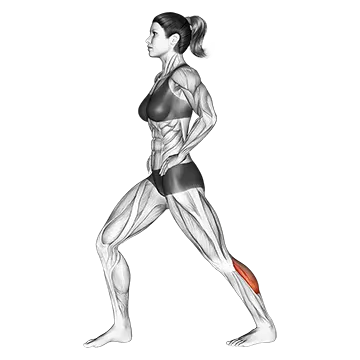
Standing Calf Raise with Support
- Músculo objetivo
- Gastrocnemius
- Músculos sinergistas
- Soleus
- Equipamiento
- Body weight
- Parte del cuerpo
- Calves
- Tipo
- Strength




The standing calf raise with support is a bodyweight lower-leg exercise that primarily targets the gastrocnemius, with the soleus working as a synergist throughout the movement. Performed while holding a wall or sturdy rail for balance, it isolates the calves through a full range of motion and is an excellent option for building lower-leg strength and ankle stability without any equipment.
Cómo hacer el Standing Calf Raise with Support
- 1Stand upright facing a wall or rail, about arm's length away, and place both hands lightly on the surface for balance — not to push or pull.
- 2Position your feet hip-width apart with toes pointing forward and your weight evenly distributed across both feet.
- 3Brace your core, stand tall, and keep your knees straight but not locked throughout the movement.
- 4Press through the balls of your feet and raise your heels as high as possible, squeezing your calves at the top.
- 5Pause for a full second at the peak contraction before lowering.
- 6Lower your heels slowly and with control until they are just below the level of the floor or platform, achieving a full stretch in the calves.
- 7Repeat for the desired number of reps, maintaining an upright posture and using the support only for balance.
Consejos de técnica
- Use the support only for balance — avoid leaning into it or pulling yourself up, which reduces the load on the calves.
- Move through the fullest range of motion you can: a complete heel drop at the bottom and a maximum heel rise at the top produce the most muscle activation.
- Add a 1–2 second pause at the top of each rep to increase time under tension and improve the mind-muscle connection.
- To progress without equipment, slow the lowering phase to 3–4 seconds or perform the exercise one leg at a time.
- Keep your ankles tracking straight — rolling outward or inward places uneven stress on the ankle joint.
Errores comunes
- Rushing through reps with no pause at the top, which shortchanges the gastrocnemius contraction and reduces the training stimulus.
- Leaning heavily into the wall or rail, which offloads weight from the calves and makes the exercise easier than intended.
- Skipping the bottom stretch by stopping before the heels reach their lowest point, which limits gastrocnemius lengthening and overall range of motion.
- Bending the knees during the raise, which shifts more of the work from the gastrocnemius to the soleus and reduces the intended training effect.
- Allowing the ankles to roll outward (supination) or inward (pronation) during the raise, which places asymmetric stress on the ankle and reduces calf engagement.
Preguntas frecuentes
What is the difference between a calf raise with support and one without?
The support (wall or rail) provides balance but adds no resistance — the exercise is mechanically the same. Using a support lets you focus entirely on calf strength and range of motion without worrying about falling, making it ideal for beginners or when training on a single leg.
How many reps should I do for calf raises?
Calves respond well to both moderate (8–15) and higher (15–30) rep ranges because they are endurance-oriented muscles. A common approach is 3–4 sets of 15–20 reps, emphasizing a slow lowering phase and a full stretch at the bottom.
Can I do this exercise on a step to get a deeper stretch?
Yes. Standing with the balls of your feet on the edge of a step allows your heels to drop below the step surface, increasing the range of motion and the stretch on the gastrocnemius. Make sure the step is stable and your grip on the support is secure before attempting this.
How do I make bodyweight calf raises harder without adding weight?
Progress by slowing the lowering phase (3–5 seconds), adding a pause at the top, or switching to single-leg calf raises. Single-leg work roughly doubles the load on each calf and significantly increases difficulty.
Will calf raises with body weight actually build muscle?
Yes, especially for beginners and intermediates. Performing them through a full range of motion with controlled tempo and high enough volume (3–4 sets, 15–25 reps) provides sufficient stimulus to build the gastrocnemius and soleus. Advanced trainees will likely need added resistance to continue progressing.