
Assisted Lying Gastrocnemius Stretch
- Target muscle
- —
- Equipment
- Assisted
- Body part
- Calves
- Type
- Stretching
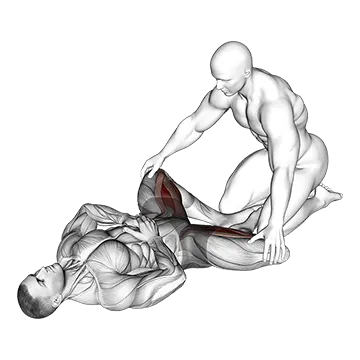


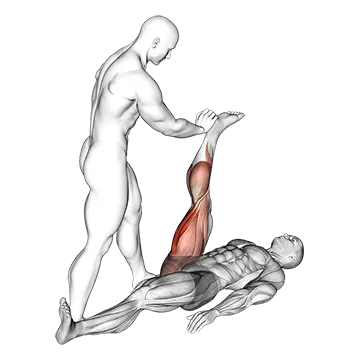
The assisted lying gastrocnemius stretch is a partner-assisted flexibility drill for the calves, targeting the gastrocnemius along the back of the lower leg. Lying on your back with the leg straight, a partner gently pushes your foot into dorsiflexion to lengthen the calf further than you could reach alone. It is useful for improving ankle mobility, easing tight calves, and cooling down after lower-body training.
How to do the Assisted Lying Gastrocnemius Stretch
- 1Lie flat on your back on a mat with both legs extended along the floor.
- 2Raise one leg and keep the knee fully straight so the stretch lands on the gastrocnemius rather than lower down the leg.
- 3Have your partner support the back of your thigh or calf to hold the leg steady.
- 4Let your partner place a hand against the ball of your foot and slowly push it toward your shin, flexing the ankle into dorsiflexion.
- 5Communicate so they ease the foot back only until you feel a firm but comfortable stretch through the calf, never into pain.
- 6Hold the stretched position and breathe steadily, keeping the knee locked out and the foot relaxed.
- 7Hold for 20 to 30 seconds, then have your partner slowly release the foot back to neutral.
- 8Lower the leg, rest briefly, and repeat on the other side.
Form tips
- Keep the stretched knee completely straight; bending it shifts tension off the gastrocnemius and onto the deeper soleus.
- Have your partner apply pressure slowly and hold steadily rather than bouncing or pulsing the foot.
- Breathe out as the foot is eased into dorsiflexion to help the calf relax into a deeper range.
- Stop at the point of a firm stretch, not pain, and give your partner clear feedback throughout.
Common mistakes
- Letting the knee bend during the stretch, which takes tension off the gastrocnemius and reduces the benefit.
- Bouncing or jerking the foot into position, which can trigger a reflex contraction or strain the calf and Achilles.
- Pushing past pain instead of stopping at a firm stretch, risking a calf or Achilles injury.
- Holding your breath and tensing up, which makes the muscle resist the stretch instead of releasing.
- Pointing or rolling the foot to one side instead of flexing it straight toward the shin, so the calf is not stretched evenly.
Frequently asked questions
What muscles does the assisted lying gastrocnemius stretch work?
It stretches the gastrocnemius, the large two-headed muscle on the back of the calf. Keeping the knee straight keeps the focus on the gastrocnemius rather than the deeper soleus.
Why keep the knee straight during this stretch?
The gastrocnemius crosses both the knee and the ankle, so it is fully lengthened only when the knee is straight and the ankle is dorsiflexed. Bending the knee slackens it and shifts the stretch to the soleus.
How long should I hold the stretch?
Hold each side for about 20 to 30 seconds, repeating two or three times. Keep the hold steady and avoid bouncing.
Do I need a partner to do this stretch?
This version uses a partner to ease your foot into a deeper dorsiflexion than you can reach on your own. If you train alone, a towel or strap looped around the ball of the foot lets you pull it back yourself.
Is this stretch good for beginners?
Yes. It is low-impact and easy to control, since your partner adjusts the pressure to your feedback. Start gently, stop at a firm but comfortable stretch, and never push into pain.