
Assisted Lying Gluteus And Piriformis Stretch
- Target muscle
- —
- Equipment
- Assisted
- Body part
- Hips
- Type
- Stretching
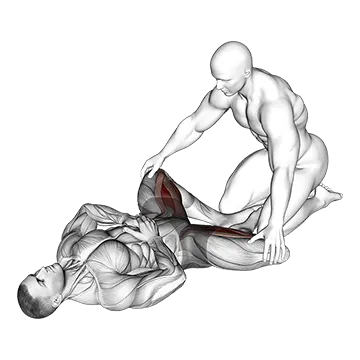


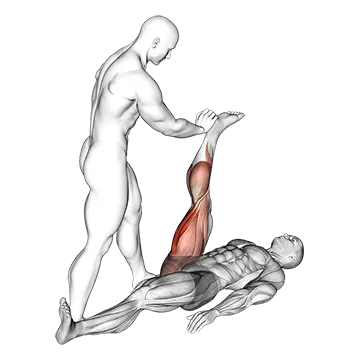
The assisted lying gluteus and piriformis stretch is a partner-assisted hip mobility stretch that lengthens the gluteus maximus and the deeper piriformis. You lie on your back while a partner gently guides your bent leg across your body, opening up the glutes and the small rotator muscle that often refers tension into the hip and lower back. It is a good way to ease hip tightness and improve rotation after lower-body training or long periods of sitting.
How to do the Assisted Lying Gluteus And Piriformis Stretch
- 1Lie flat on your back on a mat with both legs extended and your head and shoulders relaxed on the floor.
- 2Bend one knee and lift that thigh toward your chest, keeping the opposite leg straight along the floor.
- 3Have your partner support the bent leg, cradling the knee and ankle so you can fully relax the hip.
- 4Let your partner slowly draw the bent knee up and across your body toward the opposite shoulder.
- 5Allow the hip to rotate as the knee crosses the midline, keeping both shoulder blades flat on the floor.
- 6Stop when you feel a firm but comfortable stretch deep in the glute and outer hip, then breathe slowly and hold for 20–30 seconds.
- 7Tell your partner to ease off, let the leg return to the floor under control, then switch sides and repeat.
Form tips
- Keep both shoulder blades in contact with the floor so the stretch isolates the hip instead of twisting the lower back.
- Breathe out slowly as your partner guides the knee deeper, letting the glute and piriformis relax into the position.
- Agree on a clear stop signal with your partner before you start so they can read your limit and never push past it.
- Move into the stretch gradually and hold it still — avoid bouncing or jerking the leg across your body.
Common mistakes
- Letting your partner force the knee further than is comfortable, which can strain the hip rotators instead of stretching them.
- Lifting the opposite shoulder or rotating the upper back to chase more range, which shifts the stretch off the glute and into the spine.
- Holding your breath and tensing up, which keeps the glute and piriformis contracted and blocks the stretch.
- Bouncing the leg to push deeper rather than holding a steady position, which risks tweaking the hip.
Frequently asked questions
What muscles does the assisted lying gluteus and piriformis stretch work?
It stretches the gluteus maximus, the large muscle of the buttock, along with the piriformis, a small deep rotator under the glute that often holds tension in the hip and lower back.
How long should I hold the stretch?
Hold each side for about 20–30 seconds at a firm but comfortable point, breathing slowly throughout. Repeat for two to three rounds per side if you want more release.
Is this stretch good for beginners?
Yes. Because a partner controls the movement, it suits beginners well, as long as you communicate clearly and they ease off the moment the stretch feels too intense.
What is a good alternative if I do not have a partner?
You can target the same muscles solo with a lying figure-four glute stretch or a seated piriformis stretch, pulling your own bent leg across your body to the same point of mild tension.
Where should I feel this stretch?
You should feel it deep in the buttock and the outer hip of the bent leg. Sharp pain, numbness, or tingling down the leg means you have gone too far — have your partner ease off.