Bow Yoga Pose
- Target muscle
- Erector Spinae, Gluteus Maximus, Hamstrings
- Synergist muscles
- Biceps Brachii, Deltoid Posterior, Gastrocnemius, Obliques, Quadriceps, Teres Major
- Equipment
- Body weight
- Body part
- Hips
- Type
- Stretching
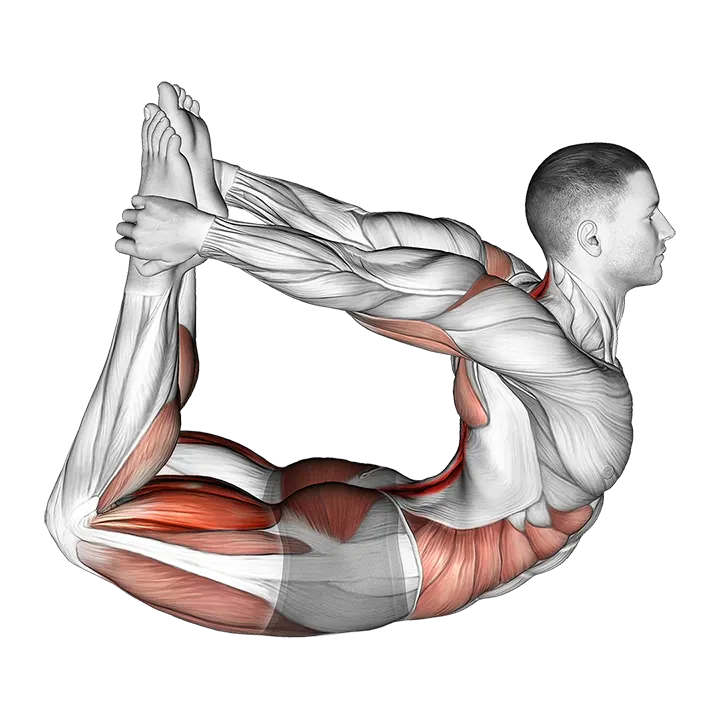
The bow yoga pose (Dhanurasana) is a prone backbend that stretches the front of the body while strengthening the back chain — primarily the erector spinae along the spine, the gluteus maximus, and the hamstrings. Reaching back to hold the ankles also engages the biceps, rear deltoids, calves, obliques, quadriceps, and teres major, making it a full-body mobility pose for opening the chest, hips, and shoulders.
How to do the Bow Yoga Pose

- 1Lie face-down on your mat with your legs together and your arms resting alongside your torso, forehead lightly on the floor.
- 2Bend both knees and bring your heels toward your glutes, keeping your knees roughly hip-width apart.
- 3Reach back with both hands and take hold of the outside of your ankles or the tops of your feet.
- 4Inhale and press your shins back into your hands, using that resistance to lift your thighs, chest, and head away from the floor.
- 5Draw your shoulder blades down and together to open the chest, keeping your gaze forward and your neck long.
- 6Hold the pose and breathe steadily for 15–30 seconds, letting the lift come from the legs rather than from yanking with the arms.
- 7To release, exhale and slowly lower your chest and thighs back to the floor under control.
- 8Let go of your ankles, extend your legs, and rest with your head turned to one side before repeating.
Form tips
- Initiate the lift by kicking your shins back into your hands; this opens the backbend more safely than pulling your feet toward your head.
- Keep your knees from splaying wider than hip-width so the lift stays even and your lower back stays protected.
- Breathe slowly and continuously — the pose compresses the belly, so let each inhale gently expand the chest and lift.
- Ease in gradually over several breaths and back off the moment you feel pinching in the lower back rather than a broad stretch.
- Warm up the spine and hip flexors first with gentler backbends such as cobra or locust before attempting the full bow.
Common mistakes
- Bouncing or pulsing to gain height, which strains the lumbar spine instead of building a stable, even backbend.
- Letting the knees flare far apart to lift higher, which collapses the lower back and reduces the stretch across the thighs.
- Pulling hard with the arms while the legs stay passive, putting the work into the shoulders instead of the back and glutes.
- Holding the breath because the abdomen is compressed, which raises tension and shortens how long you can stay in the pose.
- Cranking the neck back to look up, which compresses the cervical spine — keep the gaze forward and the neck long.
Frequently asked questions
What muscles does the bow yoga pose work?
It primarily strengthens the erector spinae, gluteus maximus, and hamstrings while stretching the front of the body. The biceps, rear deltoids, calves, obliques, quadriceps, and teres major assist as you hold the ankles and lift.
Is the bow pose good for beginners?
Beginners can work toward it, but it is a deep backbend. Start with cobra and locust pose to build spinal mobility, and only lift as high as feels like a broad stretch with no lower-back pinching.
How long should I hold the bow pose?
Hold for about 15–30 seconds while breathing steadily, then rest and repeat for 2–3 rounds. Keep the lift driven by your legs rather than by pulling with your arms.
What is a good alternative if I can't reach my ankles?
Try locust pose (Salabhasana), which builds the same back and glute strength without grabbing the feet. You can also use a yoga strap looped around each ankle to bridge the gap until your shoulders and quads open up.
Where should I feel the bow pose?
You should feel a broad stretch across the front of the thighs, hip flexors, chest, and shoulders, with the back of the body working to hold the lift. Sharp pinching in the lower back means you are arching too aggressively — ease off.