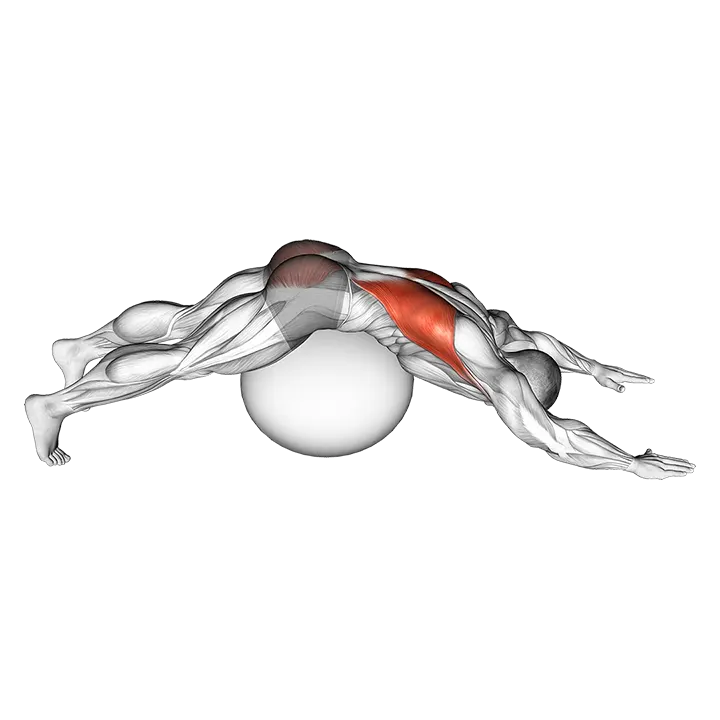
Exercise Ball Lower Back Prone Stretch
- Target muscle
- Latissimus Dorsi
- Synergist muscles
- Gluteus Maximus
- Equipment
- Stability ball
- Body part
- Back
- Type
- Stretching
The exercise ball lower back prone stretch is a gentle stretching movement that lengthens the lats (latissimus dorsi) while the glutes (gluteus maximus) help support the position. Draped face-down over a stability ball, you let gravity decompress your spine and open up the back, making it a low-stress option for easing tightness after lifting or a long day of sitting.
How to do the Exercise Ball Lower Back Prone Stretch
- 1Kneel behind a stability ball with the ball positioned in front of your hips and thighs.
- 2Slowly walk your hands forward and lean your torso over the top of the ball so your belly and chest rest across it.
- 3Let your arms reach down toward the floor in front of the ball and allow your head and neck to relax.
- 4Keep your knees or toes on the floor for balance, then gently roll forward until you feel a comfortable stretch through your back and along your sides.
- 5Relax your glutes and let your hips drape over the ball so your lower back decompresses rather than holding tension.
- 6Breathe slowly and let your body sink a little deeper into the ball with each exhale.
- 7Hold the stretch for 20–30 seconds, staying relaxed and avoiding any bouncing.
- 8To come out, walk your hands back, push your torso up off the ball, and return to a kneeling position with control.
Form tips
- Hold the position for 20–30 seconds and repeat 2–3 times, easing slightly deeper as the muscles release.
- Breathe slowly and exhale into the stretch rather than holding your breath, which helps the back relax and lengthen.
- You should feel a mild, comfortable pull across your lower back and down the sides of your torso where the lats run, never a sharp pinch.
- Keep a hand or foot anchored on the floor so the ball stays stable and you stay in full control of how far you lean.
- Use a ball sized so your hips drape over the top comfortably; too small or too large makes it hard to relax onto it.
Common mistakes
- Bouncing or forcing yourself deeper into the stretch, which can strain the lower back instead of letting it gently release.
- Holding your breath and tensing up, which keeps the muscles guarded and prevents the lats from actually lengthening.
- Letting the ball roll out from under you because nothing is anchored, risking a slip off the top of the ball.
- Pushing into pain rather than a gentle stretch, since the goal is decompression, not stressing the spine.
Frequently asked questions
What muscles does the exercise ball lower back prone stretch work?
It mainly stretches the latissimus dorsi (the lats), the broad muscles of your back, while the gluteus maximus helps support and stabilize the position as you drape over the ball.
How long should I hold this stretch?
Hold each rep for about 20–30 seconds and repeat 2–3 times. Stretch slowly and breathe out as you settle in, never bouncing or forcing the range.
Where should I feel this stretch?
You should feel a gentle pull across your lower back and along the sides of your torso where the lats run. If you feel sharp pain or pinching, ease off and roll back a little.
Is this stretch good for beginners?
Yes. It is low-stress and lets gravity do the work, so it suits beginners. Start by leaning over the ball only as far as is comfortable and keep a hand or foot on the floor for balance.
What's a safe alternative to this stretch?
If you don't have a stability ball, the child's pose stretch reaches your back and lats from the floor, and a standing overhead side reach gives a similar lat stretch with no equipment.