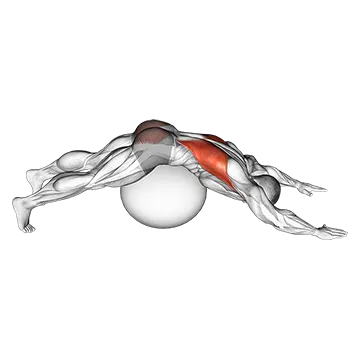
Exercise Ball Lying Side Lat Stretch
- Target muscle
- Latissimus Dorsi
- Synergist muscles
- Deltoid Posterior, Obliques
- Equipment
- Stability ball
- Body part
- Back
- Type
- Stretching




The exercise ball lying side lat stretch is a side-lying mobility drill that lengthens the latissimus dorsi down one side of your back, with the rear shoulder (posterior deltoid) and obliques also drawn into the stretch. Draping your side over a stability ball lets the ball support your ribcage while you reach overhead, making it a gentle way to open up a tight lat and the side of the torso after pulling or overhead work.
How to do the Exercise Ball Lying Side Lat Stretch
- 1Kneel beside a stability ball with the ball at your side, hips and knees roughly under your body.
- 2Lean sideways and drape your bottom ribs and waist over the top of the ball so it supports the side of your torso.
- 3Extend your bottom leg out for a wide, stable base and let your top leg rest behind it for balance.
- 4Reach your top arm up and over your head in the direction you are leaning, lengthening the side of your body that rests on the ball.
- 5Let your bottom arm rest on the floor or the ball for support as you settle into the stretch.
- 6Breathe out slowly and allow your ribcage to sink a little further over the ball, feeling the stretch along the side of your back and under your armpit.
- 7Hold the position calmly without bouncing, keeping the lengthening sensation comfortable rather than sharp.
- 8To release, press your supporting arm and leg into the floor, roll your torso back over the ball, and return upright before switching to the other side.
Form tips
- Breathe into the stretch — exhale slowly on each rep and let your ribcage settle a fraction deeper over the ball rather than forcing the range.
- Reach your top arm long and slightly forward to bias the stretch into the lat and under the armpit instead of only the shoulder.
- Keep the ball under your lower ribs and waist so it carries your bodyweight and you can relax into the position.
- Stretch both sides for a similar length of time to keep the lats and obliques balanced left to right.
- Use a wide, planted base with your bottom leg so you feel stable and aren't fighting to stay on the ball.
Common mistakes
- Bouncing or pulsing to push deeper, which triggers the muscle to tense and can strain the lat or oblique instead of lengthening it.
- Overstretching to the point of sharp pain — the stretch should feel like a strong lengthening, not a pinch, or you risk irritating the shoulder and ribs.
- Holding your breath, which keeps the torso tense and prevents the lat and obliques from relaxing into the stretch.
- Letting the ball slip up toward the armpit or down to the hip, which collapses your base and takes the stretch off the lats.
- Twisting the torso so it faces the floor, turning the side stretch into a rotation and losing tension on the target muscles.
Frequently asked questions
What muscles does the exercise ball lying side lat stretch work?
It mainly stretches the latissimus dorsi down the side of your back, while the posterior deltoid (rear shoulder) and the obliques along your waist are also lengthened as synergists.
How long should I hold this stretch?
Hold each side for about 20–30 seconds and repeat 2–3 times per side. Keep breathing slowly and ease a little deeper on each exhale rather than holding statically with tension.
Is the exercise ball lying side lat stretch good for beginners?
Yes. The ball supports your bodyweight, so it's a gentle, low-effort way to open up a tight lat and side of the torso. Start with a small range and let the ball do the work.
Where should I feel this stretch?
You should feel a long, comfortable stretch down the side of your back, under your armpit, and along your waist — never a sharp pain in the shoulder or ribs.
When is a good time to do this stretch?
It works well as a cool-down after pulling exercises (rows, pulldowns) or overhead work, when the lats and obliques are warm and tight and respond well to lengthening.