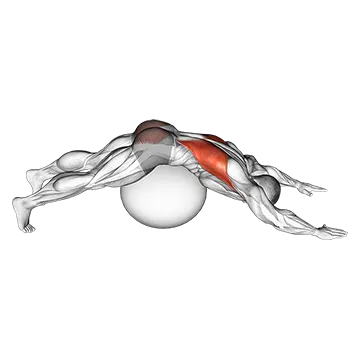
Exercise Ball Lower Back Stretch (Pyramid)
- Target muscle
- Latissimus Dorsi
- Synergist muscles
- Deltoid Anterior, Pectoralis Major Clavicular Head
- Equipment
- Stability ball
- Body part
- Back
- Type
- Stretching
The exercise ball lower back stretch (pyramid) is a gentle mobility move that draws a long stretch through the lats (latissimus dorsi) while opening the front shoulders and upper chest. Kneeling behind a stability ball and walking your arms forward, you decompress the spine and lengthen the back, making it a useful cool-down or warm-up for anyone with tight, fatigued shoulders and back.
How to do the Exercise Ball Lower Back Stretch (Pyramid)
- 1Kneel on the floor with a stability ball placed an arm's length in front of you, hips stacked over your knees.
- 2Place both hands on top of the ball, palms down, with your arms extended and thumbs facing the ceiling.
- 3Keeping your hips over your knees, hinge forward and let your chest sink toward the floor as the ball rolls away from you.
- 4Walk the ball forward until your arms are fully extended overhead and you feel a long stretch through the sides of your back and your shoulders.
- 5Lower your forehead toward the floor and let your spine lengthen, keeping a soft, neutral neck.
- 6Hold the position and breathe slowly, exhaling a little deeper into the stretch on each breath.
- 7To release, walk the ball back toward you and rise up tall, returning to the kneeling start position.
Form tips
- Let the stretch build gradually — sink into it on each exhale rather than forcing the position or bouncing.
- Keep your hips directly over your knees so the stretch lengthens your lats and spine instead of collapsing into your lower back.
- Relax your neck and let your head hang naturally between your arms to avoid tension in the shoulders and traps.
- Press your palms gently into the ball to feel the stretch travel through your lats and the front of your shoulders.
- Breathe steadily throughout the hold; never hold your breath in a stretch.
Common mistakes
- Pushing into a painful end range, which can strain the shoulders or back — a stretch should feel like tension, not sharp pain.
- Letting the hips drift back over the heels, which slackens the stretch and shifts load away from the lats.
- Bouncing or pulsing to go deeper, which triggers a protective tightening instead of a relaxed lengthening.
- Shrugging the shoulders up toward the ears, which adds neck tension and reduces the stretch through the lats.
- Holding your breath, which keeps the muscles tense and works against the stretch.
Frequently asked questions
What muscles does the exercise ball lower back stretch (pyramid) work?
It primarily stretches the lats (latissimus dorsi), with the front deltoids and the upper chest (pectoralis major, clavicular head) also lengthened as you reach your arms overhead on the ball.
How long should I hold this stretch?
Hold for about 20–30 seconds and repeat 2–3 times. For a deeper cool-down you can hold up to 60 seconds, breathing slowly throughout.
Is this stretch good for beginners?
Yes. It is a gentle, low-impact stretch with no load, so beginners can ease into it. Walk the ball forward only as far as is comfortable and back off if you feel any pinching in the shoulders.
Where should I feel this stretch?
You should feel it along the sides of your back through the lats, with a milder stretch across the front of your shoulders and upper chest. You should not feel pain in your lower spine or shoulder joints.